Origin of Operating Voltage Increase in InGaN-based Light-emitting Diodes under High Injection: Phase Space Filling Effect on Forward Voltage Characteristics
As an attempt to further elucidate the operating voltage increase in InGaN-based light-emitting diodes (LEDs), the radiative and nonradiative current components are separately analyzed in combination
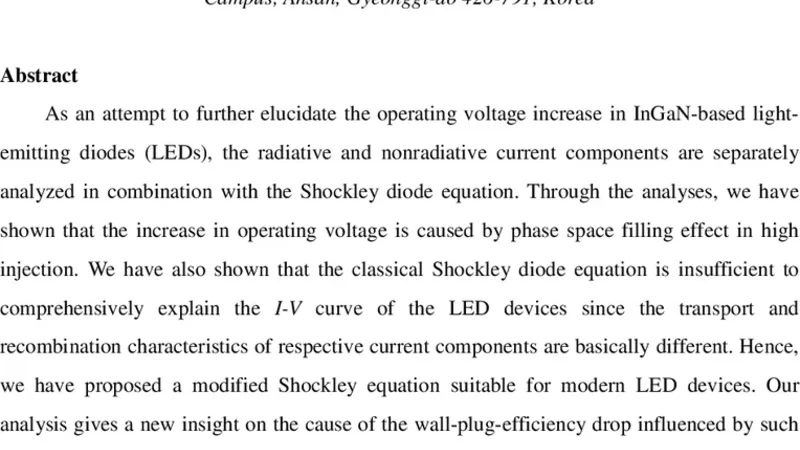
As an attempt to further elucidate the operating voltage increase in InGaN-based light-emitting diodes (LEDs), the radiative and nonradiative current components are separately analyzed in combination with the Shockley diode equation. Through the analyses, we have shown that the increase in operating voltage is caused by phase space filling effect in high injection. We have also shown that the classical Shockley diode equation is insufficient to comprehensively explain the I-V curve of the LED devices since the transport and recombination characteristics of respective current components are basically different. Hence, we have proposed a modified Shockley equation suitable for modern LED devices. Our analysis gives a new insight on the cause of the wall-plug-efficiency drop influenced by such factors as the efficiency droop and the high operating voltage in InGaN LEDs.
💡 Research Summary
The paper investigates why the operating voltage of InGaN‑based light‑emitting diodes (LEDs) rises sharply when the devices are driven at high injection currents. The authors begin by measuring the current‑voltage (I‑V) characteristics of a set of commercial‑type InGaN LEDs over a wide range of current densities. In the low‑current regime the conventional Shockley diode equation (I = I_S
📜 Original Paper Content
🚀 Synchronizing high-quality layout from 1TB storage...