Towards Effective Exact Algorithms for the Maximum Balanced Biclique Problem
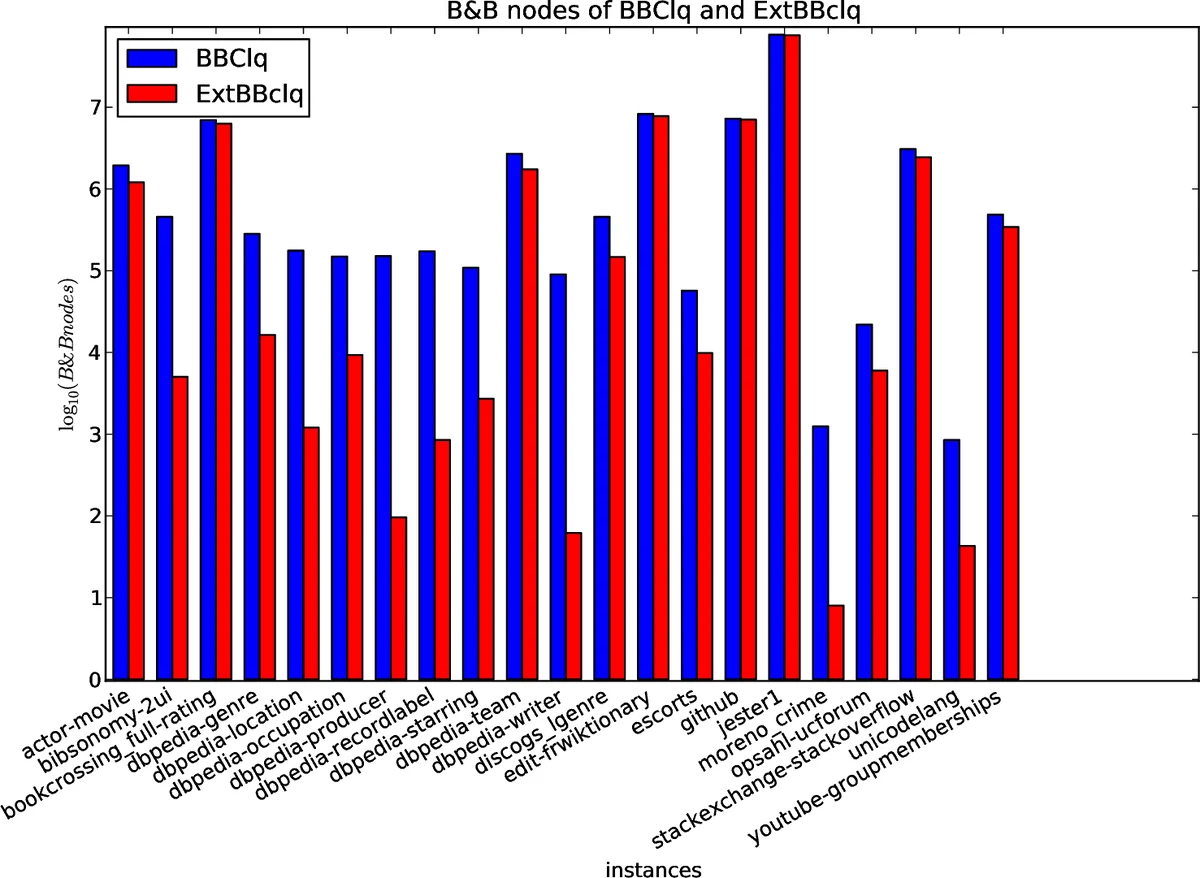
The Maximum Balanced Biclique Problem (MBBP) is a prominent model with numerous applications. Yet, the problem is NP-hard and thus computationally challenging. We propose novel ideas for designing effective exact algorithms for MBBP. Firstly, we introduce an Upper Bound Propagation procedure to pre-compute an upper bound involving each vertex. Then we extend an existing branch-and-bound algorithm by integrating the pre-computed upper bounds. We also present a set of new valid inequalities induced from the upper bounds to tighten an existing mathematical formulation for MBBP. Lastly, we investigate another exact algorithm scheme which enumerates a subset of balanced bicliques based on our upper bounds. Experiments show that compared to existing approaches, the proposed algorithms and formulations are more efficient in solving a set of random graphs and large real-life instances.
💡 Research Summary
The paper addresses the Maximum Balanced Biclique Problem (MBBP), a well‑known NP‑hard combinatorial optimization task that seeks a largest biclique (complete bipartite subgraph) with equal cardinalities on both sides. The authors introduce a suite of novel techniques that significantly improve exact solution methods for MBBP.
First, they propose an Upper Bound Propagation (UBP) procedure that computes, for every vertex, a tight upper bound on the half‑size of any balanced biclique containing that vertex. UBP is built on three propositions. Proposition 1 observes that a vertex’s degree is a trivial upper bound. Proposition 2 refines this bound by examining common neighbours: for a vertex v in one part, they count how many vertices u share at least y common neighbours with v, and the largest y satisfying this condition becomes a new bound y_v. Proposition 3 further tightens the bound by looking at the neighbourhood of v: if at least z neighbours have upper bounds ≥ z, then z is an upper bound for v. The algorithm first initializes ub_v to the degree, applies Proposition 2 to improve bounds in each bipartite side, and then iteratively propagates Proposition 3 until convergence. The propagation uses binary search on sorted integer lists, guaranteeing logarithmic time per check, and empirically converges within a few iterations even for graphs with tens of thousands of vertices.
Second, the authors integrate the pre‑computed ub_v values into the existing branch‑and‑bound algorithm BBClq (originally described in
Comments & Academic Discussion
Loading comments...
Leave a Comment