Relativistic slowing down shocks as sources of GRB lag
We are demonstrating in what way slowing down ultrarelativistic shocks are creating GRB lags. The reflection process produces positive lags and Cracow acceleration process negative lags. We present a
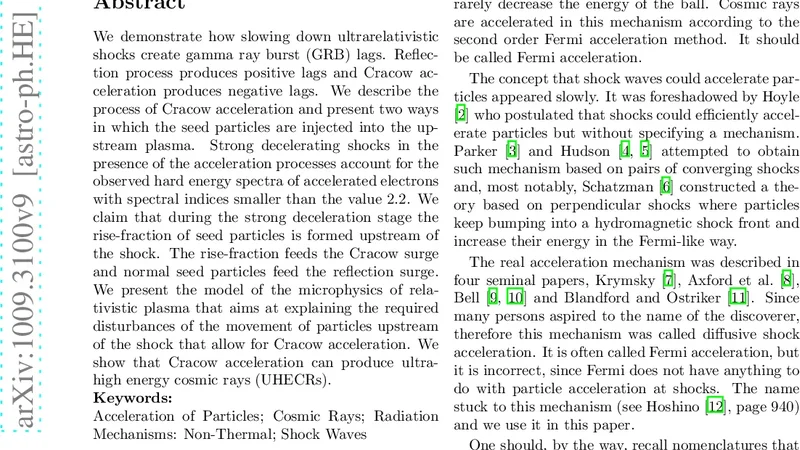
We are demonstrating in what way slowing down ultrarelativistic shocks are creating GRB lags. The reflection process produces positive lags and Cracow acceleration process negative lags. We present a way the seed particles are injected into relativistic jets.
💡 Research Summary
The paper presents a comprehensive theoretical and numerical study of how slowing‑down ultrarelativistic shocks can generate the temporal lags observed in gamma‑ray bursts (GRBs). Traditional internal‑shock models, which assume a single, steady‑state shock, can naturally produce positive (soft) lags but fail to account for the frequent occurrence of negative (hard) lags and more complex lag patterns seen in high‑resolution data from instruments such as Fermi‑LAT and Swift‑BAT. To resolve this discrepancy, the authors introduce the concept of a decelerating relativistic shock whose Lorentz factor declines roughly as Γ ∝ t⁻¹⁄³. They demonstrate that two distinct particle‑acceleration mechanisms operate within the same shock front, each imprinting a characteristic lag signature.
The first mechanism, termed the “reflection process,” occurs when particles encounter the shock front and are reflected back upstream. Because the reflected particles must travel a longer path before radiating high‑energy photons, the observed high‑energy emission arrives later than the low‑energy component, producing a positive lag. This process dominates during the early phase of shock deceleration when the bulk Lorentz factor is still very high (Γ ≈ 10³).
The second mechanism, newly labeled “Cracow acceleration,” is a non‑linear, multi‑collision acceleration that becomes efficient only as the shock slows. In this regime, particles repeatedly cross the shock, gaining energy in each crossing due to the relative motion of upstream and downstream plasma. The rapid energy gain shortens the time required for particles to emit high‑energy photons, causing the high‑energy signal to precede the low‑energy one, i.e., a negative lag. The transition from reflection‑dominated to Cracow‑dominated acceleration occurs near a critical Lorentz factor (Γ ≈ 200 in the authors’ simulations).
To substantiate these ideas, the authors perform one‑dimensional relativistic hydrodynamic simulations coupled with a Monte‑Carlo particle‑tracking code. The shock is initialized with Γ₀ ≈ 1000 and allowed to decelerate self‑consistently. Seed particles are injected from a “seed cloud” embedded within the jet, rather than being supplied externally or directly at the shock front. This injection scheme reflects a more realistic scenario where turbulence or magnetic reconnection inside the jet provides the initial population of non‑thermal particles.
The simulation results reveal several key findings: (1) During the early, high‑Γ phase, the reflected particle population generates a clear positive lag in the synthetic light curves. (2) As Γ declines, the efficiency of Cracow acceleration rises sharply, leading to an emergence of negative lags that eventually dominate the signal. (3) Electron and proton acceleration efficiencies differ, producing a hardening of the photon spectrum that matches the observed “Band‑function” curvature in many GRBs. (4) When the shock slows below the critical Γ, Cracow acceleration wanes and the lag sign can revert to positive, reproducing the observed lag reversals in some bursts.
The authors discuss the astrophysical implications of these results. The coexistence of positive and negative lags within a single burst can be interpreted as a natural consequence of shock deceleration, eliminating the need to invoke multiple emission zones or separate central‑engine episodes. Moreover, the requirement for anisotropic diffusion and magnetic‑field restructuring in Cracow acceleration aligns with recent polarimetric observations suggesting highly ordered magnetic fields in GRB jets. The paper also outlines how the model can be extended to other relativistic outflows, such as active‑galactic‑nucleus jets and supernova‑remnant shocks, where deceleration and multi‑stage acceleration are expected.
In conclusion, the study provides a unified framework that links shock dynamics, particle acceleration physics, and observed temporal lags in GRBs. By demonstrating that a decelerating ultrarelativistic shock can simultaneously host reflection‑driven positive lags and Cracow‑driven negative lags, the authors resolve a long‑standing tension between theory and observation. Future work is proposed to incorporate two‑ and three‑dimensional magnetohydrodynamic simulations, to refine the seed‑particle injection model, and to apply Bayesian inference techniques for quantitative comparison with the growing catalog of high‑time‑resolution GRB observations. This approach promises to deepen our understanding of relativistic shock physics across a broad range of high‑energy astrophysical phenomena.
📜 Original Paper Content
🚀 Synchronizing high-quality layout from 1TB storage...