The fundamental Gray 3-groupoid of a smooth manifold and local 3-dimensional holonomy based on a 2-crossed module
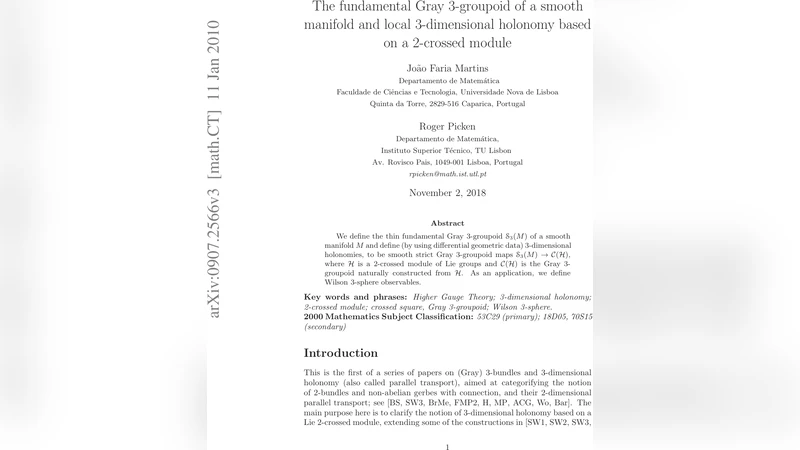
We define the thin fundamental Gray 3-groupoid $S_3(M)$ of a smooth manifold $M$ and define (by using differential geometric data) 3-dimensional holonomies, to be smooth strict Gray 3-groupoid maps $S_3(M) \to C(H)$, where $H$ is a 2-crossed module of Lie groups and $C(H)$ is the Gray 3-groupoid naturally constructed from $H$. As an application, we define Wilson 3-sphere observables.
💡 Research Summary
The paper develops a complete higher‑dimensional holonomy theory by constructing a strict Gray 3‑groupoid that captures the thin homotopy classes of smooth paths, surfaces and volumes in a manifold M, and by pairing this geometric object with a 2‑crossed module of Lie groups.
In the first part the authors recall that ordinary (1‑dimensional) holonomy is a functor from the fundamental groupoid of M to a Lie group G, while 2‑dimensional holonomy (surface holonomy) can be described by a crossed module (a 2‑group) and yields a strict 2‑groupoid. They point out that a genuine 3‑dimensional parallel transport requires a richer algebraic structure, which leads them to Gray 3‑groupoids – a strict 3‑category equipped with two compatible compositions (horizontal and vertical) and a strict interchange law.
The second section introduces thin homotopies: a thin 1‑homotopy is a path whose derivative has rank ≤ 0, a thin 2‑homotopy is a surface of zero area, and a thin 3‑homotopy is a volume of zero 3‑measure. By quotienting smooth paths, surfaces and volumes by these thin homotopies the authors obtain the fundamental Gray 3‑groupoid S₃(M). Its objects consist of a single point, its 1‑cells are thin‑homotopy classes of paths, its 2‑cells are thin‑homotopy classes of parametrised surfaces with fixed boundary, and its 3‑cells are thin‑homotopy classes of parametrised volumes with fixed boundary surface. The composition laws are defined by concatenation of representatives and are shown to be well‑defined on thin classes, giving S₃(M) the structure of a strict Gray 3‑groupoid.
The third part is devoted to the algebraic side. A 2‑crossed module H = (L → E → G) consists of Lie groups G, E, L together with equivariant boundary maps ∂₂: E→G, ∂₁: L→E, a left G‑action on E and L, and a Peiffer lifting {·,·}: E×E→L satisfying a list of coherence identities (the Peiffer identities, the 2‑crossed module axioms, etc.). From H one builds a Gray 3‑groupoid C(H) with a single object, 1‑cells = G, 2‑cells = E, 3‑cells = L, and composition rules dictated by the group operations, the G‑action, and the Peiffer lifting. The authors verify that C(H) is a strict Gray 3‑groupoid and that its interchange law is precisely the algebraic expression of the 2‑crossed module axioms.
The central contribution is the definition of a 3‑dimensional holonomy as a strict Gray 3‑functor
\
Comments & Academic Discussion
Loading comments...
Leave a Comment