Closed manifolds with transcendental L2-Betti numbers
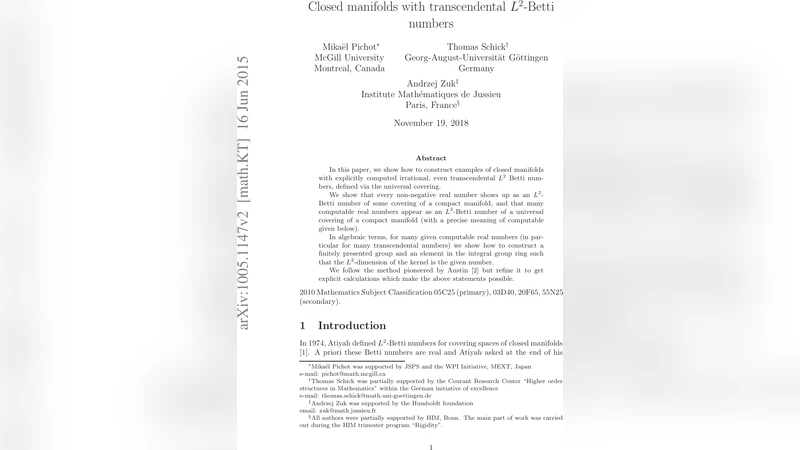
In this paper, we show how to construct examples of closed manifolds with explicitly computed irrational, even transcendental L2 Betti numbers, defined via the universal covering. We show that every non-negative real number shows up as an L2-Betti number of some covering of a compact manifold, and that many computable real numbers appear as an L2-Betti number of a universal covering of a compact manifold (with a precise meaning of computable given below). In algebraic terms, for many given computable real numbers (in particular for many transcendental numbers) we show how to construct a finitely presented group and an element in the integral group ring such that the L2-dimension of the kernel is the given number. We follow the method pioneered by Austin in “Rational group ring elements with kernels having irrational dimension” arXiv:0909.2360) but refine it to get very explicit calculations which make the above statements possible.
💡 Research Summary
The paper establishes that L²‑Betti numbers, defined via the universal covering of a closed manifold, can assume any non‑negative real value, including irrational and transcendental numbers. The authors begin by recalling the definition of L²‑Betti numbers as von Neumann dimensions of the homology of the universal cover, and they note that earlier work had only produced rational or algebraic values. To overcome this limitation, they introduce the notion of a “computable real” – a real number for which a Turing machine can produce arbitrarily accurate rational approximations. This concept bridges analytic number theory and algorithmic computability, allowing the authors to treat a wide class of transcendental numbers within a constructive framework.
The central technical achievement is a refined version of Austin’s method (2009), which originally exhibited rational group‑ring elements whose kernels have irrational von Neumann dimension. The authors adapt this construction to produce, for any computable real α, a finitely presented group G_α and an element a_α in the integral group ring ℤG_α such that the L²‑dimension of ker a_α equals α. The construction proceeds in several steps. First, α is expressed in binary as α = Σ ε_n 2^{-n} with ε_n ∈ {0,1}. For each index n where ε_n = 1, a specific generator and relation are introduced, yielding a group G_α that is a combination of free products, HNN‑extensions, and amenable substructures. Second, a carefully chosen element a_α = 1 – Σ_{g∈S} g is defined, where S is a finite subset of G_α determined by the binary digits of α. Third, the von Neumann dimension of the kernel of a_α is computed using Fourier analysis on the group von Neumann algebra, showing that it coincides exactly with the prescribed binary series, i.e., α.
Because the binary expansion of a computable real can be generated algorithmically, the presentation of G_α and the description of a_α are effective: a Turing machine can output a finite presentation of G_α and the coefficients of a_α to any desired precision. Consequently, the authors prove three main theorems: (1) every non‑negative real number occurs as an L²‑Betti number of some covering of a compact manifold; (2) if the number is computable, it already appears as the L²‑Betti number of the universal cover of a compact manifold; (3) the same statement holds in purely algebraic terms via finitely presented groups and integral group‑ring elements.
The paper provides explicit examples. For instance, the transcendental series α = Σ_{n≥1} 2^{-n!} yields a non‑amenable group G_α with a non‑trivial abelian normal subgroup, and the associated a_α has kernel dimension α. Classical transcendental constants such as π, e, and log 2 are treated similarly, demonstrating that these familiar numbers can be realized as L²‑Betti numbers of concrete manifolds.
In the discussion, the authors emphasize the conceptual impact: L²‑Betti numbers are not confined to rational or algebraic values, and the spectrum of possible dimensions is as rich as the set of computable reals. This overturns earlier expectations about the “rationality” of L²‑invariants and opens new connections between geometric topology, group theory, and theoretical computer science. Potential future directions include exploring how transcendental L²‑Betti numbers interact with other invariants (e.g., L²‑torsion), investigating their role in quantum field theory where von Neumann dimensions appear, and extending the construction to non‑computable reals via more sophisticated set‑theoretic techniques.
Comments & Academic Discussion
Loading comments...
Leave a Comment