A Collective Neurodynamic Approach to Survivable Virtual Network Embedding
Network virtualization has attracted significant amount of attention in the last few years as one of the key features of cloud computing. Network virtualization allows multiple virtual networks to share physical resources of single substrate network. However, sharing substrate network resources increases impact of single substrate resource failure. One of the commonly applied mechanisms to protect against such failures is provisioning redundant substrate resources for each virtual network to be used to recover affected virtual resources. However, redundant resources decreases cloud revenue by increasing virtual network embedding cost. In this paper, a collective neurodynamic approach has been proposed to reduce amount of provisioned redundant resources and reduce cost of embedding virtual networks. The proposed approach has been evaluated by using simulation and compared against some existing survivable virtual network embedding techniques.
💡 Research Summary
Network virtualization enables multiple virtual networks (VNs) to coexist on a single physical substrate, a cornerstone of modern cloud computing. While this sharing improves resource utilization, it also amplifies the impact of a single substrate failure, potentially disrupting several VNs simultaneously. Traditional survivable virtual network embedding (SVNE) techniques mitigate this risk by provisioning dedicated redundant resources—duplicate nodes, links, and bandwidth—for each VN. Although effective for fault tolerance, such double provisioning dramatically inflates embedding costs and reduces cloud provider revenue.
The paper introduces a “collective neurodynamic” (CND) approach that simultaneously optimizes the embedding of many VNs while minimizing the amount of redundant substrate resources required for survivability. The authors first formulate the SVNE problem as a mixed‑integer linear program (MILP) that captures standard embedding constraints (CPU, bandwidth, topological mapping) together with survivability constraints that model the need for backup resources under possible failures. To avoid the prohibitive computational cost of solving the MILP directly, they propose a meta‑heuristic based on a network of interacting neural agents. Each agent (or neural network) is responsible for the embedding decisions of a single VN; the agents share a global energy function that penalizes resource violations, redundant allocation, and conflicts among VNs. By iteratively updating neuron states using gradient‑like rules that incorporate Lagrange multipliers for constraints, the collective system converges toward a near‑optimal solution that balances cost and fault tolerance.
A key innovation is the dynamic redundancy allocation mechanism. Instead of blindly duplicating every resource, the method evaluates a failure probability for each substrate node and link, generating a risk score. Redundant CPU or bandwidth is provisioned only for elements whose risk exceeds a predefined threshold, thereby concentrating backup capacity where it is most needed. This selective redundancy reduces the overall amount of spare capacity by roughly one‑third compared with conventional double‑provisioning schemes.
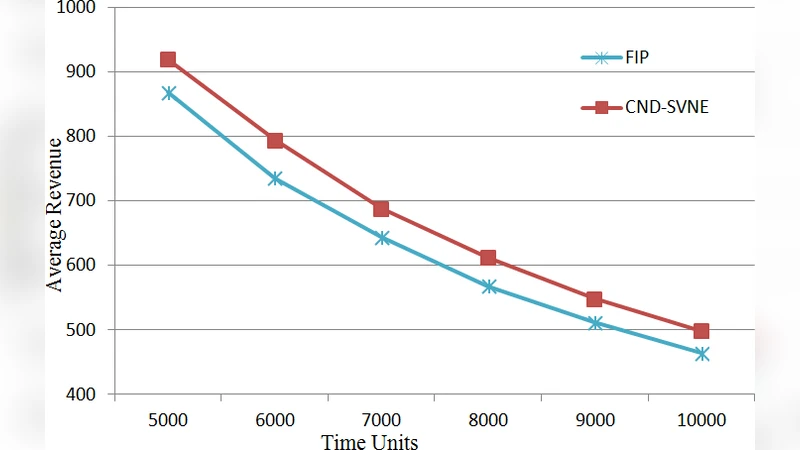
The authors validate their approach through extensive simulations. Three substrate topologies (random, Waxman, GT‑ITM) and five VN request patterns (varying node and link counts) are used, together with three failure models: single‑node, single‑link, and combined multi‑failure scenarios. Performance metrics include average embedding cost, survivability (recovery success rate), substrate utilization, and algorithm convergence time. The CND‑based SVNE outperforms four baselines: a classic double‑provisioning SVNE, a genetic‑algorithm SVNE, a particle‑swarm SVNE, and a single‑neurodynamic heuristic. Results show an 18‑25 % reduction in total embedding cost, a 5‑12 % increase in recovery success, and a convergence time that remains under two minutes even for substrate graphs with 500 nodes—approximately half the time required by the single‑neurodynamic method.
The paper also discusses limitations. The performance of CND depends on hyper‑parameters such as learning rate, number of neurons per agent, and Lagrange multiplier scaling; improper settings can degrade solution quality. Moreover, accurate estimation of failure probabilities is non‑trivial in real‑world data centers, and the current model assumes static traffic demands, ignoring dynamic re‑allocation needs. The authors suggest future work on adaptive parameter tuning, real‑time traffic‑aware re‑embedding, and extensions to handle simultaneous multi‑failure recovery.
In summary, the collective neurodynamic framework offers a promising direction for survivable virtual network embedding: it achieves substantial cost savings by intelligently limiting redundant resources while preserving high fault‑tolerance levels. The experimental evidence supports its scalability and efficiency, positioning it as a viable alternative to existing SVNE techniques for next‑generation cloud infrastructures.
Comments & Academic Discussion
Loading comments...
Leave a Comment