Recognition of the Spherical Laguerre Voronoi Diagram
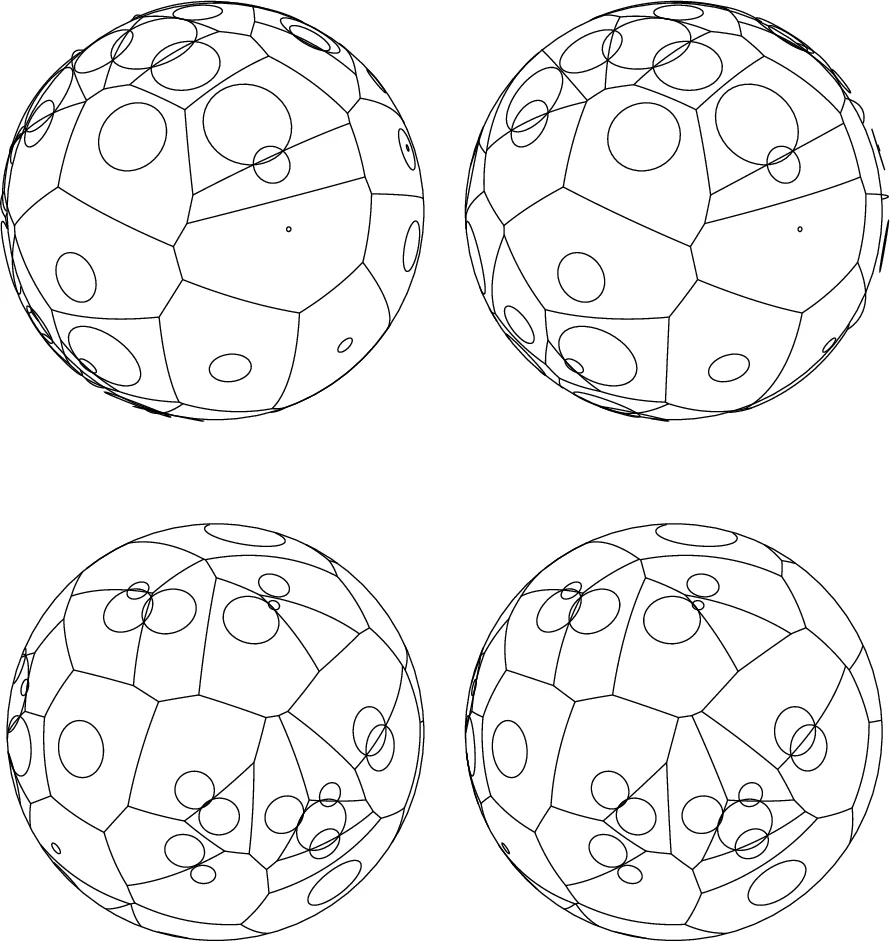
In this paper, we construct an algorithm for determining whether a given tessellation on a sphere is a spherical Laguerre Voronoi diagram or not. For spherical Laguerre tessellations, not only the locations of the Voronoi generators, but also their weights are required to recover. However, unlike the ordinary spherical Voronoi diagram, the generator set is not unique, which makes the problem difficult. To solve the problem, we use the property that a tessellation is a spherical Laguerre Voronoi diagram if and only if there is a polyhedron whose central projection coincides with the tessellation. We determine the degrees of freedom for the polyhedron, and then construct an algorithm for recognizing Laguerre tessellations.
💡 Research Summary
This paper addresses the recognition problem for the spherical Laguerre Voronoi diagram. The core challenge is to determine whether a given tessellation on a sphere can be represented as a Laguerre Voronoi diagram, and if so, to recover the corresponding generating circles (defined by their centers and weights/radii). Unlike ordinary Voronoi diagrams, the set of generators for a Laguerre diagram is not unique, making the inverse problem significantly more difficult.
The authors’ key insight is a geometric reformulation of the problem. They prove that a spherical tessellation is a Laguerre Voronoi diagram if and only if there exists a convex polyhedron that contains the center of the sphere and whose central projection onto the sphere coincides exactly with the tessellation (Proposition 3.1). Thus, the recognition task transforms into the problem of constructing such a polyhedron from the given spherical polygons.
To handle the non-uniqueness of the polyhedron corresponding to a single diagram, the paper investigates the class of all such polyhedra. It introduces a special “projection-preserving” projective transformation (Definition 3.2, Theorem 3.3). This transformation keeps the origin (sphere center) fixed and moves vertices only along lines passing through the origin, thereby preserving the central projection. The transformation is parameterized by five parameters (with four degrees of freedom), defining a continuous family of polyhedra that all project to the same spherical tessellation.
Based on this theoretical framework, the authors develop a constructive algorithm. The process begins with Algorithm 1, which details how to build three planes corresponding to three adjacent spherical polygons (i, j, k). The construction involves choosing an initial plane for polygon i (with some freedom), then constructing a plane for polygon j using an additional degree of freedom (selecting a point on a specific geodesic arc), and finally determining the plane for polygon k uniquely from the intersections of the previously defined planes and lines. Lemma 4.1 ensures the consistency of this three-plane construction.
Algorithm 2 generalizes this procedure to the entire tessellation with n polygons. It systematically traverses the adjacency graph of the spherical polygons. For each new polygon encountered, the algorithm sets up linear constraints for its corresponding plane based on the already-constructed planes of its neighbors and the geometry of the tessellation edges (which must be projections of the polyhedron’s edges). This process builds a system of linear equations. If a consistent solution exists—meaning a polyhedron satisfying all constraints can be found—the tessellation is recognized as a spherical Laguerre Voronoi diagram. The parameters of the polyhedron’s faces can then be used to recover the centers and weights of the generating circles. If the system has no solution, the input tessellation is concluded not to be a Laguerre diagram.
The paper provides a solid theoretical foundation by linking spherical Laguerre diagrams to polyhedral geometry via projective transformations. The proposed algorithm offers a principled method for solving the recognition problem. Potential future work includes improving computational efficiency, developing robust approximations for noisy real-world data, and extending the approach to higher dimensions or other curved surfaces. This research contributes to computational geometry by providing both deep theoretical insights and a practical algorithmic tool for analyzing weighted spherical tessellations.
Comments & Academic Discussion
Loading comments...
Leave a Comment