Exploring the Evolution of Node Neighborhoods in Dynamic Networks
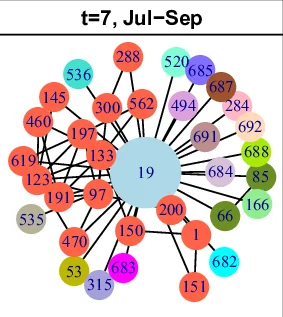
Dynamic Networks are a popular way of modeling and studying the behavior of evolving systems. However, their analysis constitutes a relatively recent subfield of Network Science, and the number of available tools is consequently much smaller than for static networks. In this work, we propose a method specifically designed to take advantage of the longitudinal nature of dynamic networks. It characterizes each individual node by studying the evolution of its direct neighborhood, based on the assumption that the way this neighborhood changes reflects the role and position of the node in the whole network. For this purpose, we define the concept of \textit{neighborhood event}, which corresponds to the various transformations such groups of nodes can undergo, and describe an algorithm for detecting such events. We demonstrate the interest of our method on three real-world networks: DBLP, LastFM and Enron. We apply frequent pattern mining to extract meaningful information from temporal sequences of neighborhood events. This results in the identification of behavioral trends emerging in the whole network, as well as the individual characterization of specific nodes. We also perform a cluster analysis, which reveals that, in all three networks, one can distinguish two types of nodes exhibiting different behaviors: a very small group of active nodes, whose neighborhood undergo diverse and frequent events, and a very large group of stable nodes.
💡 Research Summary
The paper introduces a novel microscopic approach for analyzing dynamic networks by focusing on the evolution of each node’s immediate neighborhood. After reviewing existing dynamic‑network analysis techniques—ranging from applying static metrics over time, incremental updates of community detection, to temporal‑respecting paths and motif mining—the authors argue that few methods directly capture fine‑grained changes at the node level. To fill this gap, they define “neighborhood evolution events,” a set of six elementary transformations that can occur between the neighborhoods of a node in two consecutive time slices: addition, deletion, creation, dissolution, merge, and split of neighbor groups. An efficient detection algorithm based on set operations runs in linear time with respect to the number of edges, producing for every node a chronological sequence of categorical event labels.
These event sequences are then treated as temporal categorical data. First, frequent pattern mining is applied to uncover common subsequences across the whole network. In the DBLP co‑authorship network, patterns such as “new collaborator added → merge with existing group” appear frequently, reflecting typical phases of academic collaboration. In the LastFM social network, patterns like “music‑taste based neighbor added → neighbor later removed” dominate, while the Enron email network shows “new correspondent added → subsequent dissolution” as a prevalent motif. Second, the authors vectorize each node’s event sequence (e.g., counting event types, preserving order) and perform clustering using K‑means and hierarchical methods. The clustering consistently yields two dominant groups in all three datasets: a small “active” group (2‑5 % of nodes) that experiences a high frequency and diversity of events, and a large “stable” group whose neighborhoods remain largely unchanged over time. The active nodes also tend to have higher centrality and influence scores, suggesting they act as drivers of network evolution.
Experimental validation on three real‑world networks—DBLP (scientific collaborations), LastFM (music‑based social ties), and Enron (email exchanges)—demonstrates the method’s ability to extract meaningful behavioral trends, differentiate node roles, and provide interpretable insights that complement macro‑ and mesoscopic analyses. The authors acknowledge limitations: the choice of time‑slice granularity can affect event detection, and the current six‑event taxonomy may not capture more complex structural changes. Future work is proposed on adaptive slice selection, expanding the event taxonomy, and integrating advanced sequence‑modeling techniques (e.g., recurrent neural networks) for predictive analysis. Overall, the study offers a systematic framework for leveraging the longitudinal nature of dynamic networks to reveal hidden micro‑level dynamics and to support richer modeling of evolving systems.
Comments & Academic Discussion
Loading comments...
Leave a Comment