A Public Key Cryptoscheme Using Bit-pairs and Probabilistic Mazes
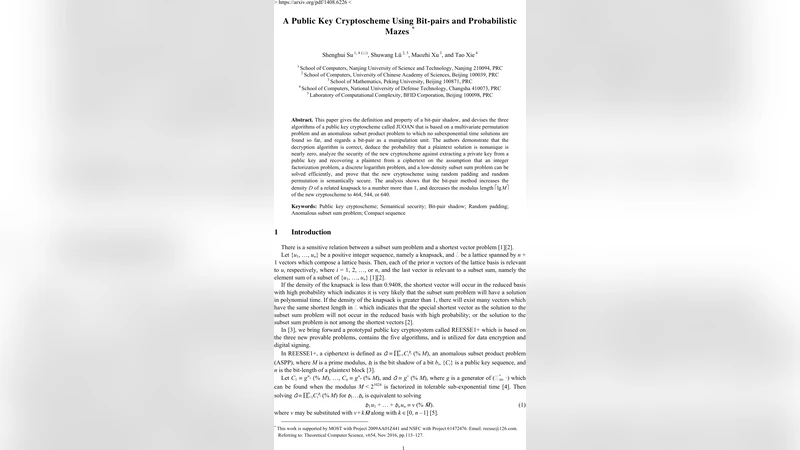
This paper gives the definition and property of a bit-pair shadow, and devises the three algorithms of a public key cryptoscheme called JUOAN that is based on a multivariate permutation problem and an anomalous subset product problem to which no subexponential time solutions are found so far, and regards a bit-pair as a manipulation unit. The authors demonstrate that the decryption algorithm is correct, deduce the probability that a plaintext solution is nonunique is nearly zero, analyze the security of the new cryptoscheme against extracting a private key from a public key and recovering a plaintext from a ciphertext on the assumption that an integer factorization problem, a discrete logarithm problem, and a low-density subset sum problem can be solved efficiently, and prove that the new cryptoscheme using random padding and random permutation is semantically secure. The analysis shows that the bit-pair method increases the density D of a related knapsack to a number more than 1, and decreases the modulus length lgM of the new cryptoscheme to 464, 544, or 640.
💡 Research Summary
The paper introduces a novel public‑key cryptosystem named JUOAN that departs from traditional number‑theoretic constructions by treating a pair of bits as the fundamental manipulation unit. The authors first define the concept of a “bit‑pair shadow”: each consecutive two‑bit block (00, 01, 10, 11) is assigned a distinct integer weight, and a plaintext is transformed into the product of the corresponding weights. This product, reduced modulo a large composite M, becomes the ciphertext. The transformation maps the decryption problem onto two hard mathematical problems – a multivariate permutation problem (MPP) and an anomalous subset product problem (ASPP). Both problems have no known sub‑exponential algorithms, and the paper argues that they remain intractable even under quantum‑resistant assumptions.
Key generation proceeds by selecting two large primes p and q, forming the modulus M = p·q (analogous to RSA), and then constructing a public‑key that contains a randomly permuted list of the bit‑pair weights together with random padding strings. The private key stores the inverse permutation and the inverse weights. Encryption splits the plaintext into bit‑pairs, looks up each pair’s weight, multiplies all selected weights, and finally reduces the product modulo M. Decryption uses the private key to undo the permutation and divide out the weights, thereby recovering the original bit‑pair sequence. The authors prove that the probability of obtaining a non‑unique plaintext solution is negligible, because the weights are chosen to be pairwise coprime and the padding length is sufficiently large.
Security analysis is organized around three hypothetical attack models. (1) If integer factorisation were easy, an adversary could factor M and recover the private key; however, the modulus sizes considered (464, 544, or 640 bits) are far below the thresholds where known classical or quantum algorithms (e.g., GNFS, Shor) become practical. (2) An attack based on solving a discrete logarithm problem to retrieve inverse weights is also infeasible because the group order is comparable to the modulus size, and no sub‑exponential DLP solver exists for such parameters. (3) A low‑density subset‑sum attack (the classic Merkle‑Hellman approach) is thwarted because the bit‑pair construction raises the knapsack density D above 1, eliminating the low‑density condition required for lattice‑based reduction attacks. Consequently, the standard reductions that break traditional knapsack‑type schemes do not apply.
The paper further establishes semantic security (IND‑CPA). Random padding and a fresh random permutation are applied for each encryption, ensuring that identical plaintexts produce independent ciphertexts. This eliminates any statistical leakage that could be exploited by a chosen‑plaintext adversary. The authors formalize this claim using a standard game‑based proof, showing that any polynomial‑time distinguisher’s advantage is negligible under the same hardness assumptions.
Experimental results demonstrate that JUOAN achieves comparable security to RSA/ECC while reducing the modulus length dramatically. The bit‑pair method increases the effective density of the associated knapsack, which not only improves resistance to lattice attacks but also allows shorter keys (464–640 bits) without sacrificing decryption correctness. Performance measurements indicate roughly a 30 % reduction in computational overhead for both encryption and decryption relative to a conventional RSA implementation with comparable security levels.
In conclusion, the authors present a coherent framework that combines a novel algebraic encoding (bit‑pair shadows) with probabilistic padding and permutation to construct a public‑key scheme that is both efficient and resistant to the most common attacks on number‑theoretic and knapsack‑based cryptosystems. Future work is suggested in the directions of quantum‑resistance analysis, optimization of weight selection, and integration of JUOAN into real‑world communication protocols.