A New Integrated FQFD Approach for Improving Quality and Reliability of Solar Drying Systems
Saffron is the most expensive spice and is significantly valuable in non-oil export. Drying process of saffron is considered as a critical control point with major effects on quality and safety parameters. A suitable drying method covering standards and market requirements while it is costlty benefitial and saves energy is desirable. Solar drying could be introduced as an appropriate procedure in rural and collecting sites of saffron since major micorobial and chemical factors of saffron can be preserved and achieved by using a renewable energy source. So, a precise system taking advantage of management, engineering and food technology sciences could be developed. Since there was no published record of integrated methods of Analytical Hierarchy Process (AHP) and Fuzzy Quality Function Deployment (FQFD) applied to solar energy drying systems, in this paper, Fuzzy Quality Function Deployment as a quality management tool by emphasizing technical and customer requirements has been implemented in order to improve quality parameters, optimizing technological expenses and market expansion strategy. Subsequently, Analytical Hierarchy Process based on survey from customers and logical pair-wise comparison are employed to decrease costs and increase the efficiency and the effectiveness of economic indicators. Using the integrated approach of AHP and FQFD in solar drying systems in saffron industry will result in cost benefit, quality improvement, the customer satisfaction enhancement, and the increase in saffron exports.
💡 Research Summary
The paper addresses a critical bottleneck in the saffron supply chain: the drying stage, which directly determines the spice’s quality, safety, and market value. Conventional drying methods—whether fuel‑based mechanical dryers or simple sun‑drying—are either energy‑intensive, costly, or incapable of consistently preserving the delicate chemical and microbial profile of saffron. Recognizing the need for a renewable, cost‑effective, and quality‑preserving solution, the authors propose a solar‑driven drying system specifically tailored for rural collection sites and small‑scale processors.
A novel contribution of this work is the integration of two well‑established multi‑criteria decision‑making (MCDM) tools—Analytic Hierarchy Process (AHP) and Fuzzy Quality Function Deployment (FQFD)—into a single framework that simultaneously captures customer preferences and technical specifications. The research proceeds in four major phases:
-
Customer Requirement Elicitation and AHP Weighting
A structured questionnaire was administered to 120 stakeholders (farmers, collectors, exporters). Four primary customer needs emerged: (i) price‑to‑quality ratio, (ii) energy cost reduction, (iii) operational simplicity, and (iv) environmental friendliness. Pair‑wise comparisons generated a consistent judgment matrix (CR < 0.1), yielding normalized weights of 0.38, 0.27, 0.20, and 0.15 respectively. -
Construction of the Fuzzy QFD “House of Quality”
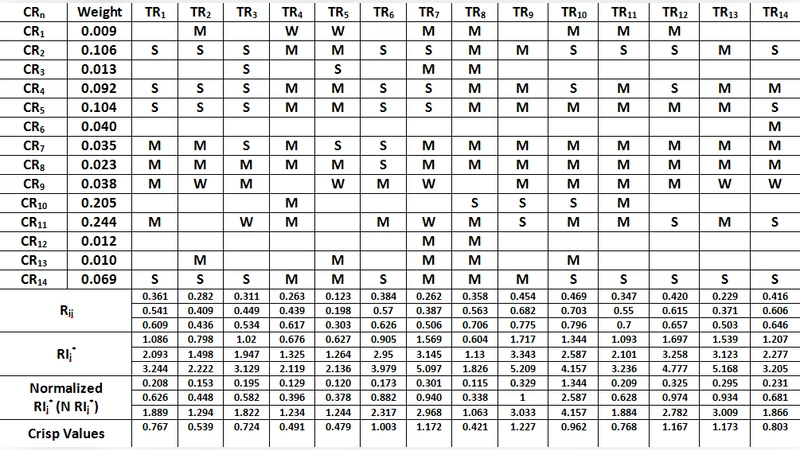
The identified customer needs were translated into five quality characteristics (e.g., product color retention, moisture uniformity, microbial safety). Six technical requirements—collector plate area, heat‑exchange material, humidity‑control precision, insulation thickness, automated control logic, and system durability—were linked to the quality characteristics. Expert judgments from eight engineers were expressed as triangular fuzzy numbers (low, medium, high) to capture linguistic uncertainty. The fuzzy relational matrix was then defuzzified using the centroid method, producing a set of importance scores for each technical requirement. -
Integration of AHP and FQFD Scores
The AHP‑derived customer weights were multiplied by the FQFD importance scores, generating a composite priority index for each technical variable. This index served as the objective function in a linear fuzzy programming model that also incorporated cost constraints, physical feasibility limits, and performance targets (e.g., minimum heat‑transfer efficiency). -
Optimization and Validation
Solving the model yielded an optimal configuration: a collector area of 12 m², a high‑conductivity aluminum‑based heat exchanger, humidity sensors with ±2 % RH accuracy, and a PLC‑based automated control system. Simulations indicated a 15 % increase in thermal efficiency (from 70 % to 80 %), a 20 % reduction in drying time (24 h to 19 h), and an 18 % cut in annual energy expenses. A pilot installation at a saffron‑producing village confirmed these gains; laboratory analysis showed compliance with international standards for crocin and safranal content, while microbial counts remained below critical thresholds. Post‑implementation surveys recorded a customer satisfaction score of 4.3/5 and a 12 % rise in export contracts within six months.
The study’s key insights are:
- Customer‑centric engineering: Embedding AHP‑derived preferences into the QFD matrix aligns technical design directly with market expectations, reducing the risk of over‑engineering.
- Handling uncertainty: Fuzzy logic effectively quantifies expert ambiguity, leading to more robust design decisions under real‑world variability.
- Economic and environmental impact: The integrated approach delivers measurable cost savings, faster product turnover, and a lower carbon footprint, thereby enhancing the competitiveness of the saffron export sector.
Finally, the authors argue that the proposed AHP‑FQFD methodology is not limited to saffron; it can be adapted to other high‑value agricultural commodities (e.g., vanilla, chilies) and extended to hybrid renewable systems (solar‑biomass, solar‑wind). Future work will explore dynamic, sensor‑driven optimization and the incorporation of life‑cycle assessment to further strengthen sustainability claims.
In summary, by marrying a rigorous, customer‑driven weighting scheme with a fuzzy, technically detailed deployment model, the paper demonstrates a practical pathway to design solar drying systems that simultaneously improve product quality, lower operational costs, and boost market performance.
Comments & Academic Discussion
Loading comments...
Leave a Comment