The derived category of quasi-coherent sheaves and axiomatic stable homotopy
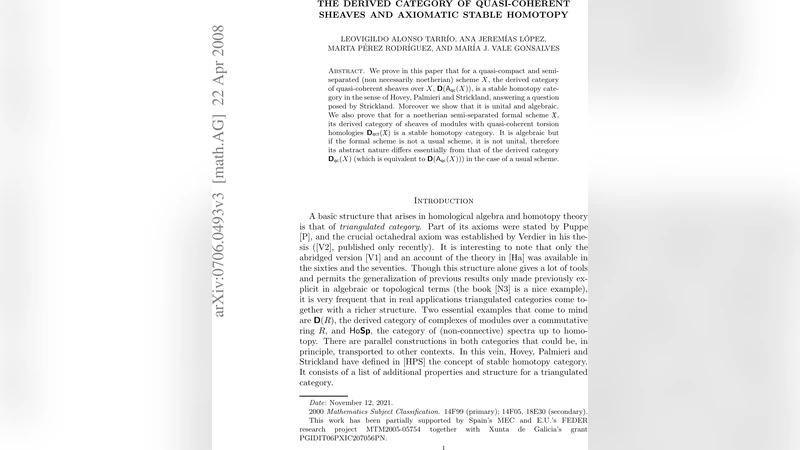
We prove in this paper that for a quasi-compact and semi-separated (non necessarily noetherian) scheme X, the derived category of quasi-coherent sheaves over X, D(A_qc(X)), is a stable homotopy category in the sense of Hovey, Palmieri and Strickland, answering a question posed by Strickland. Moreover we show that it is unital and algebraic. We also prove that for a noetherian semi-separated formal scheme X, its derived category of sheaves of modules with quasi-coherent torsion homologies D_qct(X) is a stable homotopy category. It is algebraic but if the formal scheme is not a usual scheme, it is not unital, therefore its abstract nature differs essentially from that of the derived category of a usual scheme.
💡 Research Summary
The paper addresses a question raised by Strickland concerning whether the derived category of quasi‑coherent sheaves on a scheme can be regarded as a stable homotopy category in the sense of Hovey, Palmieri, and Strickland (HPS). The authors work in two settings: (1) a quasi‑compact, semi‑separated (not necessarily Noetherian) scheme X, and (2) a Noetherian, semi‑separated formal scheme X.
In the first setting they prove that D(A_qc(X)), the derived category of quasi‑coherent O_X‑modules, satisfies all HPS axioms. First, they construct the derived tensor product ⊗^L and the internal Hom RHom, showing that these give D(A_qc(X)) a closed symmetric monoidal structure with unit object O_X. Next, using a finite affine open cover of X, they exhibit a compact generator G = ⊕i j{i*}O_{U_i}. The compactness of G follows from the quasi‑compactness of X, and the triangulated subcategory generated by G is the whole D(A_qc(X)). Because the category is compactly generated and triangulated, Brown representability holds automatically by the HPS theorem. Finally, they show that D(A_qc(X)) is algebraic: it is equivalent to the derived category of a DG‑category of complexes of quasi‑coherent sheaves, thus fitting into Keller’s framework of algebraic triangulated categories. Consequently D(A_qc(X)) is a unital, algebraic stable homotopy category.
In the second setting the authors consider D_qct(X), the derived category of O_X‑modules whose homology sheaves are quasi‑coherent and torsion (i.e., supported on the closed subscheme defined by an ideal of definition). They prove that D_qct(X) also satisfies the HPS axioms, so it is a stable homotopy category. However, the usual structure sheaf O_X does not belong to D_qct(X) unless the formal scheme is actually an ordinary scheme; therefore D_qct(X) lacks a unit for the tensor product and is termed “non‑unital”. Despite this, the category remains algebraic because it can be realized as the derived category of a suitable DG‑category of torsion complexes.
The paper highlights the conceptual difference between the two cases. For ordinary schemes the derived category is both unital and algebraic, allowing one to apply Balmer’s tensor‑triangular spectrum theory directly. For formal schemes, the absence of a unit forces a modification of the tensor‑triangular framework, suggesting new invariants and a richer homotopical structure.
Overall, the authors provide a thorough verification that D(A_qc(X)) and D_qct(X) fit into the abstract stable homotopy paradigm, thereby bridging classical algebraic geometry with modern homotopy‑theoretic techniques. Their results open the door to applying stable homotopy tools—such as Bousfield localization, chromatic filtrations, and tensor‑triangular geometry—to derived categories of quasi‑coherent sheaves on both ordinary and formal schemes.