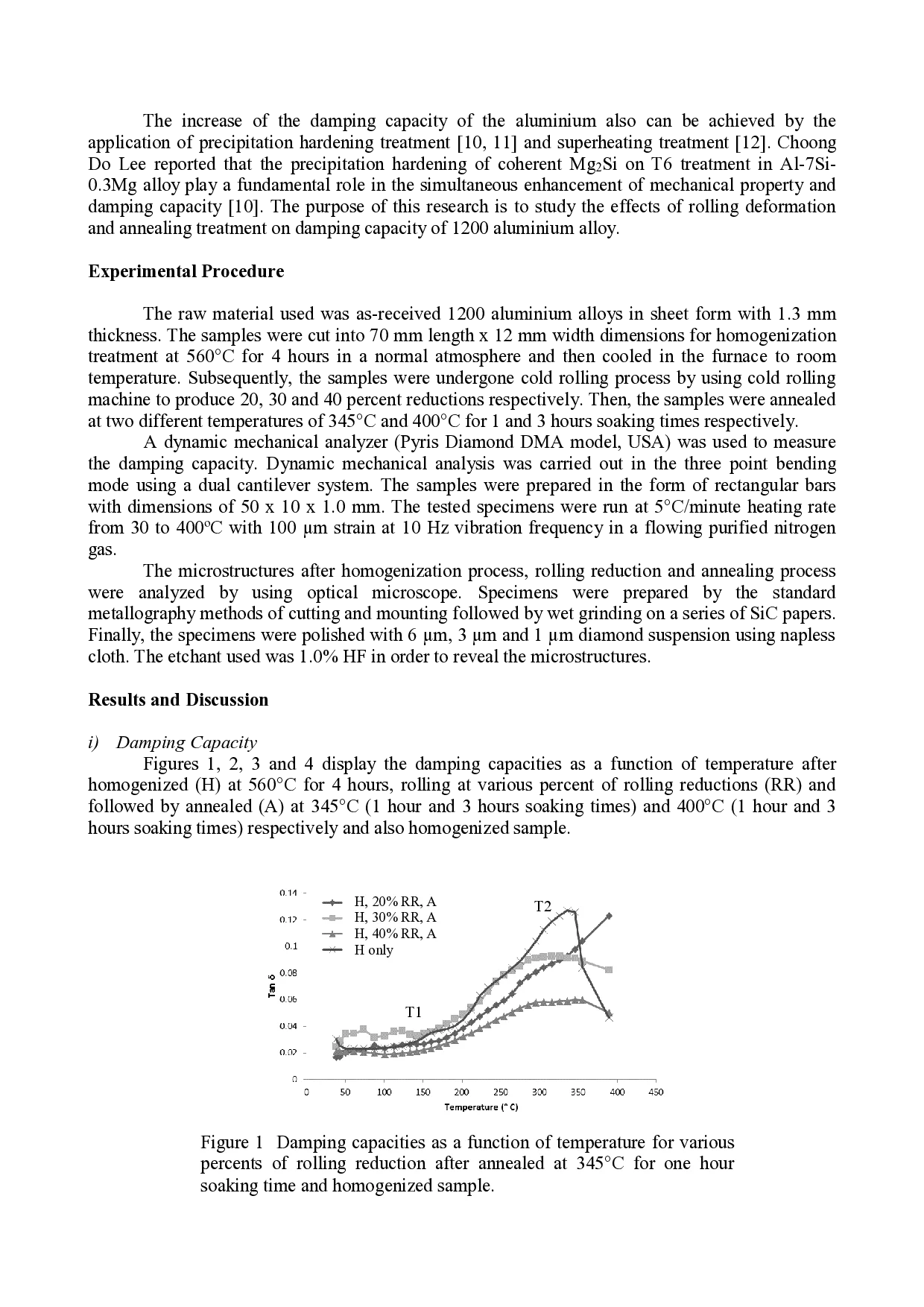
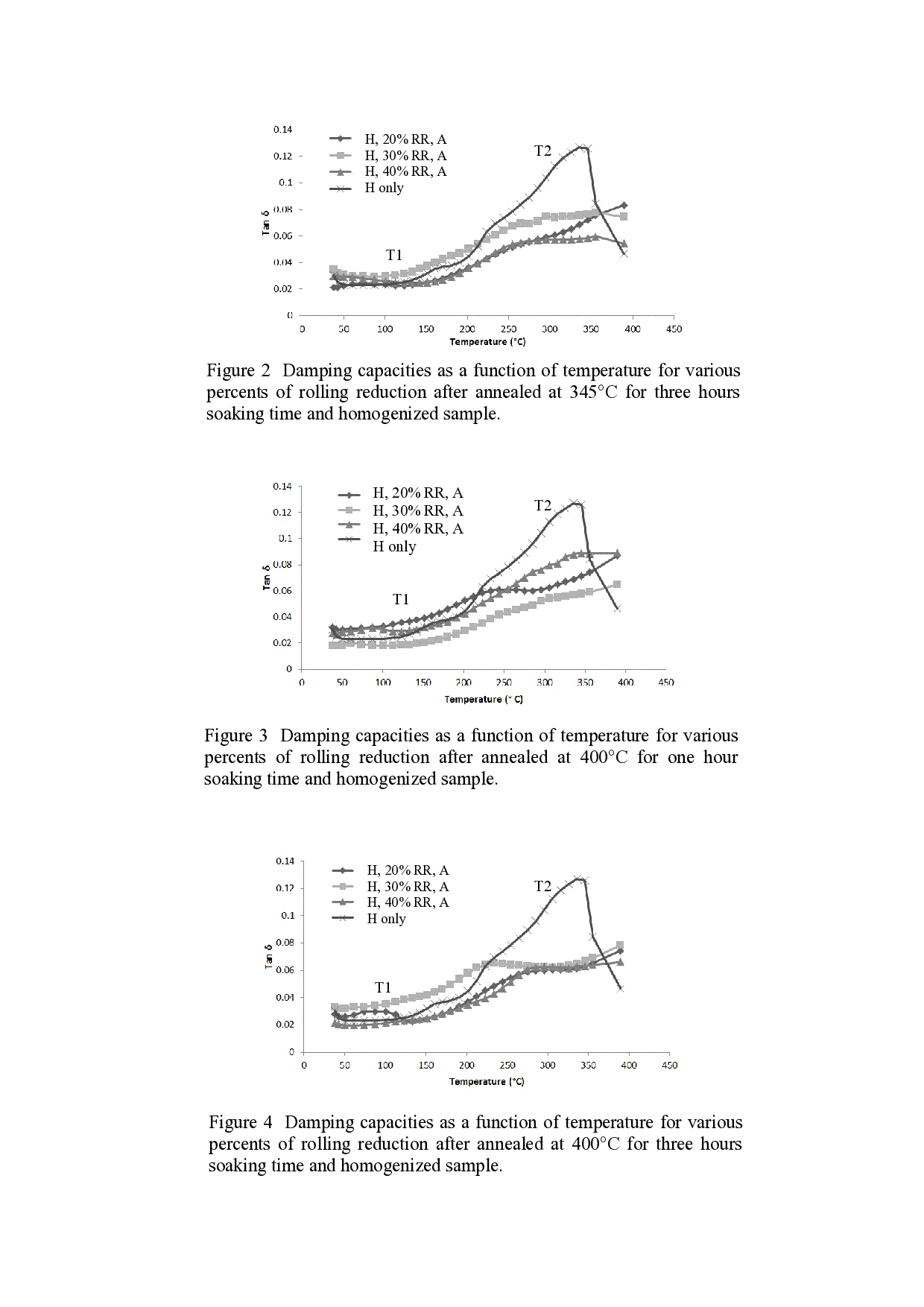
Annealing treatment is an important step of rolling deformation that contributes to microstructural evolution and leads to the significant changes in damping capacity. Damping capacities were analyzed in the parallel to rolling direction at 1 and 10 Hz respectively. It was found that severe plastic deformation at 40 percent reduction has lower damping capacity compared to that of 30 percent and 20 percent reductions respectively. The microstructural results show that the grains of as rolled alloys were changed to almost equiaxed structures after a rolling reduction at 40 percent reduction.
Deep Dive into The Effects of Rolling Deformation and Annealing Treatment on Damping Capacity of 1200 Aluminium Alloy.
Annealing treatment is an important step of rolling deformation that contributes to microstructural evolution and leads to the significant changes in damping capacity. Damping capacities were analyzed in the parallel to rolling direction at 1 and 10 Hz respectively. It was found that severe plastic deformation at 40 percent reduction has lower damping capacity compared to that of 30 percent and 20 percent reductions respectively. The microstructural results show that the grains of as rolled alloys were changed to almost equiaxed structures after a rolling reduction at 40 percent reduction.
The Effects of Rolling Deformation and Annealing Treatment
on Damping Capacity of 1200 Aluminium Alloy
*M. N. Mazlee1,a, J. B. Shamsul1,b, Y. Yasmin2,c ,
S. R. Shamsudin2,d, M. S. Risby3,e, M. Afendi4,f
1Sustainable Engineering Cluster, School of Materials Engineering,
Universiti Malaysia Perlis, 01000 Kangar, Perlis, MALAYSIA
2School of Materials Engineering, Universiti Malaysia Perlis,
02600 Arau, Perlis, MALAYSIA
3Faculty of Engineering, Universiti Pertahanan Nasional Malaysia (UPNM)
Kem Sg. Besi, 57000 Kuala Lumpur, MALAYSIA
4School of Mechatronics Engineering, Universiti Malaysia Perlis,
Pauh, 02600 Arau, Perlis, MALAYSIA
amazlee@unimap.edu.my, bsbaharin@unimap.edu.my, cyasminyuriz@yahoo.com,
drizam@unimap.edu.my, erisby@upnm.edu.my, faffendirojan@unimap.edu.my
Keywords: Rolling deformation, damping capacity, annealing treatment, 1200 aluminium alloy.
Abstract. Annealing treatment is an important step of rolling deformation that contributes to
microstructural evolution and leads to the significant changes in damping capacity. Damping
capacities were analyzed in the parallel to rolling direction at 1 and 10 Hz respectively. It was found
that severe plastic deformation at 40 percent reduction has lower damping capacity compared to that
of 30 percent and 20 percent reductions respectively. The microstructural results show that the
grains of as rolled alloys were changed to almost equiaxed structures after a rolling reduction at 40
percent reduction.
Introduction
Progress in technology and industry is based on developments in materials and the related
heat treatment processes involved. The damping capacity of a material is determined by evaluating
the energy dissipated in the material during mechanical vibration. High damping materials, which
have the ability to dissipate mechanical vibration energy, are valuable to be applied in the fields of
noise control and in stabilizing structures in order to suppress mechanical vibrations and attenuate
wave propagation [1-2]. Practical applications need low density materials that simultaneously
exhibit high damping capacity and good ductility. However, in metals these properties are usually
incompatible because of the dependence on microscopic mechanisms involved in strengthening and
damping [3].
The compatibility of high damping capacity with high strength has been considered to be
important for structural damping capacity of the aluminum severely deformed by materials
subjected to resonance loading. However, increases in damping by various methods have been
accompanied by decreases in strength [4]. It is established that severe plastic deformation is viable
to produce high strength metals with ultrafine grained microstructure [5, 6].
The severe plastic deformation is reliable also as a process to produce high damping
materials since the severely formed metals contain significant amount of lattice defects which give
rise to damping capacity. Zheng Ming Yi et al. have reported the high damping capacity of Mg-Cu-
Mn alloy severely deformed by equal channel angular press (ECAP) [7]. On the other hand, cold
rolling is the one of the severe plastic deformation processes applicable to continuous production of
large bulky materials [8, 9].
Please cite this article as: Mazlee, M. N., Jamaludin, S. B., Yasmin, Y., Shamsudin, S. R., Risby, M.
S., & Afendi, M. (2015). The Effects of Rolling Deformation and Annealing Treatment on Damping
Capacity of 1200 Aluminium Alloy. In Materials Science Forum (Vol. 819, pp. 20-24). Trans Tech
Publications.
The increase of the damping capacity of the aluminium also can be achieved by the
application of precipitation hardening treatment [10, 11] and superheating treatment [12]. Choong
Do Lee reported that the precipitation hardening of coherent Mg2Si on T6 treatment in Al-7Si-
0.3Mg alloy play a fundamental role in the simultaneous enhancement of mechanical property and
damping capacity [10]. The purpose of this research is to study the effects of rolling deformation
and annealing treatment on damping capacity of 1200 aluminium alloy.
Experimental Procedure
The raw material used was as-received 1200 aluminium alloys in sheet form with 1.3 mm
thickness. The samples were cut into 70 mm length x 12 mm width dimensions for homogenization
treatment at 560°C for 4 hours in a normal atmosphere and then cooled in the furnace to room
temperature. Subsequently, the samples were undergone cold rolling process by using cold rolling
machine to produce 20, 30 and 40 percent reductions respectively. Then, the samples were annealed
at two different temperatures of 345°C and 400°C for 1 and 3 hours soaking times respectively.
A dynamic mechanical analyzer (Pyris Diamond DMA model, USA) was used to measure
the damping capacity. Dynamic mechanical analysis was carried out in the three point bending
mode using a dual cantilever system. The samples were prepared in the form of rectangul
…(Full text truncated)…
This content is AI-processed based on ArXiv data.