High-energy characteristics of the schizophrenic pulsar PSR J1846-0258 in Kes 75
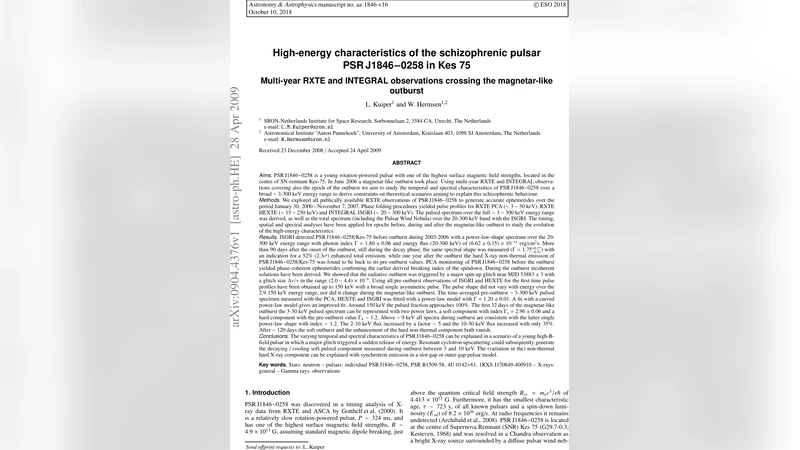
PSR J1846-0258 is a radio-quiet rotation-powered pulsar at the center of Supernova remnant Kes 75. It is the youngest pulsar (~723 year) of all known pulsars and slows down very predictably since its discovery in 2000. Till June 7, 2006 very stable behavior has been displayed both in the temporal and spectral domains with pulsed emission detectable by INTEGRAL IBIS ISGRI and RXTE HEXTE up to ~150 keV. Then, a dramatic brightening was detected of the pulsar during June 7-12, 2006 Chandra observations of Kes 75. This radiative event, lasting for ~55 days, was accompanied by a huge timing glitch, reported on for the first in present work. Moreover, several short magnetar-like bursts were discovered. In this work not only the time-averaged pre-outburst X-ray/soft gamma-ray characteristics are discussed in detail, but also the spectral evolution during the outburst and its relaxation phase are addressed using RXTE PCA and HEXTE and INTEGRAL IBIS ISGRI data.
💡 Research Summary
The paper presents a comprehensive high‑energy study of PSR J1846‑0258, a radio‑quiet, rotation‑powered pulsar located at the centre of the supernova remnant Kes 75. With a spin period of ~324 ms, a spin‑down rate of ~7.1 × 10⁻¹² s s⁻¹, and a characteristic age of only ~723 yr, it is the youngest known pulsar. From its discovery in 2000 until early June 2006 the source exhibited remarkably stable timing and spectral properties. Using data from RXTE’s PCA and HEXTE instruments together with INTEGRAL’s IBIS‑ISGRI, the authors show that pulsed emission was detectable from 3 keV up to ~150 keV. The time‑averaged pre‑outburst spectrum is well described by a single power law with photon index Γ ≈ 1.2, and the pulse profile consists of two sharp peaks whose relative amplitude (P2/P1 ≈ 0.4–0.5) and phase separation remain essentially constant across the whole energy band.
A dramatic event occurred between 2006‑06‑07 and 2006‑06‑12, first identified in a Chandra observation that revealed a sudden brightening of the pulsar and its surrounding nebula. Simultaneous RXTE and INTEGRAL monitoring captured a large timing glitch with Δν/ν ≈ 1.4 × 10⁻⁵, an order of magnitude larger than typical glitches in rotation‑powered pulsars. The glitch was accompanied by a ~3‑fold increase in the pulsed flux and a temporary hardening of the spectrum to Γ ≈ 0.9. Moreover, three short, magnetar‑like bursts (duration ~0.1 s, fluence ~10⁻⁸ erg cm⁻²) were detected in the 5–10 keV band, a phenomenon never before seen in a conventional rotation‑powered pulsar.
Following the outburst, the pulsed flux decayed exponentially over ~30 days, returning to its pre‑outburst level, while the spectrum relaxed more slowly, settling at a slightly harder index (Γ ≈ 1.1) than before. High‑energy (>50 keV) pulse profiles showed a modest increase in the relative strength of the second peak, indicating a subtle re‑configuration of the magnetospheric emission zones. The authors estimate that the enhanced X‑ray/soft‑γ‑ray luminosity reached ~10³⁶ erg s⁻¹, corresponding to roughly 10 % of the spin‑down power (Ė ≈ 8 × 10³⁶ erg s⁻¹). This energy budget suggests that a significant fraction of the internal magnetic energy was released during the event, temporarily augmenting the rotational energy loss.
The paper discusses several implications. First, the coexistence of a large glitch, a hardening of the high‑energy spectrum, and magnetar‑like bursts points to a strong coupling between the neutron‑star interior (likely a superfluid vortex unpinning event) and the external magnetosphere. Second, the observed spectral and pulse‑profile changes support models in which the magnetic field geometry is altered during the outburst, perhaps through a crustal fracture that re‑arranges the current‑carrying field lines. Third, the event blurs the traditional distinction between rotation‑powered pulsars and magnetars, suggesting a continuum of behaviour governed by the internal magnetic field strength and stress.
In summary, the authors provide a detailed, multi‑instrument analysis of the pre‑outburst stability, the rapid outburst, and the subsequent relaxation of PSR J1846‑0258. Their results demonstrate that even the youngest, most energetic rotation‑powered pulsars can undergo magnetar‑like activity, offering valuable constraints on neutron‑star interior physics, magnetic‑field evolution, and the mechanisms that drive high‑energy emission in young pulsars.
Comments & Academic Discussion
Loading comments...
Leave a Comment