Unfolding large-scale online collaborative human dynamics
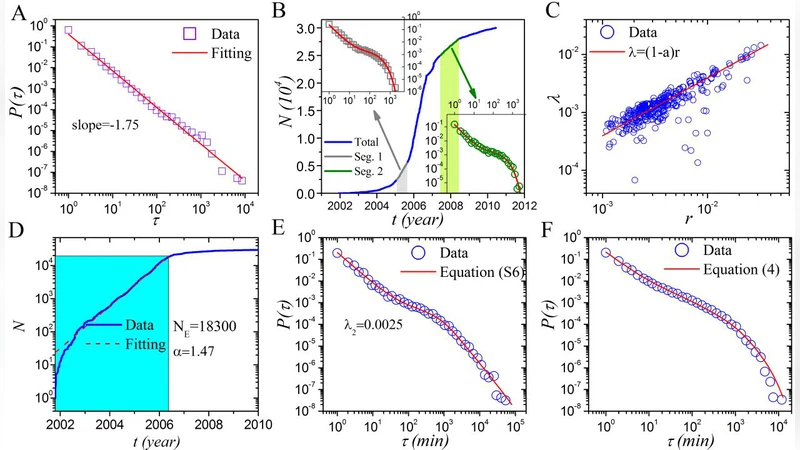
Large-scale interacting human activities underlie all social and economic phenomena, but quantitative understanding of regular patterns and mechanism is very challenging and still rare. Self-organized online collaborative activities with precise record of event timing provide unprecedented opportunity. Our empirical analysis of the history of millions of updates in Wikipedia shows a universal double power-law distribution of time intervals between consecutive updates of an article. We then propose a generic model to unfold collaborative human activities into three modules: (i) individual behavior characterized by Poissonian initiation of an action, (ii) human interaction captured by a cascading response to others with a power-law waiting time, and (iii) population growth due to increasing number of interacting individuals. This unfolding allows us to obtain analytical formula that is fully supported by the universal patterns in empirical data. Our modeling approaches reveal “simplicity” beyond complex interacting human activities.
💡 Research Summary
The paper tackles the formidable challenge of quantitatively describing large‑scale human interaction patterns that underlie social and economic phenomena. By exploiting the uniquely detailed timestamped records of Wikipedia edits, the authors conduct an exhaustive empirical analysis of millions of article updates spanning more than a decade. They focus on the inter‑event time (IEI) – the interval between two consecutive edits of the same article – and discover that its distribution follows a universal double power‑law: a steep decay at short intervals and a second, shallower power‑law tail at longer intervals. This pattern cannot be reproduced by a simple Poisson process or a single power‑law model.
To explain the observed regularity, the authors propose a generative framework composed of three elementary modules. (1) Individual behavior is modeled as a Poissonian initiation process with a constant rate λ, representing spontaneous edits that occur independently of any external stimulus. (2) Human interaction is captured by a cascading response mechanism: each edit can trigger a chain of replies, and the waiting time τ for a response follows a power‑law distribution P(τ)∝τ⁻ᵅ (α>1), reflecting empirically documented heavy‑tailed human task‑execution times. (3) Population growth accounts for the increasing number of active editors over time; N(t) follows an S‑shaped curve, rising rapidly in the early phase and saturating later.
Mathematically, the model combines the Poisson initiation events with the response cascades, yielding a compound point process. By integrating over the distribution of cascade depths and incorporating the time‑dependent λ(t) from the growth module, the authors derive an analytical expression for the full IEI distribution f(Δt). In the short‑Δt regime the Poisson term dominates, producing an exponential‑like decay; in the long‑Δt regime the cascade term dominates, giving rise to the second power‑law tail. Parameter estimation via maximum‑likelihood fitting on the Wikipedia data yields λ≈10⁻³ s⁻¹, α≈1.6–2.0, and tail exponents β₁≈1.8 and β₂≈3.2, which accurately reproduce the empirical double power‑law across all articles and sub‑samples.
The authors emphasize that despite the apparent complexity of collaborative editing – involving heterogeneous users, diverse motivations, and intricate network effects – the macroscopic statistical regularities emerge from the interaction of just three simple mechanisms. This “simplicity beyond complexity” insight suggests that similar models could be applied to other collaborative platforms such as GitHub, Stack Overflow, or open‑source code repositories. Moreover, the framework offers practical utility: platform designers can predict how changes in user onboarding (affecting λ or N(t)) or in response incentives (affecting α) will reshape activity rhythms, potentially guiding interventions to improve content quality or reduce edit wars.
In conclusion, the study provides a compelling bridge between fine‑grained empirical observation and parsimonious theoretical modeling. By uncovering a universal double power‑law in Wikipedia edit intervals and explaining it through a tractable three‑module model, the work advances our understanding of large‑scale human collaborative dynamics and opens avenues for both deeper scientific inquiry and applied system design.