Short Labeling Schemes for Topology Recognition in Wireless Tree Networks
We consider the problem of topology recognition in wireless (radio) networks modeled as undirected graphs. Topology recognition is a fundamental task in which every node of the network has to output a map of the underlying graph i.e., an isomorphic copy of it, and situate itself in this map. In wireless networks, nodes communicate in synchronous rounds. In each round a node can either transmit a message to all its neighbors, or stay silent and listen. At the receiving end, a node $v$ hears a message from a neighbor $w$ in a given round, if $v$ listens in this round, and if $w$ is its only neighbor that transmits in this round. Nodes have labels which are (not necessarily different) binary strings. The length of a labeling scheme is the largest length of a label. We concentrate on wireless networks modeled by trees, and we investigate two problems. \begin{itemize} \item What is the shortest labeling scheme that permits topology recognition in all wireless tree networks of diameter $D$ and maximum degree $\Delta$? \item What is the fastest topology recognition algorithm working for all wireless tree networks of diameter $D$ and maximum degree $\Delta$, using such a short labeling scheme? \end{itemize} We are interested in deterministic topology recognition algorithms. For the first problem, we show that the minimum length of a labeling scheme allowing topology recognition in all trees of maximum degree $\Delta \geq 3$ is $\Theta(\log\log \Delta)$. For such short schemes, used by an algorithm working for the class of trees of diameter $D\geq 4$ and maximum degree $\Delta \geq 3$, we show almost matching bounds on the time of topology recognition: an upper bound $O(D\Delta)$, and a lower bound $\Omega(D\Delta^{\epsilon})$, for any constant $\epsilon<1$.
💡 Research Summary
The paper investigates deterministic topology recognition in wireless (radio) networks that are modeled as undirected trees. In the radio model, communication proceeds in synchronous rounds; in each round a node either transmits a message to all its neighbors or stays silent and listens. A node receives a message only if exactly one of its neighbors transmits in that round. Because nodes start without any identifiers, a labeling scheme—an assignment of binary strings to the nodes—is required to break symmetry and enable any deterministic algorithm to exchange information.
Two fundamental questions are addressed. (1) What is the minimum length of a labeling scheme that guarantees topology recognition for every tree of maximum degree Δ (Δ ≥ 3) and arbitrary diameter D? (2) Using such a minimal scheme, what is the fastest possible deterministic algorithm for topology recognition?
The authors prove that the optimal label length is Θ(log log Δ). The lower bound Ω(log log Δ) is established by constructing a family of trees based on a star with a central node of degree Δ and varying numbers of leaves attached to a distinguished leaf. If the label length were o(log log Δ), the number of distinct label patterns would be insufficient to distinguish all trees in the family, leading to two non‑isomorphic trees that appear identical from the root’s perspective, which contradicts correctness. An upper bound of O(log log Δ) is achieved by explicitly designing a labeling scheme that encodes enough information for the algorithm while keeping the bit‑length within the bound.
For the time complexity, the paper presents an algorithm that works with Θ(log log Δ)‑length labels and completes topology recognition in O(D·Δ) rounds for trees with diameter D ≥ 4 and maximum degree Δ ≥ 3. The algorithm proceeds bottom‑up: each node learns the structure of its subtree and then sends a coded message to its parent. Nodes are classified as “heavy” if their subtree contains at least ¼·(⌈log Δ⌉+1) nodes; otherwise they are “light”. Heavy nodes use the unique labels of a carefully chosen sub‑subtree to encode a transmission round number ρ, ensuring that among siblings exactly one transmits in each round, thus avoiding collisions. Light nodes follow a simple sequential schedule. The root eventually gathers the full tree description, then disseminates it to all nodes. Because each level contains at most Δ children and the height is O(D), the total number of rounds is bounded by O(D·Δ).
A matching lower bound is proved: for any constant ε < 1, any deterministic algorithm that uses a labeling scheme of length Θ(log log Δ) must take at least Ω(D·Δ^ε) rounds on some tree. The construction forces a situation where many siblings must transmit distinct pieces of information, and the limited label size prevents them from coordinating without a number of rounds proportional to a fractional power of Δ.
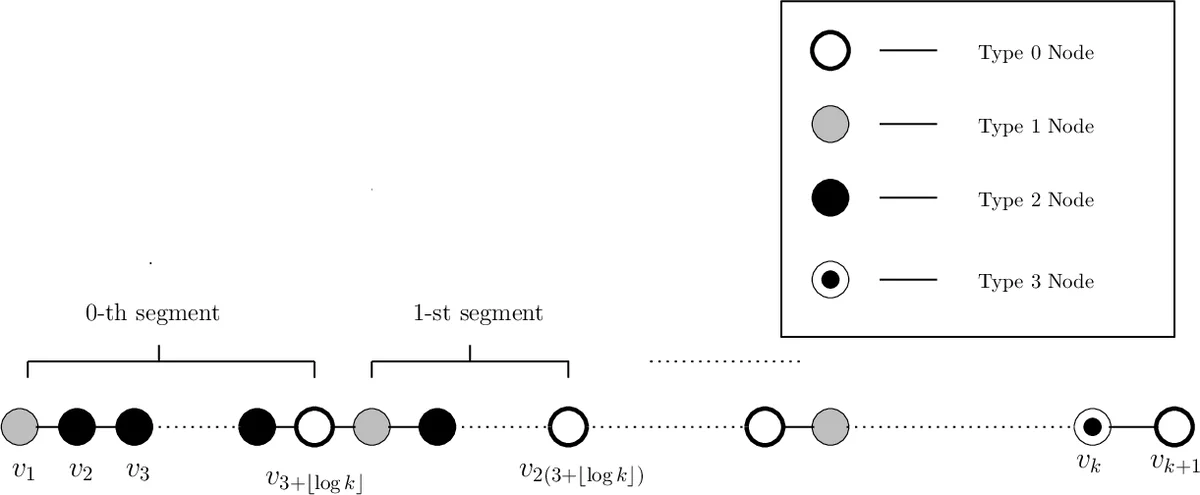
The paper also treats the small‑parameter regimes. For diameter D = 2 or D = 3, topology recognition can be performed in Θ(log Δ·log log Δ) time using the optimal Θ(log log Δ) labels. For Δ = 2 (i.e., line graphs), a constant‑length labeling scheme suffices, and recognition can be done in Θ(log D) rounds.
In the related work discussion, the authors contrast their results with those for wired networks with port numbers, where a single‑bit label and O(D) time are sufficient because collisions do not occur. In the wireless setting, the need to avoid collisions forces both longer labels and higher time complexity, highlighting a fundamental trade‑off between information provided a priori (label size) and communication time.
Overall, the paper quantifies this trade‑off for wireless tree networks: the minimal label size is Θ(log log Δ), and with such labels the optimal deterministic recognition time lies between Ω(D·Δ^ε) and O(D·Δ). The results provide concrete guidelines for designing efficient labeling and communication protocols in radio‑based tree topologies and open several directions for future research, including tighter bounds for the exponent ε, extensions to general graphs, and handling dynamic topology changes.
Comments & Academic Discussion
Loading comments...
Leave a Comment