What Gets Media Attention and How Media Attention Evolves Over Time - Large-scale Empirical Evidence from 196 Countries
It is known that news topics, covered more frequently and over longer periods of time, are considered to be important to the public. Hence, what gets media attention and how media attention evolves over time has been studied for decades in communication study. However, previous studies are confined to a few countries or a few topics, mainly due to lack of longitudinal global data. In this work, we use a large-scale news data compiled from 196 countries to provide empirical analyses of media attention dynamics.
💡 Research Summary
The paper “What Gets Media Attention and How Media Attention Evolves Over Time – Large‑scale Empirical Evidence from 196 Countries” presents a comprehensive, data‑driven investigation of global news‑media dynamics. Using the Unfiltered News dataset (originally compiled by Google Ideas), the authors collected the top k trending topics for each of 196 countries on a daily basis between March 7 and October 9, 2016. For most analyses they set k = 10, which yields a total of 33,911 unique (country, topic) pairs over 211 days. Each topic is annotated with a fine‑grained Schema.org type (e.g., Domestic Country, Foreign Country, Person, SportsTeam, etc.), allowing the authors to study attention at the level of topic categories rather than individual events.
What gets media attention?
By normalising the number of articles per country and computing the proportion of each topic type, the authors find a remarkably stable global hierarchy. Domestic Country dominates with an average share of 74 % of all coverage, followed by Person, SportsTeam, Organization, and other types. This pattern aligns with classic news‑value theories that emphasize geographic relevance, elite or celebrity status, and audience interest in sports and entertainment. The authors also split geographic types into domestic versus foreign, confirming that domestic news still far outweighs foreign coverage (74 % vs. 26 %).
Cross‑country differences
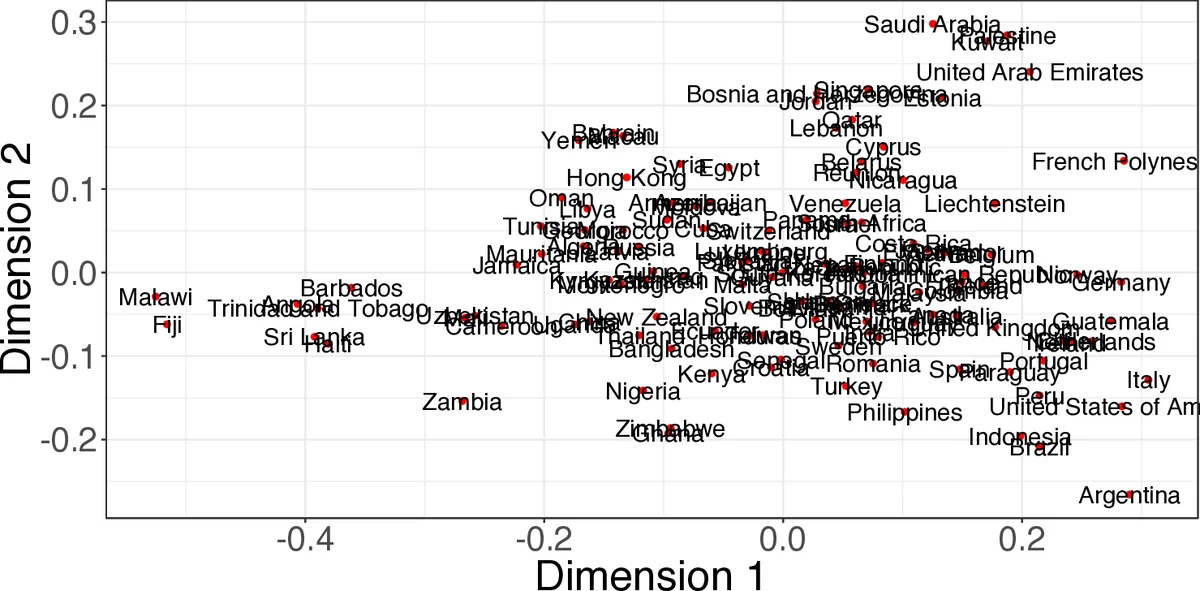
Using classic multidimensional scaling (MDS), each country is placed in a two‑dimensional space based on its topic‑type profile. The resulting map shows clear clusters: Argentina, for example, is person‑oriented, while Saudi Arabia is organization‑oriented. These differences demonstrate that, despite a common global ranking, national media ecosystems prioritize distinct categories, reflecting cultural, political, and economic contexts.
Temporal dynamics – attention span
The authors define “attention span” as the number of consecutive days a topic remains within the top k list for a given country. The theoretical maximum (assuming uniform distribution) would be 8 days, but the empirical median is only 1 day and the mean 2.38 days. In other words, 69 % of topic‑country pairs appear for a single day only. Long‑lasting attention (> 100 days) is observed for domestic geography (countries, major cities), major sports events (e.g., soccer in several European countries), and persistent conflict topics such as terrorism in Syria.
Temporal patterns – clustering of time series
To capture not just span but recurrence, the authors construct a 211‑day time series for each (country, topic) pair, representing daily mention counts. After aligning series (removing leading zeros) and normalising to
Comments & Academic Discussion
Loading comments...
Leave a Comment