Batanins category of pruned trees is Koszul
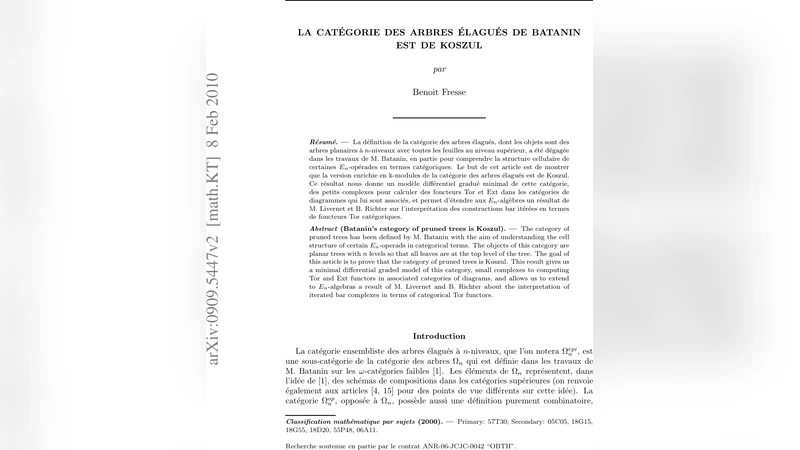
The category of pruned trees has been defined by M. Batanin with the aim of understanding the cell structure of certain E_n-operads in categorical terms. The objects of this category are planar trees with n levels so that all leaves are at the top level of the tree. The goal of this article is to prove that the category of pruned trees is Koszul. This result gives us a minimal differential graded model of this category, small complexes to compute Tor and Ext functors in associated categories of diagrams, and allows us to generalize a recent result of M. Livernet and B. Richter about the interpretation of E_n-homology in terms of categorical Tor functors.
💡 Research Summary
The paper establishes that the category of pruned trees, introduced by M. Batanin to model the cellular structure of certain Eₙ‑operads, is a Koszul category. Objects in this category are planar trees with n levels such that every leaf sits at the top level; morphisms are generated by inserting or collapsing sub‑trees while preserving the planar ordering. The author first gives a precise combinatorial description of these trees and the composition law, showing that the category admits a natural graded structure where the degree records the number of internal vertices.
To prove Koszulity, the work proceeds in two main steps. The first step identifies a quadratic presentation of the category: all relations among generators are shown to be consequences of degree‑two relations, and higher‑order relations can be derived by repeatedly applying these quadratic ones. This is achieved by adapting the Baez‑Dolan identification of tree‑based operadic compositions and by constructing an explicit Gröbner‑type basis for the ideal of relations. The second step verifies that the quadratic presentation satisfies the Koszul criterion, i.e., the associated quadratic dual yields a resolution whose homology is concentrated in a single internal degree. The author constructs the Koszul complex explicitly, checks its exactness using a filtration by tree height, and demonstrates that the resulting minimal differential graded (DG) model has differential only on quadratic generators.
Having a Koszul structure yields a minimal DG model for the category, dramatically simplifying homological calculations. In particular, for any diagram (functor) defined on the pruned‑tree category, the Tor and Ext groups can be computed using a small chain complex whose size is governed by the number of quadratic generators rather than the full combinatorial explosion of all trees. This provides concrete, computationally tractable tools for studying modules over operads encoded by pruned trees.
The paper then applies these results to the theory of Eₙ‑homology. Livernet and Richter previously showed that for the little n‑cubes operad, Eₙ‑homology can be expressed as a categorical Tor functor over a certain tree‑based category. By proving Koszulity for the entire pruned‑tree category, the author extends this interpretation to any operad whose underlying combinatorics can be described by pruned trees. Consequently, Eₙ‑homology for a broad class of operads is now realized as Tor over a Koszul category, allowing the use of the minimal DG model to compute homology groups efficiently.
Finally, the paper discusses further directions. The author suggests that the Koszul framework may be adaptable to more general “pruned” combinatorial structures, such as pruned graphs or higher‑dimensional cell complexes, potentially leading to new Koszul categories in higher‑dimensional algebraic topology. Moreover, the explicit minimal model opens the door to algorithmic implementations, enabling computer‑assisted calculations of operadic (co)homology and facilitating the study of deformation theory for operads built from pruned trees.
In summary, the work provides a rigorous proof that Batanin’s category of pruned trees is Koszul, constructs its minimal DG model, shows how this model yields streamlined Tor/Ext computations, and generalizes the Livernet‑Richter categorical description of Eₙ‑homology to all operads governed by pruned trees. This bridges operadic topology and homological algebra, offering powerful new tools for researchers in both fields.
Comments & Academic Discussion
Loading comments...
Leave a Comment