Hierarchical tissue organization as a general mechanism to limit the accumulation of somatic mutations
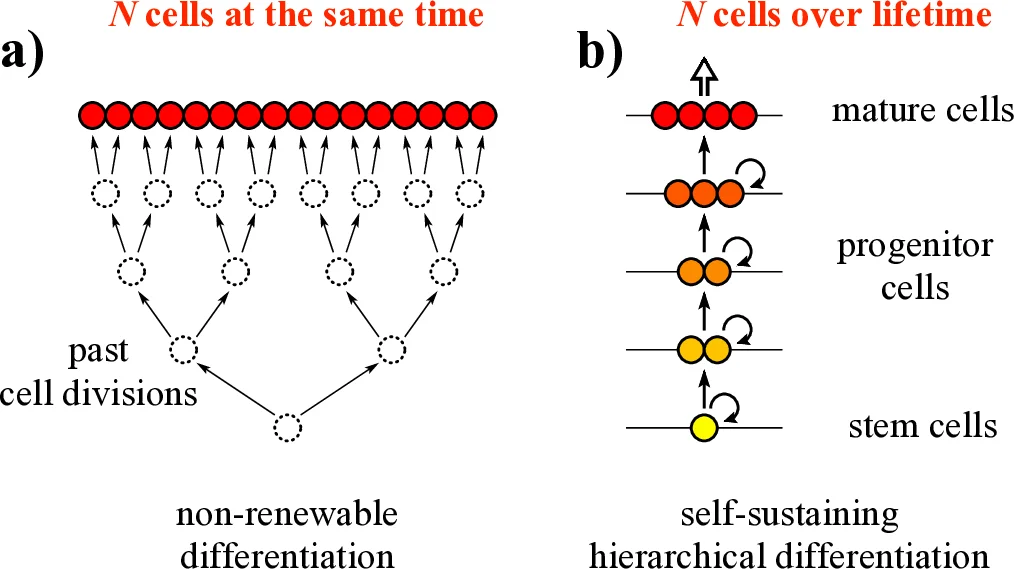
How can tissues generate large numbers of cells, yet keep the divisional load (the number of divisions along cell lineages) low in order to curtail the accumulation of somatic mutations and reduce the risk of cancer? To answer the question we consider a general model of hierarchically organized self-renewing tissues and show that the lifetime divisional load of such a tissue is independent of the details of the cell differentiation processes, and depends only on two structural and two dynamical parameters. Our results demonstrate that a strict analytical relationship exists between two seemingly disparate characteristics of self-renewing tissues: divisional load and tissue organization. Most remarkably, we find that a sufficient number of progressively slower dividing cell types can be almost as efficient in minimizing the divisional load, as non-renewing tissues. We argue that one of the main functions of tissue-specific stem cells and differentiation hierarchies is the prevention of cancer.
💡 Research Summary
The paper addresses a fundamental question in tissue biology: how can multicellular organisms generate and maintain vast numbers of differentiated cells while keeping the number of cell divisions along each lineage—the “divisional load”—low enough to limit the accumulation of somatic mutations that drive cancer? To answer this, the authors construct a minimal yet general mathematical model of hierarchically organized, self‑renewing tissues. The model consists of n + 1 discrete levels: level 0 contains tissue‑specific stem cells, intermediate levels (1 … n‑1) contain progressively differentiated progenitor cells, and level n comprises terminally differentiated cells that no longer divide.
Key variables are the number of cells at each level (Nₖ), the total differentiation rate from level k (δₖ), the fraction of differentiation events that occur via symmetric division (pₖ), and the fraction of replenishment events that come from the level below (qₖ). By considering five possible microscopic events—symmetric division with differentiation, asymmetric division, symmetric division without differentiation, single‑cell differentiation, and cell death—the authors derive a recursion relation for differentiation rates:
δₖ₋₁ = δₖ pₖ qₖ / 2 (1)
and a set of mean‑field differential equations governing the average divisional load Dₖ(t) at each level:
d/dt(Dₖ Nₖ) = (δₖ − δₖ₋₁) − δₖ pₖ Dₖ + δₖ(1 − pₖ) + (δₖ pₖ/2)
Comments & Academic Discussion
Loading comments...
Leave a Comment