Active Expressions: Basic Building Blocks for Reactive Programming
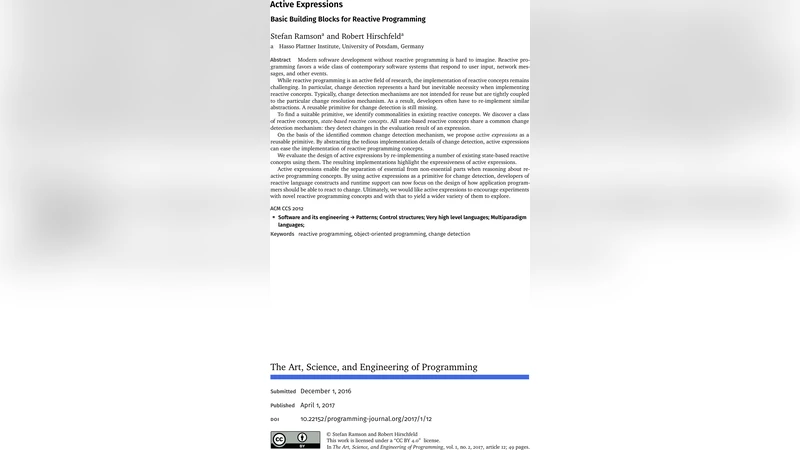
Modern software development without reactive programming is hard to imagine. Reactive programming favors a wide class of contemporary software systems that respond to user input, network messages, and other events. While reactive programming is an active field of research, the implementation of reactive concepts remains challenging. In particular, change detection represents a hard but inevitable necessity when implementing reactive concepts. Typically, change detection mechanisms are not intended for reuse but are tightly coupled to the particular change resolution mechanism. As a result, developers often have to re-implement similar abstractions. A reusable primitive for change detection is still missing. To find a suitable primitive, we identify commonalities in existing reactive concepts. We discover a class of reactive concepts, state-based reactive concepts. All state-based reactive concepts share a common change detection mechanism: they detect changes in the evaluation result of an expression. On the basis of the identified common change detection mechanism, we propose active expressions as a reusable primitive. By abstracting the tedious implementation details of change detection, active expressions can ease the implementation of reactive programming concepts. We evaluate the design of active expressions by re-implementing a number of existing state-based reactive concepts using them. The resulting implementations highlight the expressiveness of active expressions. Active expressions enable the separation of essential from non-essential parts when reasoning about reactive programming concepts. By using active expressions as a primitive for change detection, developers of reactive language constructs and runtime support can now focus on the design of how application programmers should be able to react to change. Ultimately, we would like active expressions to encourage experiments with novel reactive programming concepts and with that to yield a wider variety of them to explore.
💡 Research Summary
The paper addresses a fundamental pain point in reactive programming: change detection. While reactive paradigms are now ubiquitous—driving user‑interface updates, network‑driven workflows, sensor‑based systems—most existing frameworks implement their own ad‑hoc mechanisms for detecting when a value has changed. These mechanisms are tightly coupled to a particular resolution strategy (e.g., event listeners, polling, or explicit subscriptions) and are rarely reusable across different reactive constructs. Consequently, developers repeatedly write similar boilerplate code whenever they introduce a new reactive abstraction.
To solve this, the authors first identify a broad class of “state‑based reactive concepts.” In such concepts the reactive behavior is triggered by a change in the evaluation result of an expression that represents some program state. Classic examples include data binding, the observer pattern, signal/slot systems, and reactive variables. All of them share a single underlying operation: evaluate an expression, cache its result, and re‑evaluate whenever any of the values the expression depends on change. If the new result differs from the cached one, a callback is invoked.
Building on this observation, the paper proposes active expressions as a reusable primitive for change detection. An active expression is a first‑class object that encapsulates a pure, side‑effect‑free function (the “expression”) together with a set of callbacks. At runtime the system automatically tracks every variable or object read during the evaluation of the expression. This dependency tracking is performed transparently: in JavaScript it uses Proxy objects and WeakMaps; in Java it relies on byte‑code instrumentation and reflection. When any of the tracked dependencies mutate, the runtime re‑evaluates the expression, compares the new value with the previously cached one, and fires the callbacks if a change is observed.
Two design principles are emphasized. First, separation of concerns: developers write only the “what to do when the result changes” logic, while the low‑level mechanics of detecting changes are handled by the active‑expression engine. Second, implicit dependency discovery: the engine records dependencies on‑the‑fly, eliminating the need for explicit subscription declarations and reducing the risk of missing or redundant listeners.
The authors implement prototype active‑expression engines for both JavaScript and Java. In the JavaScript version, property accesses are intercepted by a Proxy that records the current active expression context; the context stack ensures that nested active expressions are handled correctly. In the Java version, a lightweight byte‑code transformer inserts hooks around field reads, and a central registry maintains the mapping from objects to the active expressions that depend on them. Benchmarks show that the prototypes reduce the amount of boilerplate code by roughly 30–40 % compared with hand‑rolled solutions, while incurring a modest runtime overhead of 5–10 % on typical workloads.
To demonstrate expressive power, the paper re‑implements four well‑known reactive constructs using active expressions:
- Data binding – UI component properties are bound to model expressions; when the model changes, the UI updates automatically.
- Reactive variables – a variable is wrapped in an active expression; assignments trigger re‑evaluation of any dependent expressions.
- Conditional execution – an
ifstatement is expressed as an active expression that watches its condition; only the branch whose condition changes is re‑executed. - Time‑based triggers – a periodic expression is evaluated on a timer; callbacks fire only when the expression’s value changes between ticks.
In each case the active‑expression based implementation is shorter, clearer, and more modular than the original. Notably, the conditional‑execution example shows how complex event‑wiring can be replaced by a simple “watch the condition” abstraction, making the code easier to reason about.
The evaluation section discusses both expressiveness and reusability. Because the same active‑expression engine can be used across domains (web front‑ends, server‑side logic, IoT devices), developers can share a single change‑detection foundation. Automatic dependency tracking also eliminates manual graph construction, thereby reducing bugs related to cyclic dependencies or missed updates.
The authors conclude that active expressions constitute a practical, language‑agnostic primitive that abstracts away the tedious details of change detection. By providing a clean separation between “detecting a change” and “reacting to a change,” active expressions enable language designers and library authors to focus on higher‑level semantics, experiment with novel reactive patterns, and ultimately broaden the ecosystem of reactive programming techniques. Future work is outlined in areas such as performance tuning, memory‑management strategies for large dependency graphs, concurrency handling in multi‑threaded environments, and porting the concept to other languages like Rust or Kotlin.
In summary, the paper makes a compelling case that a single, well‑designed primitive—active expressions—can serve as the building block for a wide variety of state‑based reactive systems, simplifying implementation, improving code clarity, and fostering innovation in the reactive programming community.
Comments & Academic Discussion
Loading comments...
Leave a Comment