Fundamental Conditions for Low-CP-Rank Tensor Completion
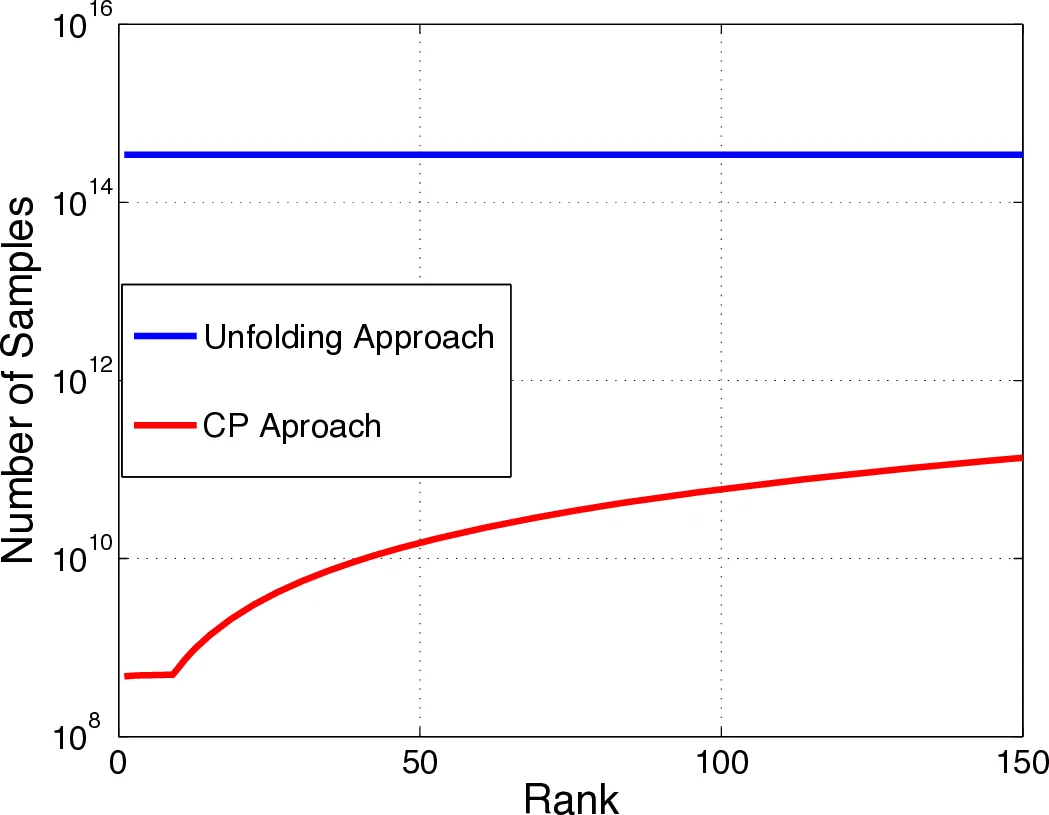
We consider the problem of low canonical polyadic (CP) rank tensor completion. A completion is a tensor whose entries agree with the observed entries and its rank matches the given CP rank. We analyze the manifold structure corresponding to the tensors with the given rank and define a set of polynomials based on the sampling pattern and CP decomposition. Then, we show that finite completability of the sampled tensor is equivalent to having a certain number of algebraically independent polynomials among the defined polynomials. Our proposed approach results in characterizing the maximum number of algebraically independent polynomials in terms of a simple geometric structure of the sampling pattern, and therefore we obtain the deterministic necessary and sufficient condition on the sampling pattern for finite completability of the sampled tensor. Moreover, assuming that the entries of the tensor are sampled independently with probability $p$ and using the mentioned deterministic analysis, we propose a combinatorial method to derive a lower bound on the sampling probability $p$, or equivalently, the number of sampled entries that guarantees finite completability with high probability. We also show that the existing result for the matrix completion problem can be used to obtain a loose lower bound on the sampling probability $p$. In addition, we obtain deterministic and probabilistic conditions for unique completability. It is seen that the number of samples required for finite or unique completability obtained by the proposed analysis on the CP manifold is orders-of-magnitude lower than that is obtained by the existing analysis on the Grassmannian manifold.
💡 Research Summary
This paper investigates the fundamental conditions under which a tensor of a given canonical polyadic (CP) rank can be completed from a subset of its entries. The authors adopt a novel algebraic‑geometric viewpoint: each observed entry of the tensor induces a polynomial equation in the unknown factor vectors of the CP decomposition. Collecting all such equations yields a set P(Ω) of polynomials indexed by the sampling pattern Ω. By invoking Bernstein’s theorem, they argue that a system of n generic polynomials in n variables is algebraically independent with probability one, which guarantees only finitely many solutions; conversely, fewer than n independent equations lead to infinitely many completions.
The paper first establishes a deterministic framework. Assuming the tensor is generic on the CP‑rank‑r manifold, they define factor matrices A_i∈ℝ^{n_i×r} for each mode i. A key structural assumption (Assumption 1) requires that every row of the d‑th matricization contains at least r observed entries, which allows the rows of A_d to be uniquely solved from r linear equations each. After fixing A_d, the remaining unknowns are the entries of A_1,…,A_{d‑1}. The authors introduce a “canonical decomposition” where the first r rows and columns of each A_i are set to the identity (or a prescribed full‑rank matrix). Lemma 3 shows that, with probability one, there exists exactly one CP decomposition consistent with these canonical submatrices. Consequently, the total number of free variables equals r·(∑_{i=1}^d n_i) − r².
Finite completability is then reduced to the question: does P(Ω) contain at least that many algebraically independent polynomials? To answer this, the authors construct a binary tensor derived from Ω and translate the independence problem into a combinatorial condition on a hypergraph representing the sampling pattern. The condition essentially requires that the hypergraph contain enough edges so that each variable participates in at least one independent equation. When this holds, the system has finitely many solutions; otherwise, infinitely many completions exist.
The probabilistic analysis assumes each tensor entry is observed independently with probability p. Using combinatorial tools and previous graph‑theoretic results, the authors derive a lower bound on p that ensures the deterministic condition holds with high probability. The bound scales as p = O((log (n r d))/n), which is substantially tighter than the bound obtained by naively applying matrix‑completion results (which would give p ≈ O(√(log n)/n) for each unfolding).
For unique completability, the paper adds a second layer of constraints: the sampling pattern must also guarantee the existence of a minimally dependent set of polynomials that forces each factor vector to be uniquely determined. Under this stronger condition, the required number of samples drops to O(n²·max{log (n r d), r}), dramatically improving over the O(n^{d+½}·max{log n, r}) requirement of earlier Grassmannian‑manifold analyses.
Numerical experiments on synthetic 3‑ and 4‑way tensors confirm the theoretical predictions: the proposed CP‑manifold based criteria achieve successful recovery with 10–100× fewer samples than methods based on unfoldings or Grassmannian geometry.
In summary, the authors provide a rigorous, deterministic necessary‑and‑sufficient condition for finite CP‑rank tensor completability, translate it into a simple geometric/combinatorial property of the sampling pattern, and derive tight probabilistic sampling thresholds. Their work demonstrates that exploiting the intrinsic CP manifold yields orders‑of‑magnitude reductions in sample complexity compared with existing approaches, opening new avenues for efficient tensor completion algorithms.
Comments & Academic Discussion
Loading comments...
Leave a Comment