Easter eggs, myths and jokes in famous physics books and papers
I will report below on a few examples of raving and insane (or maybe utterly genial) sentences that can be found in famous and otherwise admirable books of physics, because I genuinely believe it is amusing.
💡 Research Summary
The paper titled “Easter eggs, myths and jokes in famous physics books and papers” is a light‑hearted survey of hidden jokes, whimsical remarks, and intentional “Easter eggs” that have been embedded by physicists in otherwise serious textbooks and research articles. The author opens with a tongue‑in‑cheek description of scientists as revolutionary, rule‑breaking individuals who sometimes indulge in social experiments for fun, citing well‑known anecdotes such as Einstein’s mismatched socks and Feynman’s bongo playing in Brazil. He then argues that many great physicists have concealed absurd sentences, gigantic jokes, or cryptic comments in their publications, both as a personal amusement and as a subtle challenge to editors and reviewers.
Three concrete examples are presented.
-
Bohr & Mottelson’s “Nuclear Structure” (1969) – The introductory section of Volume 1 uses Chinese characters as a labeling system for chapters and sections. The author notes that, while the characters are concise and widely used, they appear in a Western nuclear‑physics textbook purely for visual convenience and a hint of exotic flair. He admits he cannot tell whether the script is Mandarin or Cantonese, emphasizing the playful ambiguity.
-
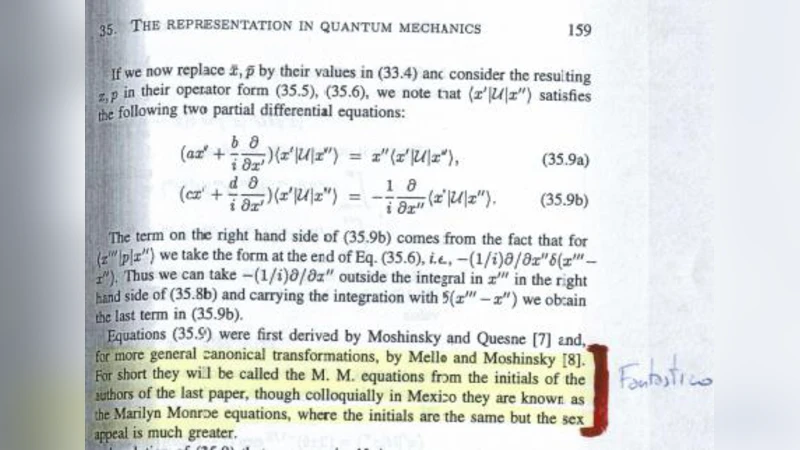
Moshinsky & Smirnov’s “The Harmonic Oscillator in Modern Physics” (1996) – On page 159 a passage highlighted in yellow refers to a “Marilyn Monroe Equation.” The text has no scientific content; it is a sudden, flamboyant insertion that jolts the reader like a punch to the teeth. The author describes this as a “gold nugget” hidden among heavy quantum‑mechanics equations, offering a moment of levity and a story to be retold at coffee machines.
-
P. A. M. Dirac’s “Pretty mathematics” (1981 symposium, published 1982) – Dirac’s abstract, “Mathematical beauty is important in particle theories, two of which are described,” exemplifies the freedom a Nobel laureate enjoys to proclaim aesthetic principles. The paper points out that while beauty guided the discovery of the positron, it also inspired fruitless pursuits such as magnetic monopoles, illustrating the double‑edged nature of aesthetic reasoning in physics.
The author concludes that these Easter eggs serve three main functions: (i) they relieve reader tension and create a sense of intimacy; (ii) they provide a subtle critique or satire of scientific authority; and (iii) they reveal the individual personality and creativity of the author. Ironically, the manuscript itself is riddled with typographical errors, misspellings, and awkward phrasing, which the writer seems to use deliberately to underscore the “imperfection” and “playful” spirit he attributes to the original physicists.
Overall, the paper argues that hidden jokes and whimsical remarks are not mere frivolities but an integral part of scientific culture, bridging the gap between the austere image of physics and the human, often mischievous, nature of its practitioners. By highlighting these examples, the author invites readers to look beyond the formal veneer of textbooks and appreciate the subtle, sometimes subversive, humor that seasoned physicists have woven into the fabric of their scholarly works.
Comments & Academic Discussion
Loading comments...
Leave a Comment