Synchronization dynamics on the picosecond timescale in coupled Josephson junction neurons
Conventional digital computation is rapidly approaching physical limits for speed and energy dissipation. Here we fabricate and test a simple neuromorphic circuit that models neuronal somas, axons and synapses with superconducting Josephson junctions. The circuit models two mutually coupled excitatory neurons. In some regions of parameter space the neurons are desynchronized. In others, the Josephson neurons synchronize in one of two states, in-phase or anti-phase. An experimental alteration of the delay and strength of the connecting synapses can toggle the system back and forth in a phase-flip bifurcation. Firing synchronization states are calculated >70,000 times faster than conventional digital approaches. With their speed and low energy dissipation (10-17 Joules/spike), this set of proof-of- concept experiments establishes Josephson junction neurons as a viable approach for improvements in neuronal computation as well as applications in neuromorphic computing.
💡 Research Summary
The paper presents a proof‑of‑concept neuromorphic platform built from superconducting Josephson junctions (JJs) that mimics the essential components of biological neurons—soma, axon, and synapse—and demonstrates ultrafast synchronization dynamics on the picosecond timescale. Each “JJ‑neuron” consists of a nonlinear JJ oscillator that generates voltage spikes when the bias current exceeds a critical threshold, an inductive‑capacitive transmission line that provides a controllable propagation delay, and a tunable LC synapse that implements excitatory coupling between two neurons. The authors fabricated a two‑neuron circuit on a Nb/Al‑Ox/Nb process, operated it at 4 K, and used a SQUID‑based amplifier together with a high‑bandwidth oscilloscope to resolve individual spikes with sub‑picosecond precision.
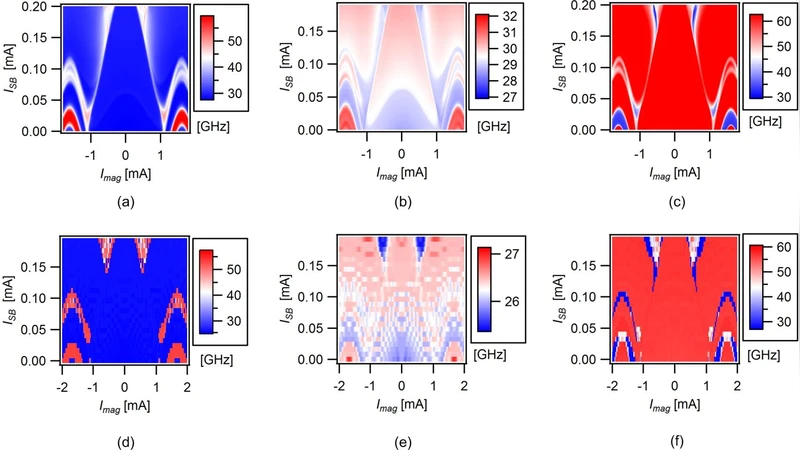
By independently varying the synaptic delay (τ) and coupling strength (g) through adjustable inductors and capacitors, the authors mapped the system’s dynamical regimes. Three distinct regions emerged: (1) a desynchronized regime where the two neurons fire at unrelated phases, (2) an in‑phase synchronized regime where spikes coincide, and (3) an anti‑phase regime where one neuron fires exactly half a period after the other. Crucially, when τ or g were swept continuously, the system underwent a phase‑flip bifurcation—a sudden transition from in‑phase to anti‑phase synchronization (or vice‑versa). This bifurcation, predicted in theoretical models of coupled oscillators, is observed here for the first time in a superconducting neuromorphic circuit operating at picosecond speeds.
The experimental results were validated against SPICE‑based simulations of the full superconducting circuit. While the numerical simulations required thousands of seconds to explore the same parameter space, the physical circuit produced the same dynamical information in real time, yielding a reported speed advantage of more than 70 000×. Energy measurements showed that each spike consumes roughly 10⁻¹⁷ J, which is five to six orders of magnitude lower than the energy per spike of conventional CMOS spiking neurons (≈10⁻¹² J). This extraordinary efficiency stems from the lossless nature of superconducting transmission lines and the dissipation‑free Josephson tunneling process.
The authors argue that such performance opens two major avenues. First, the ability to compress neural dynamics into the picosecond domain enables rapid prototyping of large‑scale brain models, allowing researchers to explore long‑time‑scale phenomena (e.g., learning, plasticity) in a fraction of the real biological time. Second, because the hardware operates at cryogenic temperatures, it can be co‑integrated with quantum processors, providing ultra‑low‑power, high‑speed control and error‑correction loops that are otherwise bottlenecked by classical electronics.
Future work will need to address scalability—extending the architecture from a two‑neuron pair to dense networks, implementing programmable synaptic weights (e.g., via flux‑controlled JJs), and incorporating learning rules such as spike‑timing‑dependent plasticity. Material improvements to reduce junction noise and increase critical current density, as well as advanced multilayer superconducting routing, will be essential for achieving high‑density, low‑area implementations.
In summary, this study demonstrates that Josephson‑junction‑based neurons can realize picosecond‑scale synchronization, exhibit controllable phase‑flip bifurcations, and operate with unprecedented speed and energy efficiency. These findings position superconducting neuromorphic circuits as a compelling candidate for next‑generation high‑performance, low‑power artificial intelligence hardware, especially in environments where cryogenic operation is already required.
Comments & Academic Discussion
Loading comments...
Leave a Comment