Post-Quantum Cryptography: A Zero-Knowledge Authentication Protocol
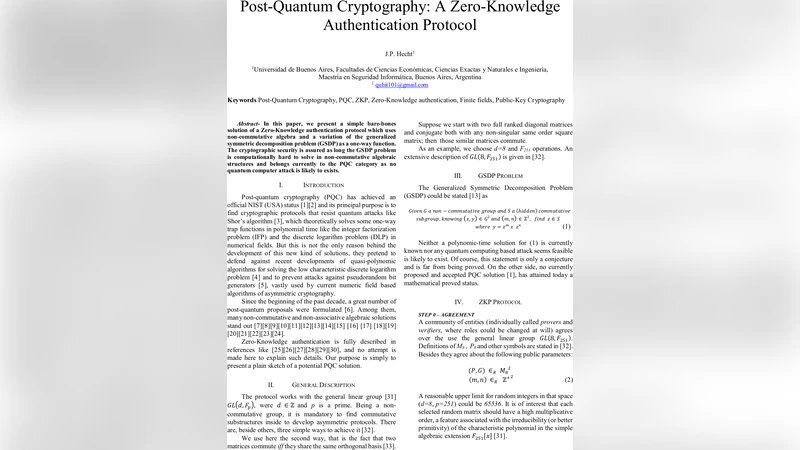
In this paper, we present a simple bare-bones solution of a Zero-Knowledge authentication protocol which uses non-commutative algebra and a variation of the generalized symmetric decomposition problem (GSDP) as a one-way function. The cryptographic security is assured as long the GSDP problem is computationally hard to solve in non-commutative algebraic structures and belongs currently to the PQC category as no quantum computer attack is likely to exists.
💡 Research Summary
The paper proposes a zero‑knowledge authentication (ZKA) protocol that relies on non‑commutative algebraic structures and a problem called the Generalized Symmetric Decomposition Problem (GSDP) as its one‑way function. The authors claim that GSDP is computationally hard both for classical and quantum computers, placing the scheme in the post‑quantum cryptography (PQC) category.
Core Construction
The protocol is built on the general linear group GLₙ over the finite field GF(2⁵¹). The authors fix parameters d = 8 (matrix dimension) and a prime p = 251, which yields a field of size 2⁵¹. Each participant generates a private key by selecting a diagonal matrix with distinct entries and conjugating it with a random non‑singular matrix of the same order. The public key is derived from the private key through the GSDP mapping, which is described only as a symbolic expression without a precise mathematical definition.
Protocol Steps
- Agreement – All parties agree on the public parameters (the group, the field, and the orthogonal basis).
- Key Generation – Private keys (diagonal matrices) are created, and public keys are obtained by applying the GSDP transformation.
- Witness Generation – The prover (Alice) creates a random witness S and sends it to the verifier (Bob).
- Challenge – Bob chooses a random bit b ∈ {0,1} and a question Q. If b = 0, the challenge is independent of the secret; if b = 1, the challenge incorporates the prover’s secret key.
- Response – Alice computes a response R based on S, Q, and possibly her secret key, then sends R to Bob.
- Verification – Bob checks a relation that depends on b. If the relation holds, he accepts Alice’s identity; otherwise he repeats the interaction.
The authors argue that the protocol satisfies the three standard ZKP properties:
- Completeness – An honest prover always convinces an honest verifier.
- Soundness – A cheating prover succeeds with probability at most ½, because the verifier’s challenge bit is uniformly random and the prover cannot answer correctly when b = 1 without knowing the secret.
- Zero‑Knowledge – A simulator can generate a transcript (S, Q, b, R) without knowledge of the secret, by picking random S when b = 0 and constructing S, Q, R from the public data when b = 1.
Security Claims
The security argument rests on the hardness of GSDP. The paper states that no polynomial‑time algorithm (classical or quantum) is known for solving GSDP in the chosen non‑commutative group, and therefore the public data (public keys, witnesses, challenges, responses) leak no information about the private key. The authors estimate a 64‑bit security level for the (d = 8, p = 251) setting, asserting that increasing d linearly increases the security bits (e.g., d = 16 would give ≈127‑bit security).
Critical Assessment
-
Undefined Hard Problem – GSDP is never formally defined. The paper presents a garbled string of symbols instead of a clear mathematical statement, making it impossible to assess its placement in complexity theory or to compare it with known hard problems such as the conjugacy search problem or the hidden subgroup problem.
-
Lack of Rigorous Proofs – The completeness, soundness, and zero‑knowledge claims are supported only by informal arguments and a high‑level description of a simulator. No reductionist proofs (e.g., “if an adversary breaks soundness, then GSDP can be solved”) are provided. Consequently, the protocol’s security rests on an unverified conjecture.
-
Questionable Algebraic Assumptions – The authors claim that two matrices commuting is guaranteed when they share the same orthogonal basis, which is not generally true in GLₙ. No conditions on the basis or on the matrices are given to ensure commutativity, nor is there a discussion of how to efficiently find such a basis.
-
Parameter Selection and Security Level – The security estimate (64 bits for d = 8) is derived by counting the size of the key space, ignoring structural attacks that exploit the algebraic properties of matrix groups (e.g., eigenvalue analysis, reduction to smaller subgroups). No concrete attack model or reduction to known hard problems is presented.
-
Performance and Implementation – The protocol requires multiple matrix multiplications, inverses, and exponentiations in a high‑dimensional non‑commutative group for each authentication round. The paper provides no benchmarks, communication cost analysis, or memory requirements, which are essential for evaluating practicality, especially for resource‑constrained devices.
-
Comparison with Existing Work – While the bibliography lists many non‑abelian group‑based cryptosystems (braid groups, poly‑cyclic groups, etc.), the manuscript does not explain how the proposed scheme improves upon them in terms of security, efficiency, or ease of implementation.
Conclusion
The manuscript introduces an interesting conceptual direction—using a presumed hard problem in a non‑commutative matrix group for zero‑knowledge authentication—but it falls short of the standards required for a scholarly contribution. The core problem (GSDP) lacks a precise definition and hardness proof; the protocol’s algebraic foundations are under‑specified; security arguments are informal; and no experimental or complexity analysis is offered. For the work to be publishable, the authors would need to (i) formally define GSDP and provide evidence of its computational difficulty, (ii) supply rigorous reductions for completeness, soundness, and zero‑knowledge, (iii) clarify the algebraic conditions that guarantee commutativity, (iv) perform a detailed security parameter analysis against known algebraic attacks, and (v) present implementation results that demonstrate feasible performance. Until such developments are made, the protocol remains a speculative proposal rather than a validated post‑quantum authentication scheme.
Comments & Academic Discussion
Loading comments...
Leave a Comment