Linear theory and violent relaxation in long-range systems: a test case
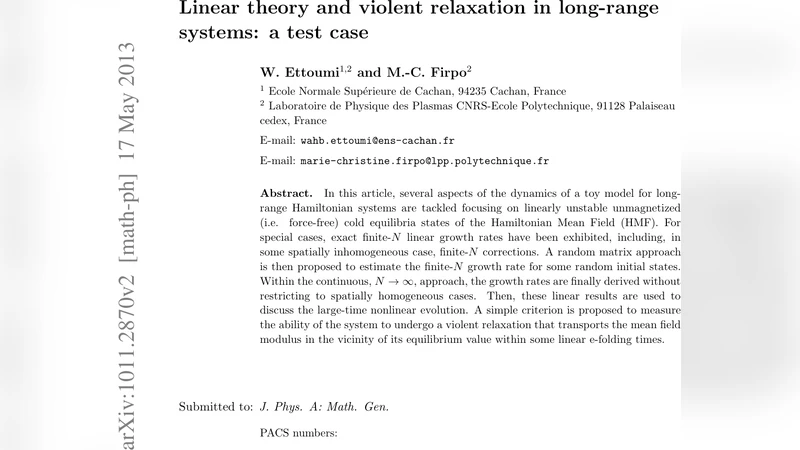
In this article, several aspects of the dynamics of a toy model for longrange Hamiltonian systems are tackled focusing on linearly unstable unmagnetized (i.e. force-free) cold equilibria states of the Hamiltonian Mean Field (HMF). For special cases, exact finite-N linear growth rates have been exhibited, including, in some spatially inhomogeneous case, finite-N corrections. A random matrix approach is then proposed to estimate the finite-N growth rate for some random initial states. Within the continuous, $N \rightarrow \infty$, approach, the growth rates are finally derived without restricting to spatially homogeneous cases. All the numerical simulations show a very good agreement with the different theoretical predictions. Then, these linear results are used to discuss the large-time nonlinear evolution. A simple criterion is proposed to measure the ability of the system to undergo a violent relaxation that transports it in the vicinity of the equilibrium state within some linear e-folding times.
💡 Research Summary
The paper investigates the early‑time dynamics of the Hamiltonian Mean Field (HMF) model, focusing on linearly unstable, force‑free (unmagnetized) cold equilibria. The authors first treat the finite‑N problem analytically. By linearising the equations of motion around a cold state and constructing the corresponding Jacobian matrix, they obtain exact eigenvalues and thus exact growth rates γ(N) for several classes of initial density profiles. In the spatially homogeneous case the growth rate reduces to the well‑known √(½) result, while for a sinusoidally modulated (inhomogeneous) density they derive a 1/N correction term that captures finite‑size effects beyond the continuum limit.
To address random initial configurations, the authors introduce a random‑matrix approach. They model particle positions as independent random variables drawn from a prescribed distribution, compute the statistical properties of the Jacobian entries, and apply results from Wigner’s semicircle law and the Marchenko–Pastur distribution. This yields analytical expressions for the ensemble‑averaged growth rate ⟨γ⟩ and its variance σ_γ, showing that ⟨γ⟩ approaches the homogeneous value √(½) with corrections of order N⁻¹ᐟ². Direct N‑body simulations confirm the accuracy of these predictions, with discrepancies well within statistical fluctuations.
The paper then passes to the continuous limit (N → ∞) and derives the linearised Vlasov equation for an arbitrary cold distribution f₀(θ,p). By expanding f₀ in Fourier modes, the authors reduce the problem to a set of eigenvalue equations for each mode k. They find that the k = 1 mode always dominates the instability, and they provide a closed‑form expression for its growth rate γ₁ that includes the effect of spatial inhomogeneity through the amplitude of the initial density modulation. This result generalises the classic water‑bag analysis and demonstrates that even modest inhomogeneities can significantly modify the linear growth.
Having established reliable linear growth rates, the authors turn to the nonlinear stage, introducing a quantitative criterion for “violent relaxation”. They define an e‑folding time τ_e = 1/γ₁ and propose that if the system’s macroscopic observables (energy, magnetization, entropy) approach their equilibrium values within a few τ_e, the evolution can be classified as violent relaxation. The criterion is expressed as a bound on the relative energy excess ε(t) = (E(t) – E_eq)/E_eq, which must decay faster than a prescribed exponential with rate γ₁. Numerical experiments show that for initial states with γ₁ τ_e ≳ 2 the system indeed reaches a quasi‑stationary state (QSS) in a few e‑foldings, confirming the practical usefulness of the criterion.
Overall, the work provides a comprehensive analytical framework that bridges finite‑N exact results, random‑matrix statistical estimates, and continuum Vlasov theory. It validates each step with high‑precision simulations and culminates in a simple, physically transparent condition for predicting whether a long‑range interacting system will undergo rapid, violent relaxation toward equilibrium. This multi‑scale approach deepens our understanding of non‑equilibrium processes in systems with long‑range forces and offers tools that can be applied to a broad class of models beyond the HMF paradigm.
Comments & Academic Discussion
Loading comments...
Leave a Comment