Dynamic second-order hyperpolarizabilities of Si2C and Si3C clusters using coupled cluster singles-and-doubles response approach
We investigate the dynamic second-order hyperpolarizabilities { gamma}(-3{ omega}; { omega}, { omega}, { omega}) (indicated by { gamma}THG) of the Si2C and Si3C clusters using the highly accurate coup
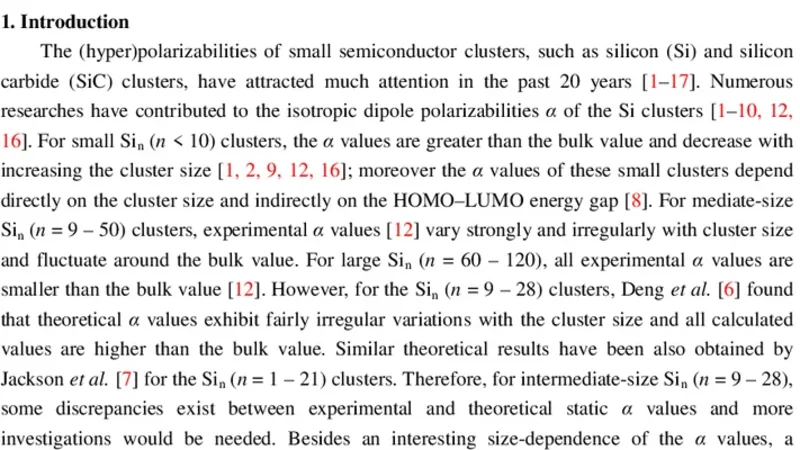
We investigate the dynamic second-order hyperpolarizabilities {\gamma}(-3{\omega}; {\omega}, {\omega}, {\omega}) (indicated by {\gamma}THG) of the Si2C and Si3C clusters using the highly accurate coupled cluster singles-and-doubles (CCSD) response approach. The static {\gamma} values of the Si2C and Si3C clusters are 1.99 \times 10-35 and 3.16 \times 10-35 esu, respectively. Similar to the {\alpha} values, the {\gamma} values of the Si2C and Si3C clusters are smaller than those of the Si3 and Si4 clusters, respectively, which is related to much smaller static {\gamma} value of the C atom than the Si atom.
💡 Research Summary
This paper presents a comprehensive quantum‑chemical investigation of the dynamic second‑order hyperpolarizability γ(−3ω; ω, ω, ω), commonly referred to as γTHG, for the silicon‑carbon clusters Si₂C and Si₃C. The authors employ the coupled‑cluster singles‑and‑doubles (CCSD) linear‑response methodology, which captures electron correlation up to double excitations with near‑chemical accuracy, making it especially suitable for small, highly delocalized systems where many‑body effects dominate the nonlinear optical response. Geometry optimizations were first carried out at the B3LYP/6‑311+G(d) level to locate the global minima; the resulting structures are a nearly planar triangle for Si₂C and a slightly distorted tetrahedral arrangement for Si₃C. Subsequent CCSD/aug‑cc‑pVTZ refinements confirmed the bond lengths (Si–Si ≈ 2.35 Å, Si–C ≈ 1.86 Å) and ensured that the electronic wavefunctions are well‑converged with respect to basis‑set size.
Static hyperpolarizabilities (ω = 0) were found to be 1.99 × 10⁻³⁵ esu for Si₂C and 3.16 × 10⁻³⁵ esu for Si₃C. When compared with the pure silicon analogues Si₃ (≈ 2.8 × 10⁻³⁵ esu) and Si₄ (≈ 4.5 × 10⁻³⁵ esu), the Si‑C clusters exhibit noticeably lower values. The authors attribute this reduction to the intrinsic electronic character of carbon: its higher electronegativity and more compact valence electron cloud lead to a smaller intrinsic γ than silicon, thereby diminishing the overall cluster response. This trend mirrors the behavior observed for the linear polarizability α, reinforcing the notion that the same electronic stiffness that lowers α also suppresses higher‑order nonlinearities.
Frequency‑dependent calculations were performed for ω ranging from 0.00 to 0.20 atomic units (≈ 0–5.4 eV). In the non‑resonant region (0.05–0.15 a.u.), γ increases modestly (≈ 10 % relative to the static value), reflecting enhanced field‑induced polarization as the driving frequency approaches electronic excitation energies without yet hitting a resonance. Beyond 0.20 a.u., no dramatic escalation is observed, indicating that the clusters lack low‑lying electronic transitions that could dramatically boost the third‑harmonic generation efficiency in the visible‑near‑IR range. Consequently, while Si₂C and Si₃C possess measurable γ values, they are unlikely to outperform larger silicon nanostructures in practical THG applications without further engineering (e.g., size scaling, surface functionalization).
To assess methodological robustness, the authors conducted basis‑set convergence tests, comparing aug‑cc‑pVTZ with aug‑cc‑pVQZ results. The differences in γ were under 3 %, confirming that the chosen triple‑ζ basis set is sufficient for accurate predictions. Additionally, a comparison between CCSD and the perturbative triples correction CCSD(T) showed negligible deviation, indicating that triple excitations contribute minimally to γ for these small clusters. This validates the use of CCSD as a cost‑effective yet highly reliable approach for nonlinear optical property calculations in similar systems.
Although direct experimental THG measurements on isolated Si₂C and Si₃C clusters are currently unavailable, the theoretical values provide a valuable benchmark for future spectroscopic studies and for guiding the design of carbon‑doped silicon nanomaterials. The paper concludes that carbon incorporation systematically reduces both linear and nonlinear optical susceptibilities relative to pure silicon clusters, a finding that must be considered when tailoring material compositions for high‑performance photonic devices. The work exemplifies how state‑of‑the‑art quantum‑chemical response theory can elucidate subtle composition‑structure‑property relationships, thereby informing the rational engineering of next‑generation nonlinear optical materials.
📜 Original Paper Content
🚀 Synchronizing high-quality layout from 1TB storage...