A new framework for dynamical models on multiplex networks
Many complex systems have natural representations as multi-layer networks. While these formulations retain more information than standard single-layer network models, there is not yet a fully developed theory for computing network metrics and statistics on these objects. We introduce a family of models of multiplex processes motivated by dynamical applications and investigate the properties of their spectra both theoretically and computationally. We study special cases of multiplex diffusion and Markov dynamics, using the spectral results to compute their rates of convergence. We use our framework to define a version of multiplex eigenvector centrality, which generalizes some existing notions in the literature. Last, we compare our operator to structurally-derived models on synthetic and real-world networks, helping delineate the contexts in which the different frameworks are appropriate.
💡 Research Summary
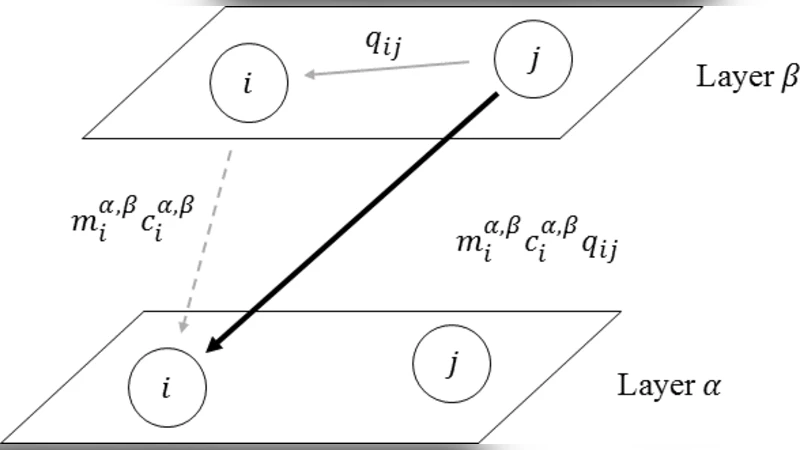
The paper introduces a novel dynamical framework for multiplex (multi‑layer) networks that departs from the prevailing structural approaches such as supra‑adjacency matrices or matched‑sum constructions. Traditional models treat each node as a set of copies—one per layer—and connect these copies with identity links, which can distort dynamical processes when the underlying entity is indivisible. To avoid this distortion, the authors propose to model inter‑layer interactions directly as a flow of information or influence, without creating explicit node replicas.
Formally, each layer α is associated with a standard intra‑layer operator: a Laplacian Lα for diffusion or a stochastic matrix Pα for random walks. Inter‑layer dynamics are encoded in a set of non‑negative coupling matrices Cαβ that specify how much of the activity emerging from layer β is transferred to layer α. The core multiplex operator is then defined as
M = Σα,β Cαβ Lβ (for diffusion)
or
P = Σα,β Cαβ Pβ (for stochastic processes).
The coupling matrices satisfy Σβ Cαβ = 1, ensuring that the total out‑flow from any layer is conserved. This construction yields a family of models that interpolate between two extremes:
-
Equi‑distribution model – all Cαβ are equal (1/k). The resulting operator is spectrally equivalent to the Laplacian of the simple aggregate network (the average of all layers).
-
Unified‑node model – each node’s copies are treated as a single entity; off‑diagonal couplings are 1/(k‑1) and diagonal entries are zero. This model approaches the disjoint‑layers case, where each layer evolves independently but the results are combined only at the final aggregation step.
A third intermediate case, the ranked‑layer model, assigns higher weights to selected layers (e.g., a medical‑trust layer in a social network) to reflect domain‑specific importance.
The authors conduct a thorough spectral analysis of M. They prove that the eigenvalues of M are weighted combinations of the eigenvalues of the individual layer Laplacians. In particular, the second smallest eigenvalue λ2 (the algebraic connectivity) governs the convergence rate of diffusion. They identify regimes where λ2 of the multiplex operator exceeds the maximum λ2 among all single layers—a phenomenon they term “super‑diffusion.” Unlike the supra‑Laplacian, where super‑diffusion appears only when the inter‑layer diffusion constant ω is made very large (i.e., by artificially speeding up inter‑layer transfer), the new framework achieves super‑diffusion through a balanced interplay of layer weights, revealing a more subtle mechanism.
For random walks, the stochastic multiplex operator P inherits stationary distributions that are weighted sums of the layer‑specific stationary vectors. Numerical experiments show that, as the number of layers grows, the mixing time of P remains essentially constant. This contrasts sharply with the supra‑adjacency model, where adding layers creates a dense clique among node copies, dramatically slowing convergence, and with the aggregate model, where mixing accelerates with more layers.
The paper also extends the framework to a multiplex version of eigenvector centrality. By taking the dominant eigenvector of M (or of the corresponding stochastic operator), node importance scores are obtained. The equi‑distribution model yields centralities close to those computed on the aggregate network, while the unified‑node model reproduces scores similar to the disjoint‑layers case. The supra‑adjacency centrality sits at the extreme end, essentially a linear transformation of the disjoint‑layers scores.
Empirical validation is performed on two real‑world multiplex datasets. The first consists of 12‑layer social networks from 75 villages in the Karnakata region of India, collected to study information diffusion about micro‑loan programs. By applying the ranked‑layer model—giving the “medical‑trust” layer higher weight—the authors demonstrate faster and more realistic spread of health‑related information compared with both aggregate and disjoint‑layers baselines. The second dataset is the World Trade Web, where each layer corresponds to a commodity class (e.g., petroleum, machinery). Using the unified‑node model, they find that petroleum‑rich countries obtain markedly higher centrality scores, capturing trade asymmetries that are invisible in the aggregate network. Random‑walk betweenness centrality computed under this model also reveals nuanced pathways of economic influence.
Overall, the paper makes several key contributions:
- It proposes a principled, dynamics‑first construction of multiplex operators that avoids artificial node‑copy artifacts.
- It provides a unified mathematical framework that smoothly interpolates between aggregate and disjoint‑layers extremes via adjustable inter‑layer coupling matrices.
- It delivers rigorous spectral results linking multiplex operator eigenvalues to those of individual layers, explaining convergence rates for diffusion and random walks, and identifying conditions for super‑diffusion.
- It demonstrates practical relevance through extensive simulations and two substantive case studies, showing that the framework can capture domain‑specific layer importance and reveal hidden structural‑dynamic effects.
The work thus offers a versatile toolkit for researchers studying processes on multiplex networks, from epidemiology and information spread to economics and infrastructure, and sets a foundation for future extensions such as temporal multiplexes, adaptive coupling, or higher‑order dynamics.
Comments & Academic Discussion
Loading comments...
Leave a Comment