On determinant representations of scalar products and form factors in the SoV approach: the XXX case
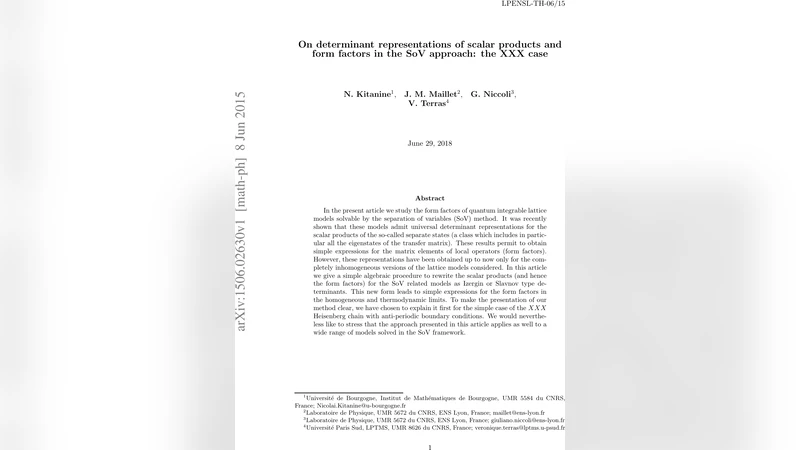
In the present article we study the form factors of quantum integrable lattice models solvable by the separation of variables (SoV) method. It was recently shown that these models admit universal determinant representations for the scalar products of the so-called separate states (a class which includes in particular all the eigenstates of the transfer matrix). These results permit to obtain simple expressions for the matrix elements of local operators (form factors). However, these representations have been obtained up to now only for the completely inhomogeneous versions of the lattice models considered. In this article we give a simple algebraic procedure to rewrite the scalar products (and hence the form factors) for the SoV related models as Izergin or Slavnov type determinants. This new form leads to simple expressions for the form factors in the homogeneous and thermodynamic limits. To make the presentation of our method clear, we have chosen to explain it first for the simple case of the $XXX$ Heisenberg chain with anti-periodic boundary conditions. We would nevertheless like to stress that the approach presented in this article applies as well to a wide range of models solved in the SoV framework.
💡 Research Summary
This paper addresses a long‑standing difficulty in the Separation of Variables (SoV) approach to quantum integrable lattice models: while SoV provides universal determinant representations for scalar products of “separate states” (a class that contains all transfer‑matrix eigenstates), those determinants are expressed in a dressed Vandermonde form that is cumbersome to handle in the homogeneous limit. Consequently, extracting form factors and correlation functions for physically relevant homogeneous or thermodynamic regimes has been problematic.
The authors present a concise algebraic procedure that rewrites the SoV scalar products—and therefore the associated form factors—into the more familiar Izergin‑type and Slavnov‑type determinants. The key insight is that the Vandermonde‑dressed determinants arising in SoV can be systematically transformed, via elementary row‑column operations and polynomial identities, into determinants whose entries are rational functions of the spectral parameters, exactly matching the structure of the six‑vertex model partition function (Izergin determinant) or the scalar product of two Bethe vectors (Slavnov determinant).
To make the method transparent, the paper focuses on the spin‑½ XXX Heisenberg chain with anti‑periodic (twisted) boundary conditions. The model is first formulated in the inhomogeneous setting, introducing generic site‑dependent parameters ξₙ that guarantee the existence of a simple SoV basis (the F‑basis). The transfer matrix T(λ)=B(λ)+C(λ) is shown to be a polynomial of degree N‑1, and its quantum determinant is given explicitly. The SoV basis diagonalizes D(λ), and separate states are constructed by acting with B(ξ_j) on the reference state.
Section 3 derives the universal SoV determinant for the scalar product of two separate states. By applying a sequence of algebraic identities, the authors demonstrate that this determinant equals an Izergin‑type determinant built from the same inhomogeneity parameters. When one of the states satisfies the Bethe equations (i.e., it is an eigenstate of the transfer matrix), the Izergin determinant collapses to a Slavnov‑type determinant, reproducing the well‑known ABA formula for the scalar product of an on‑shell and an off‑shell Bethe vector. This equivalence is proved without invoking any analytic continuation; it follows purely from polynomial manipulations.
Section 4 extends the analysis to form factors of local operators. Using the quantum inverse scattering problem, local spin operators are expressed in terms of the monodromy matrix entries B and C. Their matrix elements between separate states are then obtained by inserting the corresponding operators into the Izergin/Slavnov determinants, yielding compact determinant formulas for the form factors. Crucially, because the determinants are now in Izergin/Slavnov form, the homogeneous limit (ξₙ→0) and the thermodynamic limit (N→∞) become trivial to take, eliminating the previous 0/0 ambiguities.
Section 5 establishes the precise correspondence between the SoV results and those obtained from the Algebraic Bethe Ansatz (ABA). By performing a simple basis change—essentially a σˣ twist—the anti‑periodic XXX chain can be mapped onto the standard periodic chain solved by ABA. Under this map, the SoV separate states become the usual Bethe vectors, and the Izergin/Slavnov determinants derived in the SoV framework coincide exactly with the ABA expressions for scalar products and form factors. This demonstrates that the SoV approach, once the determinant transformation is applied, is fully compatible with the traditional ABA machinery, while offering a more flexible starting point for models where ABA is not directly applicable.
The paper concludes by emphasizing the universality of the method. The algebraic identities used to convert dressed Vandermonde determinants into Izergin/Slavnov form do not rely on specific features of the XXX model; they are expected to hold for XXZ, XYZ, higher‑rank spin chains, and models with non‑trivial integrable boundaries. The authors indicate that a forthcoming publication will treat these extensions. The main achievement is thus a bridge between the SoV and ABA formalisms, providing determinant representations that are both mathematically elegant and practically useful for taking homogeneous and thermodynamic limits, thereby opening the way to systematic calculations of correlation functions, dynamical response functions, and entanglement measures in a broad class of quantum integrable systems.
Comments & Academic Discussion
Loading comments...
Leave a Comment