Comparing simulations of ionisation triggered star formation and observations in RCW 120
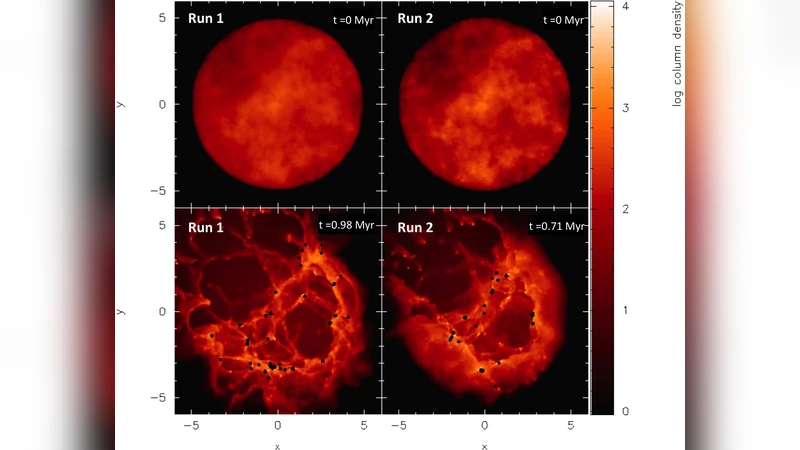
Massive clumps within the swept-up shells of bubbles, like that surrounding the galactic HII region RCW 120, have been interpreted in terms of the Collect and Collapse (C&C) mechanism for triggered star formation. The cold, dusty clumps surrounding RCW 120 are arranged in an almost spherical shell and harbour many young stellar objects. By performing high-resolution, three-dimensional SPH simulations of HII regions expanding into fractal molecular clouds, we investigate whether the formation of massive clumps in dense, swept-up shells necessarily requires the C&C mechanism. In a second step, we use RADMC-3D to compute the synthetic dust continuum emission from our simulations, in order to compare them with observations of RCW 120 made with APEX-LABOCA at 870 micron. We show that a distribution of clumps similar to the one seen in RCW 120 can readily be explained by a non-uniform initial molecular cloud structure. Hence, a shell-like configuration of massive clumps does not imply that the C&C mechanism is at work. Rather, we find a hybrid form of triggering, which combines elements of C&C and Radiatively Driven Implosion (RDI). In addition, we investigate the reliability of deriving clump masses from their 870 micron emission. We find that for clumps with more than 100 M_sun the observational estimates are accurate to within a factor of two and that, even at these long wavelengths, it is important to account for the radiative heating from triggered, embedded protostars.
💡 Research Summary
The paper investigates whether the massive clumps observed in the swept‑up shell of the Galactic H II region RCW 120 necessarily arise from the classic Collect‑and‑Collapse (C&C) triggering mechanism, or whether a more complex interplay of initial cloud structure and radiative feedback can produce a similar morphology. To address this, the authors perform high‑resolution three‑dimensional smoothed particle hydrodynamics (SPH) simulations of an ionising O‑type star (ℒLyC = 10⁴⁹ s⁻¹) embedded at the centre of a fractal molecular cloud. Two cloud realizations are generated using a Fourier‑based algorithm with a fractal dimension D = 2.4 (power‑law index n = 3). The only difference between the runs is the density‑scaling parameter ρ₀, which controls the width of the log‑normal density probability distribution: Run 1 (σ≈0.88, Mach≈2.2) has a relatively narrow PDF, while Run 2 (σ≈1.31, Mach≈4.3) exhibits stronger density contrasts. Both clouds have a total mass of 10⁴ M⊙ and a radius of 5 pc; the ionising source corresponds roughly to an O7.5 ZAMS star.
Radiation is treated with a HEALPix‑based adaptive ray‑splitting scheme under the on‑the‑spot approximation, and gas thermodynamics are modelled with a barotropic equation of state (T = 30 K for low densities, rising adiabatically above ρ_crit = 10⁻¹³ g cm⁻³). The simulations employ 2.5 × 10⁶ SPH particles (mass resolution ≈0.4 M⊙) and a sink‑particle algorithm that creates protostars when the density exceeds 10⁻¹¹ g cm⁻³.
Both runs develop an H II region of ≈5 pc diameter that expands into the inhomogeneous medium, carving an elongated, perforated shell. The shell is not perfectly spherical; low‑density channels allow ionised gas to vent, producing “holes” and a modest population of pillars and EGG‑like structures. As the shell sweeps up material, pre‑existing overdensities are amplified, leading to a clumpy distribution of massive condensations. At the epoch when ≈500 M⊙ of gas has been converted into stars (t ≈ 0.98 Myr for Run 1, 0.68 Myr for Run 2), the simulations contain 79 and 38 sink particles respectively, with masses ranging from ~1 M⊙ to ~40 M⊙. The mean accretion rate onto active sinks is ≈10⁻⁵ M⊙ yr⁻¹, with no clear correlation between sink mass and accretion rate. Run 2, owing to its higher initial density contrast, forms a larger number of massive, rapidly accreting protostars.
To compare directly with observations, the authors post‑process the SPH snapshots with the Monte‑Carlo radiative transfer code RADMC‑3D, generating synthetic dust continuum maps at 870 µm. They adopt the same beam size (19.2″ FWHM) and distance (1.34 kpc) as the APEX‑LABOCA observations of RCW 120. Clumps are identified in the synthetic images, and their masses are estimated using the standard optically thin formula M = F_ν D² / (κ_ν B_ν(T_dust)). The comparison shows that for clumps more massive than ~100 M⊙ the derived masses are within a factor of two of the true simulated masses, confirming that long‑wavelength dust emission can provide reasonably accurate mass estimates for the most massive condensations. However, the authors note that internal heating from embedded protostars raises the dust temperature locally, and neglecting this effect can bias the mass estimates even at 870 µm.
The key scientific conclusions are: (1) A shell‑like arrangement of massive clumps does not uniquely signal the C&C mechanism; the same morphology can arise from the interaction of an expanding H II region with a pre‑existing fractal density field. (2) The simulated clump distribution reproduces the observed configuration around RCW 120, supporting the idea that the observed shell is largely a product of the initial cloud’s non‑uniformity. (3) Star formation in this environment proceeds via a hybrid triggering mode that combines elements of C&C (global shell accumulation and gravitational instability) and RDI (local compression of pre‑existing dense cores by the ionisation front). (4) Masses derived from 870 µm observations are reliable for clumps > 100 M⊙ but must account for radiative heating from embedded sources.
Overall, the work demonstrates that interpreting bubble‑associated star formation solely through the lens of Collect‑and‑Collapse can be misleading. A realistic assessment must consider the fractal nature of molecular clouds, the dynamical evolution of the ionisation front, and the possible coexistence of multiple triggering processes. The methodology—combining high‑resolution SPH with detailed radiative transfer—provides a powerful framework for future studies of triggered star formation in other Galactic bubbles.
Comments & Academic Discussion
Loading comments...
Leave a Comment