The high-conductance state enables neural sampling in networks of LIF neurons
The apparent stochasticity of in-vivo neural circuits has long been hypothesized to represent a signature of ongoing stochastic inference in the brain. More recently, a theoretical framework for neural sampling has been proposed, which explains how s…
Authors: Mihai A. Petrovici, Ilja Bytschok, Johannes Bill
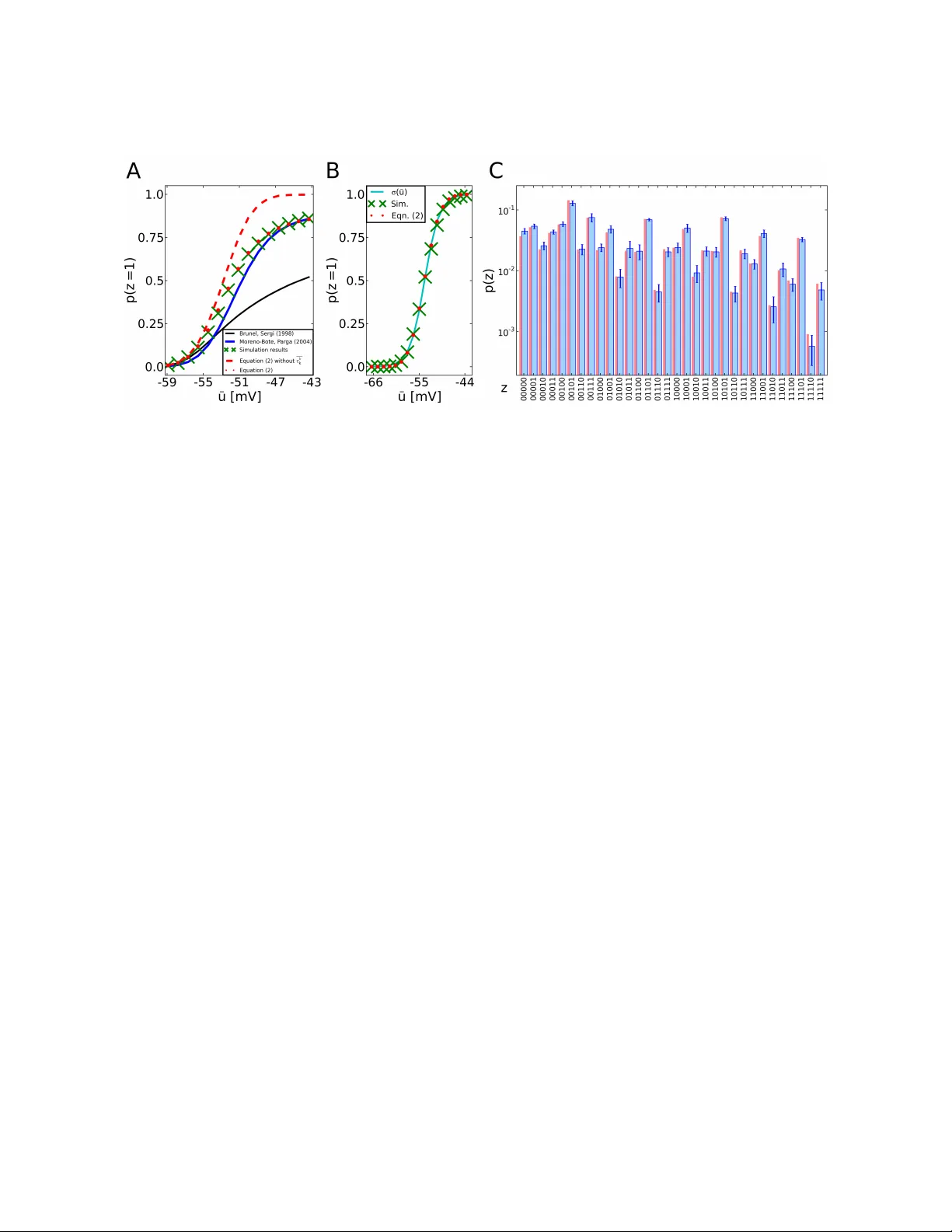
The high-conductance state enables neural sampling in net w orks of LIF neurons Mihai A. P etrovici, Ilja Bytsc hok, Johannes Bill, Johannes Schemmel and Karlheinz Meier ∗ 26.02.2015 The apparent stochasticit y of in-vivo neural circuits has long b een hypothesized to represent a signa- ture of ongoing sto c hastic inference in the brain [1, 2, 3]. More recen tly , a theoretical framew ork for neur al sampling has been proposed, whic h explains ho w sample-based inference can be performed b y netw orks of spiking neurons [4, 5]. One particular requiremen t of this approach is that the membrane potential of these neurons satisfies the so-called neur al c omputability c ondition (NCC) , whic h in turn leads to a lo gistic neur al r esp onse function ν k ( ¯ u k ) : ¯ u k = ln p ( z k = 1 | z \ k ) p ( z k = 0 | z \ k ) = ⇒ ν k ∝ p ( z k = 1 | z \ k ) = 1 1 + exp( − ¯ u k ) , (1) where ¯ u k represen ts the mean free mem brane p oten tial of the neuron. Analytical approac hes to calculating neural response functions ha ve b een the sub ject of man y theo- retical studies. In order to make the problem tractable, particular assumptions regarding the neural or synaptic parameters are usually made. One common assumption is that synaptic time constan ts are negligible ( τ syn → 0 ) compared to the mem brane time constant, whic h, in the diffusion appro ximation, allo ws treating the membrane p oten tial as an Ornstein-Uhlenb e ck (OU) pr o c ess [6]. The particular app eal of this formal equiv alence is that it allo ws calculating the mean first-passage time h T ( ϑ, % ) i of the neural mem brane potential u from the reset potential % to the threshold potential ϑ [7], which is equiv alent to the inv erse of the firing rate ν . This approach can b e further refined by considering nonzero, but small τ syn b y means of an expansion in p τ syn /τ m [8]. How ever, biologically significant activity regimes exist which are not cov ered b y the underlying assumption: Under strong synaptic bombardmen t, as is often the case in cortex, the summation of synaptic conductances shifts the neuron into a high-c onductanc e state (HCS) , whic h is c haracterized b y a v ery fast effectiv e mem brane time constan t τ eff . In this case, the opp osite limit ma y app ear ( p τ syn /τ eff → ∞ ), and the correlation b et ween the mem brane p oten tial b efore and after an output spike b ecomes significan t (Figure 1A, black curv e). The sp ecific limit of τ syn τ m has also been studied [9], alb eit with a differen t approach. In this limit, an adiab atic (or quasistatic) appr oximation can b e made, since the mem brane reacts muc h faster than the synaptic input changes. This allo ws calculating the resp onse function as an integral of the firing rate ˜ ν ( I ) for constan t input current I ov er the probability densit y function (PDF) p ( I syn ) , which, for an OU pro cess, can b e giv en in closed form. The adiabatic assumption, ho wev er, also represents the limitation of this approach. When the synaptic time constants are in the order of the refractory perio d τ ref , the synaptic input curren t is no longer quasistatic with respect to the tim e of s piking compared to the time when the membrane is released from the reset p oten tial (Figure 1A, blue curve). The regime in which τ eff τ syn ∼ τ ref is, how ever, not only biologically relev ant, but also particularly in teresting from a functional p oin t of view. In [5], we hav e shown that LIF neurons that are shifted into a HCS b y background synaptic b om bardment can attain the correct firing statistics (i.e., satisfy the NCC) to sample from well-defined probabilit y distributions. This framework builds on the abstract mo del from ∗ This researc h was supported by EU grants #269921 (BrainScaleS), #237955 (F ACETS-ITN), #604102 (Human Brain Pro ject), the Austrian Science F und FWF #I753-N23 (PNEUMA) and the Manfred Stärk F oundation. 1 [4], whic h explicitly establishes an approximate equiv alenc e of τ ref and τ syn . In order to calculate the resp onse function of neurons in this regime, w e were therefore required to consider a different approach. Here, we present an extended version of this theory , which remains v alid for a larger parameter space. The core idea of this approach is to separately consider tw o different “mo des” of spiking dynamics: burst spiking, where the effectiv e mem brane potential is suprathreshold and the inter-spik e-interv als are close to the refractory time, and transient quiescence, in which the neuron do es not spike for longer p eriods. F or the bursting mo de, we explicitly take into consideration the auto correlation of the membrane p oten tial b efore and after refractoriness by pr op agating the PDF of the effective mem brane p otential from spik e to spike within a burst. F or the membrane p oten tial evolution b et ween bursts, we consider an OU- lik e approximation. The resp onse function can then b e given by ν k = P n nP n τ ref P n P n nτ ref + P n − 1 k =1 τ b k + T n , (2) where P n , T n and τ b k represen t quantities that are asso ciated with a burst length of n spikes and can b e calculated recurs iv ely: P n = 1 − P n − 1 i =1 P i R ∞ ϑ du n − 1 p ( u n − 1 | u n − 1 ≥ ϑ ) h R ϑ −∞ du n p ( u n | u n − 1 ) i , (3) T n = R ∞ ϑ du n − 1 p ( u n − 1 | u n − 1 ≥ ϑ ) h R ϑ −∞ du n p ( u n | u n < ϑ, u n − 1 ) h T ( ϑ, u n ) i i , (4) τ b k = τ eff R ∞ ϑ du k ln % − u k ϑ − u k p ( u k | u k > ϑ, u k − 1 ) . (5) In the limit of small τ eff , we show that the neural activ ation function p ( z k = 1 | I syn ) = ν k τ ref b ecomes symmetric and can b e well approximated by a logistic function, thereby providing the correct dynamics in order to p erform neural sampling (Figure 1B). Such sto c hastic firing units can then b e used to sample from arbitrary probability distributions ov er binary random v ariables (R V s) z k [5, 4, 10, 11]. Figure 1C sho ws a net work of 5 neurons sampling from an exemplary Boltzmann distribution. Inference in these spaces is readily p erformed by injecting a strong curren t into the neurons corresp onding to observed R V s, allo wing the netw ork to sample from the resulting p osterior distribution. This spike-based sampling approac h offers several important adv antages: it allo ws an increasingly accurate representation of the underlying probability distribution at any time (“anytime computing”), marginalization comes at no cost, as it can b e done by simply neglecting the v alues of the “uninteresting” or unobserved R V s, and the physical implemen tation of the sampling algorithm, i.e., the netw ork structure, is massively parallel b y construction. W e thereby provide not only a normativ e framework for Bay esian inference in cortex, but also p ow erful applications of low-pow er, accelerated neuromorphic systems to highly relev ant machine learning problems. References [1] K onrad Körding and Daniel W olpert. Ba yesian integration in sensorimotor learning, Natur e , 2004 [2] József Fizser, Pietro Berk es, Gergő Orbán and Máté Lengy el. Statistically optimal p erception and learning: from b eha vior to neural represen tations, T r ends in Co gnitive Scienc es , 2010 [3] Karl F riston, Jérémie Mattout and James Kilner. A ction understanding and activ e inference, Biolo gic al Cyb ernetics , 2011 2 Figure 1: (A) Prediction of the neural resp onse function for an LIF neuron under Poisson b om bardment of intermediate strength. Existing theories (black and blue curves) do not hold in this regime, due to particular assumed appro ximations. Our theory , based on a propagation of the membrane auto correlation throughout spik e bursts (red dots), accurately repro duces sim ulation results (green crosses). The theo- retical approach presen ted here represents an extension of the one we previously developed in [5] (dashed red curv e). (B) Prediction of the neural response function for an LIF neuron in the HCS (red dots) and sim ulation data (green crosses). In this regime, the resp onse function b ecomes a (linearly transformed) logistic function (cyan curv e). (C) A recurrent net work of 5 LIF neurons in the HCS sampling from a (randomly drawn) Boltzmann distribution. The joint probability distribution sampled by the net work after 10 4 ms (blue bars) is compared to the target distribution (red bars). Errors are calculated ov er 10 differen t trials. [4] Lars Büsing, Johannes Bill, Bernhard Nessler and W olfgang Maass. Neural dynamics as sampling: A model for stochastic computation in recurren t netw orks of spiking neurons PL oS Computational Biolo gy , 2011. [5] Mihai A. Petro vici*, Johannes Bill*, Ilja Bytsc hok, Johannes Schemmel and Karlheinz Meier. Sto c has- tic inference with deterministic spiking neurons, arXiv pr eprint arXiv:1311.3211 , 2013. [6] Luigi M. Ricciardi and Laura Sacerdote. The Ornstein-Uhlen b ec k pro cess as a mo del for neuronal activit y , Biolo gic al Cyb ernetics , 1979. [7] Luigi M. Ricciardi and Shunsuk e Sato. First-passage-time densit y and momen ts of the Ornstein- Uhlen b ec k pro cess, Journal of Applie d Pr ob ability , 1988. [8] Nicolas Brunel and Simone Sergi. Firing F requency of leaky integrate-and-fire neurons with synaptic curren t dynamics, Journal of The or etic al Biolo gy , 1998. [9] Rubén Moreno-Bote and Néstor Parga. Role of synaptic filtering on the firing resp onse of simple mo del neurons, Physic al R eview L etters , 2004. [10] Dejan Pecevski, Lars Büsing and W olfgang Maass. Probabilistic in ference in general graphical models through sampling in sto c hastic netw orks of spiking neurons PL oS Computational Biolo gy , 2011. [11] Dimitri Probst*, Mihai A. Petro vici*, Ilja Bytschok, Johannes Bill, Dejan P ecevski, Johannes Schem- mel and Karlheinz Meier. Probabilistic inference in discrete spaces can b e implemented into netw orks of LIF neurons F r ontiers in Neur oscienc e , 2015. 3
Original Paper
Loading high-quality paper...
Comments & Academic Discussion
Loading comments...
Leave a Comment