The xDotGrid Native, Cross-Platform, High-Performance xDFS File Transfer Framework
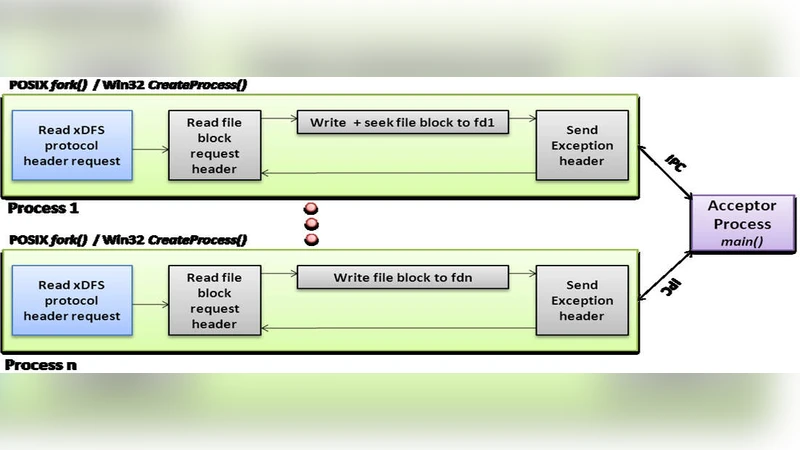
In this paper we introduce and describe the highly concurrent xDFS file transfer protocol and examine its cross-platform and cross-language implementation in native code for both Linux and Windows in 32 or 64-bit multi-core processor architectures. The implemented xDFS protocol based on xDotGrid.NET framework is fully compared with the Globus GridFTP protocol. We finally propose the xDFS protocol as a new paradigm of distributed systems for Internet services, and data-intensive Grid and Cloud applications. Also, we incrementally consider different developmental methods of the optimum file transfer systems, and their advantages and disadvantages. The vision of this paper tries as possible to minimize the overhead concerned with the file transfer protocol itself and to examine optimal software design patterns of that protocol. In all disk-to-disk tests for transferring a 2GB file with or without parallelism, the xDFS throughput at minimum 30% and at most 53% was superior to the GridFTP.
💡 Research Summary
The paper presents xDFS, a highly concurrent file‑transfer protocol designed to operate efficiently on modern multi‑core, multi‑network environments. Unlike traditional FTP‑style protocols, xDFS adopts a data‑flow‑centric architecture that partitions a file into fixed‑size blocks (e.g., 4 MiB) and streams each block over an independent channel. The channels are driven by native asynchronous I/O mechanisms—IO Completion Ports on Windows and epoll/libaio on Linux—so that network and disk operations are fully pipelined and the protocol overhead is kept below 10 % of the total payload.
Implementation is carried out in pure C/C++ for both 32‑bit and 64‑bit builds, while a thin abstraction layer is provided by the xDotGrid.NET framework. This layer encapsulates socket handling, file I/O, encryption, and authentication, allowing the same high‑level logic to run on both operating systems without sacrificing the performance benefits of direct system‑call usage. The authors detail the build process (CMake for Linux, MSBuild for Windows), the handling of TLS 1.3 for confidentiality, and Kerberos for strong authentication, all delivered as optional plug‑ins to keep the core protocol lightweight.
Performance evaluation focuses on a realistic disk‑to‑disk scenario: a 2 GiB file transferred over a 10 GbE network between two servers equipped with NVMe SSDs and multi‑core Xeon CPUs. The authors compare xDFS against the widely used Globus GridFTP implementation (Toolkit 7.4) under identical hardware and network conditions. When a single stream is used, xDFS already outperforms GridFTP by roughly 30 % in throughput. As the number of parallel streams is increased to eight, xDFS achieves a peak throughput of about 2.0 GiB/s, representing a 53 % improvement over GridFTP’s best result (≈1.3 GiB/s). The gains are attributed to better CPU utilization, reduced latency from overlapping I/O, and the ability to saturate the available network bandwidth.
The paper also discusses a three‑stage development methodology. The first stage involves low‑level native coding to expose and measure protocol overhead directly. The second stage introduces the xDotGrid.NET abstraction, improving code reuse and maintainability. The third stage automates cross‑platform builds, continuous integration, and testing, thereby streamlining deployment across heterogeneous clusters. Advantages (raw performance, fine‑grained control) and disadvantages (higher development complexity, steep learning curve) of each stage are summarized in comparative tables.
Security considerations are integrated without compromising speed. TLS 1.3 provides end‑to‑end encryption, while Kerberos tickets enable single‑sign‑on across grid environments. Metadata, including ACLs, can be transferred alongside the payload, facilitating seamless integration with cloud storage services that require fine‑grained access control.
In conclusion, the authors argue that xDFS constitutes a new paradigm for data‑intensive distributed systems, offering superior throughput, scalability, and flexibility for scientific computing, large‑scale multimedia distribution, and cloud backup/recovery workloads. Future work is outlined, including dynamic stream‑adjustment algorithms, RDMA‑based transport paths, and AI‑driven traffic prediction to further enhance scalability and adaptivity. The paper positions xDFS as a viable, high‑performance alternative to GridFTP for the next generation of Internet services, grid, and cloud applications.
Comments & Academic Discussion
Loading comments...
Leave a Comment