Exponential Segregation in a Two-Dimensional Schelling Model with Tolerant Individuals
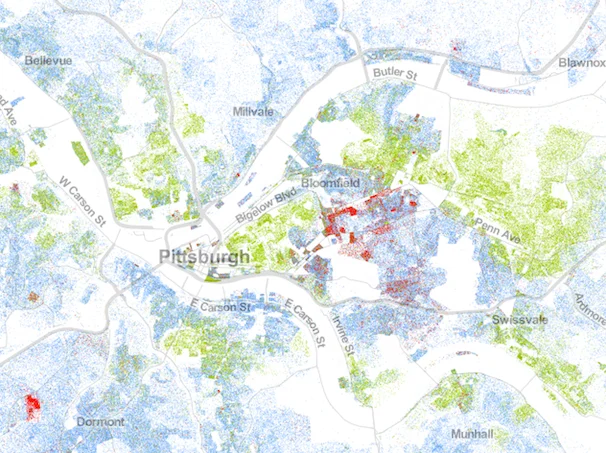
We prove that the two-dimensional Schelling segregation model yields monochromatic regions of size exponential in the area of individuals’ neighborhoods, provided that the tolerance parameter is a constant strictly less than 1/2 but sufficiently close to it. Our analysis makes use of a connection with the first-passage percolation model from the theory of stochastic processes.
💡 Research Summary
The paper provides a rigorous analysis of the classic Schelling segregation model on a two‑dimensional toroidal grid, focusing on the regime where the tolerance parameter τ is a constant strictly less than 1/2 but sufficiently close to it. Each node occupies a site on an n × n lattice and has a “neighbourhood” consisting of all sites within L∞ distance w (a square of side 2w + 1). Initially every node independently chooses a spin +1 or –1 with equal probability. Time evolves in continuous‑time: each node is equipped with an independent Poisson clock of rate 1; when a clock rings the node checks whether it is “unhappy”, i.e., whether the fraction of neighbours sharing its colour is below τ. If unhappy, the node flips its spin. The process stops when no unhappy nodes remain; this occurs almost surely for τ ≤ 1/2.
The main theorem states that for any node x, the expected distance from x to the nearest oppositely‑coloured node in the final stable configuration is e^{Θ(w²)}. Consequently, starting from a random initial configuration, the system almost surely produces monochromatic regions whose linear size is exponential in the neighbourhood area w². Moreover, the expected size of these regions is non‑monotonic in τ: for τ < 1/4 the regions remain O(1), while for τ approaching 1/2 the size grows as e^{Θ((½ − τ)² w²)}. Thus higher tolerance (τ nearer ½) can paradoxically lead to dramatically larger segregation.
The proof proceeds in two conceptual stages. First, the authors identify “viral” nodes: nodes whose neighbourhood bias exceeds a small constant ε (where τ = (1 − ε)/2). Although the probability that a given node is unhappy is e^{-Θ(w²)}, the probability of being viral is only slightly larger, still exponential but sufficiently frequent to matter. When a viral node’s clock rings, it triggers a local “snowball” effect: within O(w) steps the surrounding area becomes monochromatic, forming a small seed cluster.
Second, the authors analyse how these seed clusters expand and compete. They couple the Schelling dynamics to a first‑passage percolation (FPP) process on the same lattice. In FPP, each edge receives an i.i.d. passage time and the infected region grows outward at a deterministic asymptotic shape. By showing that the boundary of a monochromatic cluster evolves essentially like the infection front of an FPP process, they leverage known shape theorems to bound the maximal expansion before encountering an oppositely‑coloured region. The shape theorem implies that, with high probability, a cluster can grow to distance e^{Θ(w²)} before being blocked, which yields the claimed exponential scaling.
The paper situates its contribution relative to prior work. Earlier rigorous results either perturbed the dynamics to obtain an ergodic Markov chain (adding noise or allowing colour swaps) or were limited to one‑dimensional rings. A recent pre‑print by Barmpalias et al. studied a two‑dimensional model but allowed colour changes only when a node left the system and introduced possibly different tolerance thresholds for the two colours; their conclusions either gave total integration or domination by one colour, failing to capture the mixed large‑region patterns observed in simulations. In contrast, the present work analyses the original unperturbed Schelling process, retains symmetric tolerances, and proves the emergence of large, intermingled monochromatic domains.
The structure of the paper is as follows. Section 2 formalises the model, introduces notation (bias, neighbourhood, unhappy condition) and states the main theorem. Section 3 outlines the proof strategy. Sections 4 and 5 develop the two main technical components: the existence and local impact of viral nodes, and the coupling to FPP that controls global spread. Section 6 assembles these ingredients to complete the proof and discusses implications. The authors also remark on the relevance of their findings to urban economics and network science, noting that the exponential growth of segregated patches despite only mild individual preferences provides a theoretical underpinning for the striking segregation patterns seen in real cities and in large‑scale simulations of Schelling’s model.
Comments & Academic Discussion
Loading comments...
Leave a Comment