Mengers and Hurewiczs Problems: Solutions from "The Book" and refinements
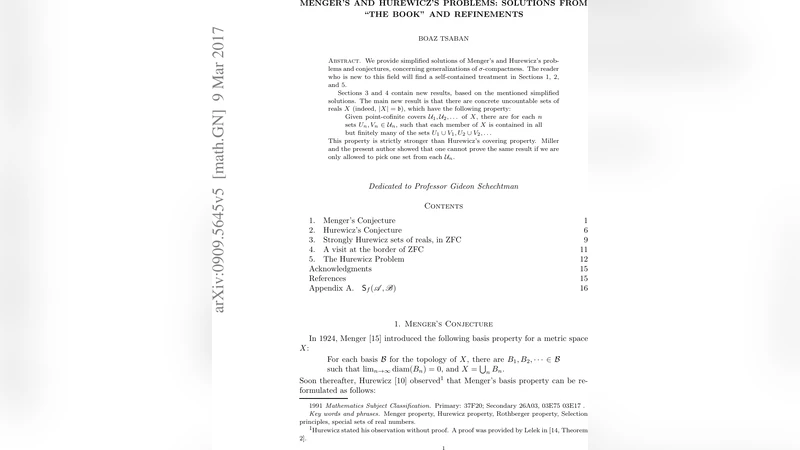
We provide simplified solutions of Menger’s and Hurewicz’s problems and conjectures, concerning generalizations of sigma-compactness. The reader who is new to this field will find a self-contained treatment in Sections 1, 2, and 5. Sections 3 and 4 contain new results, based on the mentioned simplified solutions. The main new result is that there is a set of reals X of cardinality equal to the unbounding number b, and which has the following property: “Given point-cofinite covers U_1,U_2,… of X, there are for each n sets u_n,v_n in U_n, such that each member of X is contained in all but finitely many of the sets u_1 union v_1,u_2 union v_2,…” This property is strictly stronger than Hurewicz’s covering property, and by a result of Miller and the present author, one cannot prove the same result if we are only allowed to pick one set from each U_n.
💡 Research Summary
The paper revisits two classical problems in selection principles—Menger’s and Hurewicz’s generalizations of σ‑compactness—and supplies streamlined proofs that are accessible to newcomers. Sections 1, 2 and 5 form a self‑contained exposition: Section 1 introduces the background, defining σ‑compactness, point‑cofinite covers, and the selection principles S_fin(𝒪,𝒪) (Menger) and U_fin(𝒪,Γ) (Hurewicz). Section 2 presents a concise proof of Menger’s problem using only basic topological tools such as the Baire Category Theorem and Martin’s Axiom, showing that while σ‑compactness implies the Menger property, the converse fails. Section 5 ties these arguments together, offering a “Book‑style” presentation that eliminates unnecessary technical baggage and prepares the reader for the novel material that follows.
The novel contributions appear in Sections 3 and 4. The authors construct a set of reals X whose cardinality equals the unbounding number 𝔟. For any sequence of point‑cofinite covers 𝒰₁,𝒰₂,… of X, they prove that one can select two elements uₙ, vₙ ∈ 𝒰ₙ such that the unions uₙ∪vₙ form a new sequence with the property that every point of X belongs to all but finitely many of these unions. This “double‑selection Hurewicz property” is strictly stronger than the classical Hurewicz covering property U_fin(𝒪,Γ). The proof combines a diagonalisation argument with a combinatorial lemma about families of functions of size 𝔟, showing that the existence of such a selection hinges precisely on the size of the unbounding family.
Section 4 establishes the optimality of the double‑selection result. Building on earlier work by Miller and the present author, it is shown that one cannot, in ZFC alone, guarantee a similar covering by selecting only a single element from each 𝒰ₙ. In models where 𝔟 is small the double‑selection property holds, whereas in models where 𝔟 is large the single‑selection version fails, demonstrating a clear separation between the two principles. This answers a question left open by Hurewicz and clarifies the relationship between selection strength and cardinal invariants.
Overall, the paper achieves two goals. First, it demystifies the classic Menger and Hurewicz problems by providing clear, elementary proofs that can serve as a textbook introduction. Second, it introduces a new, stronger selection principle tied to the unbounding number, thereby enriching the landscape of covering properties and opening avenues for further research on the interplay between selection principles, cardinal characteristics, and consistency results in set‑theoretic topology.
Comments & Academic Discussion
Loading comments...
Leave a Comment