Publication boost in Web of Science journals and its effect on citation distributions
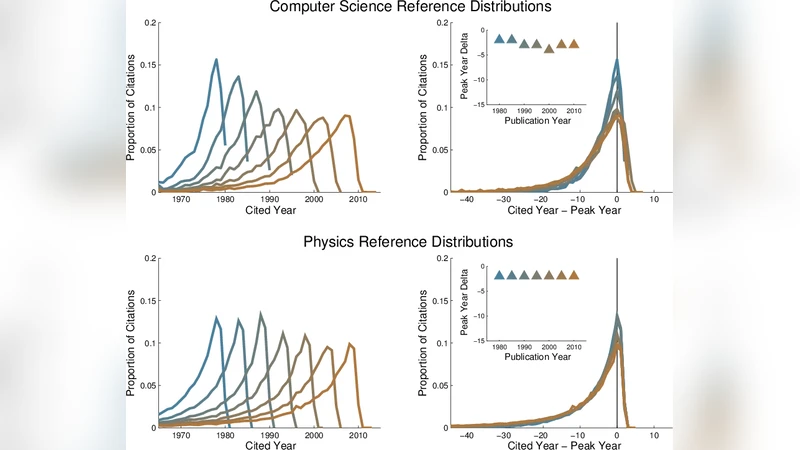
In this paper we show that the dramatic increase in the number of research articles indexed in the Web of Science database impacts the commonly observed distributions of citations within these articles. First, we document that the growing number of physics articles in recent years is due to existing journals publishing more and more papers rather than more new journals coming into being as it happens in computer science. And second, even though the references from the more recent papers generally cover a longer time span, the newer papers are cited more frequently than the older ones if the uneven paper growth is not corrected for. Nevertheless, despite this change in the distribution of citations, the citation behavior of scientists does not seem to have changed.
💡 Research Summary
The paper investigates how the dramatic increase in the number of research articles indexed in the Web of Science (WoS) over recent decades reshapes citation distributions and what this means for bibliometric evaluation. The authors focus on two representative fields—physics and computer science—to illustrate contrasting mechanisms behind article growth. By extracting journal and article counts from WoS for the period 1980‑2020, they show that physics’s surge in article volume is driven almost entirely by existing journals publishing more papers each year, with the total number of physics journals remaining relatively stable. In contrast, computer science experiences a substantial rise in the number of distinct journals, reflecting a field that continuously creates new venues to accommodate rapidly evolving sub‑disciplines and technological trends. This structural difference is linked to disciplinary publishing cultures: physics relies on a few established, high‑impact journals, whereas computer science’s fragmented research landscape encourages the launch of specialty outlets.
The second major contribution is a quantitative analysis of citation patterns in the context of this uneven article growth. The authors compute yearly citation counts for individual papers and introduce a “growth‑adjusted citation metric” that normalizes citation numbers by the annual expansion rate of the article pool. Without adjustment, recent papers appear to receive far more citations on average, a phenomenon that could be misinterpreted as a change in scholarly behavior. After correcting for the expanding denominator, the average citation rates across years flatten, indicating that scientists’ citation practices have remained essentially constant. Moreover, the reference lists of newer papers span a broader temporal window than those of older papers, suggesting that contemporary researchers continue to draw on historical literature despite the influx of new publications.
These findings have several important implications for bibliometric indicators. Metrics such as the h‑index, impact factor, and citation‑based rankings are highly sensitive to the size and growth dynamics of the underlying publication set. Ignoring the growth correction can lead to systematic over‑estimation of recent papers’ impact and to unfair comparisons across time periods or disciplines. The study therefore recommends that evaluators incorporate annual article growth rates when normalizing citation counts, especially in fields where publication volume is expanding unevenly.
Finally, the paper underscores that the observed shift in citation distributions is a statistical artifact of database expansion rather than evidence of a genuine change in scientists’ referencing behavior. Understanding the distinct drivers of article growth in different disciplines enables more nuanced interpretation of citation data and supports the design of fairer, more accurate research assessment frameworks.
Comments & Academic Discussion
Loading comments...
Leave a Comment