Measuring Emotional Contagion in Social Media
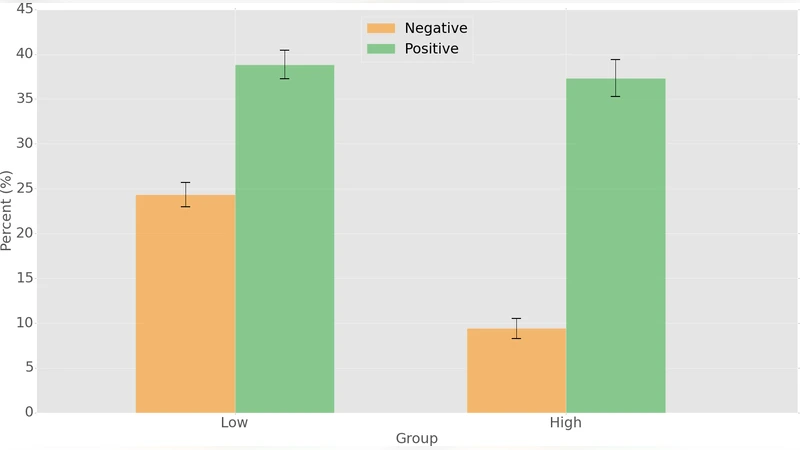
Social media are used as main discussion channels by millions of individuals every day. The content individuals produce in daily social-media-based micro-communications, and the emotions therein expressed, may impact the emotional states of others. A recent experiment performed on Facebook hypothesized that emotions spread online, even in absence of non-verbal cues typical of in-person interactions, and that individuals are more likely to adopt positive or negative emotions if these are over-expressed in their social network. Experiments of this type, however, raise ethical concerns, as they require massive-scale content manipulation with unknown consequences for the individuals therein involved. Here, we study the dynamics of emotional contagion using Twitter. Rather than manipulating content, we devise a null model that discounts some confounding factors (including the effect of emotional contagion). We measure the emotional valence of content the users are exposed to before posting their own tweets. We determine that on average a negative post follows an over-exposure to 4.34% more negative content than baseline, while positive posts occur after an average over-exposure to 4.50% more positive contents. We highlight the presence of a linear relationship between the average emotional valence of the stimuli users are exposed to, and that of the responses they produce. We also identify two different classes of individuals: highly and scarcely susceptible to emotional contagion. Highly susceptible users are significantly less inclined to adopt negative emotions than the scarcely susceptible ones, but equally likely to adopt positive emotions. In general, the likelihood of adopting positive emotions is much greater than that of negative emotions.
💡 Research Summary
The paper investigates whether emotional contagion—a well‑documented psychological phenomenon—occurs on a large‑scale digital platform, specifically Twitter, without resorting to any manipulation of users’ feeds. The authors collect a comprehensive dataset from the last week of September 2014, consisting of 3,800 English‑speaking Twitter users and all tweets posted by their followees during that period. For each tweet authored by a user, they retrieve the set of tweets posted by the user’s followees in the preceding one‑hour window, retaining only those cases where at least 20 such “stimulus” tweets are available. This design ensures a robust representation of the emotional environment each user experienced before posting.
Sentiment analysis is performed with SentiStrength, a tool optimized for short, informal texts. Each tweet receives a positive score (S⁺) and a negative score (S⁻) ranging from 1 (neutral) to 5 (strong). The polarity score S = S⁺ − S⁻, ranging from –4 (strongly negative) to +4 (strongly positive), is used to classify tweets into three categories: negative (S ≤ –1), neutral (S = 0), and positive (S ≥ 1).
To isolate the effect of emotional contagion from confounding factors such as overall activity levels, the authors construct a null model. All stimulus tweets across all users are pooled into a single bucket B. For each observed tweet, they sample with replacement from B a number of tweets equal to the size of that tweet’s stimulus set. This reshuffling destroys any temporal or relational link between a user’s exposure and their subsequent posting while preserving the overall distribution of sentiment in the population. The baseline distribution derived from the null model is 34.44 % positive, 48.27 % neutral, and 17.29 % negative.
Comparing the observed stimulus composition with the baseline reveals systematic over‑exposure: before a negative tweet, users are exposed on average to 21.63 % negative tweets—a 4.34 %p increase over the baseline; before a positive tweet, exposure to positive tweets rises to 38.94 %—a 4.50 %p increase. Neutral tweets show virtually no deviation from the baseline, suggesting no contagion effect in that case. Mann‑Whitney U tests confirm that the differences for positive and negative conditions are highly significant (p < 10⁻⁶).
To capture the intensity of the emotional environment, the authors introduce a “valence” metric V = 2·p − 1, where p is the proportion of positive tweets in a stimulus set and n is the proportion of negative tweets (V ranges from –1 to +1). They compute V for each stimulus window, bin the values into 20 equally spaced intervals, and calculate the average response valence for each bin. The resulting relationship is strikingly linear (R² = 0.975), indicating that the more positive (or negative) the surrounding stream, the more likely the user’s subsequent tweet will reflect that polarity.
Beyond aggregate effects, the study examines individual susceptibility. For each user, the fraction of their tweets that appear to be influenced by emotional contagion is measured. Approximately 80 % of users have ≤50 % of their tweets affected, while the remaining 20 % show contagion influence on >50 % of their posts. Users are split into “highly susceptible” and “scarcely susceptible” groups. Highly susceptible users are significantly less likely to adopt negative emotions than their low‑susceptibility counterparts, yet both groups are equally likely to adopt positive emotions. This asymmetry suggests that negative emotional contagion may be more readily suppressed or moderated at the individual level.
The paper’s contributions are threefold. First, it demonstrates that emotional contagion can be detected in a massive, real‑world social‑media dataset without any experimental manipulation, thereby sidestepping the ethical concerns raised by prior Facebook studies. Second, the reshuffling null model provides a rigorous statistical baseline that isolates contagion from confounding exposure effects. Third, the identification of distinct susceptibility profiles adds nuance to the understanding of how emotions spread online, highlighting that contagion is not uniform across the user population.
Overall, the findings confirm that emotions do indeed “travel” through Twitter’s information streams, with measurable effect sizes (≈4 % over‑exposure) that, while modest at the individual level, become substantial when aggregated across millions of users. The linear valence relationship and the heterogeneous susceptibility patterns have practical implications for platform design, public‑health messaging, and interventions aimed at mitigating the spread of harmful emotional content while promoting positive discourse.
Comments & Academic Discussion
Loading comments...
Leave a Comment