Weighted Random Walk Sampling for Multi-Relational Recommendation
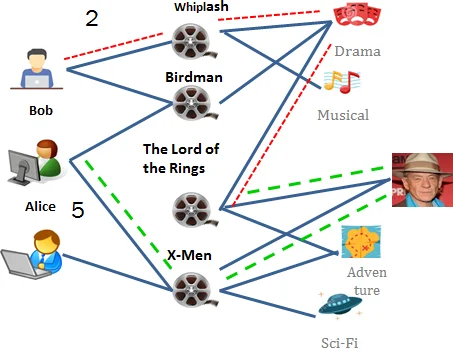
In the information overloaded web, personalized recommender systems are essential tools to help users find most relevant information. The most heavily-used recommendation frameworks assume user interactions that are characterized by a single relation. However, for many tasks, such as recommendation in social networks, user-item interactions must be modeled as a complex network of multiple relations, not only a single relation. Recently research on multi-relational factorization and hybrid recommender models has shown that using extended meta-paths to capture additional information about both users and items in the network can enhance the accuracy of recommendations in such networks. Most of this work is focused on unweighted heterogeneous networks, and to apply these techniques, weighted relations must be simplified into binary ones. However, information associated with weighted edges, such as user ratings, which may be crucial for recommendation, are lost in such binarization. In this paper, we explore a random walk sampling method in which the frequency of edge sampling is a function of edge weight, and apply this generate extended meta-paths in weighted heterogeneous networks. With this sampling technique, we demonstrate improved performance on multiple data sets both in terms of recommendation accuracy and model generation efficiency.
💡 Research Summary
The paper “Weighted Random Walk Sampling for Multi-Relational Recommendation” addresses the challenge of building recommender systems within complex Heterogeneous Information Networks (HINs), where multiple types of nodes (users, items, attributes) are connected by multiple types of relations. A key limitation in prior work is the treatment of weighted edges (e.g., user ratings). Often, these weights are binarized to fit unweighted network analysis techniques, leading to a significant loss of nuanced preference information.
The authors propose a novel method for generating extended meta-paths in weighted HINs. Meta-paths are sequences of relation types (e.g., User-(rates)->Movie-(has)->Genre-(has)->Movie) that define semantic connections between nodes. Their core innovation is a weighted random walk sampling algorithm. When traversing the network according to a predefined meta-path, the algorithm uses a biased sampling strategy specifically for weighted edge types (typically the user-item rating relation). The probability of selecting a particular weighted edge is proportional to e^w, where w is the edge weight. This ensures that paths originating from highly-rated items (high w) are sampled much more frequently than those from poorly-rated items, directly incorporating user preference strength into the path generation process. For unweighted auxiliary relations (e.g., Movie-Genre), uniform sampling is applied.
These sampled meta-paths are used to create new indirect relations between users and items. These relations are then integrated as auxiliary information into a Multi-relational Matrix Factorization (DMF) model. DMF learns latent factor representations for all entities by jointly factorizing the target relation (user-item ratings) and all auxiliary relations, including those derived from the meta-paths.
The experimental evaluation is conducted on three real-world datasets: Yelp (business reviews), Book Crossing (book ratings), and MovieLens (movie ratings). For each, a HIN schema is constructed, and a set of 2-step and 3-step meta-paths starting from the user node are generated using both the proposed weighted sampling method and a standard unweighted expansion method for comparison. The DMF models built from these different path sets are evaluated using recall and precision metrics.
The results demonstrate that the DMF model utilizing weighted random walk sampling consistently outperforms the model using unweighted meta-path expansion across all datasets, particularly for shorter recommendation lists. This confirms the value of preserving weight information. Furthermore, the proposed approach is shown to be competitive with or superior to several state-of-the-art graph-based random walk recommendation algorithms (P3α, RP3β, and a hybrid HeatS/ProbS method). An additional advantage of the sampling approach is its improved efficiency compared to exhaustive meta-path generation, as it requires exploring only a sampled subset of all possible paths.
In conclusion, the paper successfully argues that weighting matters in HIN-based recommendation. The proposed weighted random walk sampling technique provides an effective and efficient mechanism to generate meta-paths that are sensitive to user preference strength, leading to significant gains in recommendation accuracy when used with multi-relational learning models like DMF.
Comments & Academic Discussion
Loading comments...
Leave a Comment