Zone diagrams in compact subsets of uniformly convex normed spaces
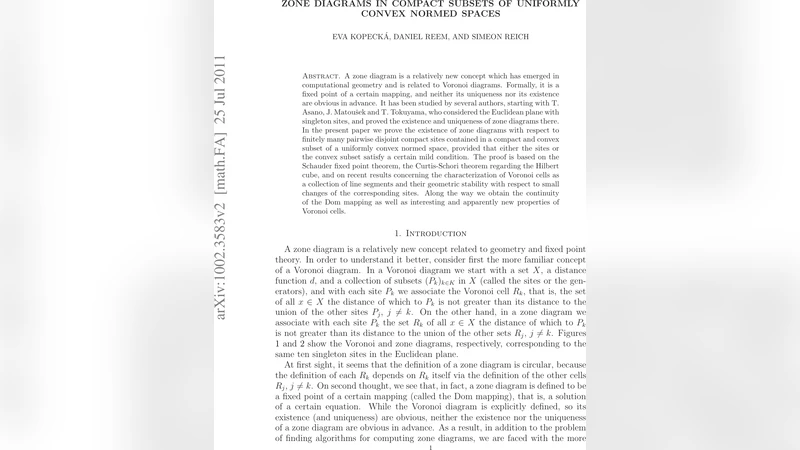
A zone diagram is a relatively new concept which has emerged in computational geometry and is related to Voronoi diagrams. Formally, it is a fixed point of a certain mapping, and neither its uniqueness nor its existence are obvious in advance. It has been studied by several authors, starting with T. Asano, J. Matousek and T. Tokuyama, who considered the Euclidean plane with singleton sites, and proved the existence and uniqueness of zone diagrams there. In the present paper we prove the existence of zone diagrams with respect to finitely many pairwise disjoint compact sites contained in a compact and convex subset of a uniformly convex normed space, provided that either the sites or the convex subset satisfy a certain mild condition. The proof is based on the Schauder fixed point theorem, the Curtis-Schori theorem regarding the Hilbert cube, and on recent results concerning the characterization of Voronoi cells as a collection of line segments and their geometric stability with respect to small changes of the corresponding sites. Along the way we obtain the continuity of the Dom mapping as well as interesting and apparently new properties of Voronoi cells.
💡 Research Summary
The paper investigates the existence of zone diagrams—a relatively recent construct that generalizes Voronoi diagrams—within a broad geometric setting: compact, convex subsets of uniformly convex normed spaces. A zone diagram is defined as a fixed point of a mapping that assigns to each site a region constrained by the regions of all other sites. While previous work by Asano, Matoušek, and Tokuyama established existence and uniqueness for point sites in the Euclidean plane, the behavior of zone diagrams in higher‑dimensional or non‑Euclidean normed spaces remained largely unexplored.
The authors consider a uniformly convex normed space (X) and a compact, convex set (K\subset X). Inside (K) they place finitely many pairwise disjoint compact “sites” (S_1,\dots,S_n). Uniform convexity provides a strong form of strict convexity of the norm, guaranteeing that midpoints of distinct points lie deep inside the unit ball. This property is crucial for two recent geometric results the authors rely on: (i) a characterization of Voronoi cells as unions of line segments, and (ii) a stability theorem stating that small perturbations of the sites induce only small, Lipschitz‑continuous changes in the corresponding Voronoi cells.
The central technical device is the “Dom” mapping. Given a tuple ((A_1,\dots,A_n)) of closed subsets with (A_i\subseteq K), Dom produces a new tuple ((B_1,\dots,B_n)) where each (B_i) is the intersection of the Voronoi cell of (S_i) (computed with respect to the current tuple) with (K). In other words, Dom updates each region by trimming it to the part that is still closer to its own site than to any other site. The authors show that Dom is a continuous self‑map on the product space (\mathcal{K}^n) of compact subsets of (K) equipped with the Hausdorff metric.
To apply a fixed‑point theorem, the authors need a compact, convex, and non‑empty invariant set for Dom. They achieve this by invoking the Curtis‑Schori theorem, which asserts that any non‑empty compact absolute retract is homeomorphic to the Hilbert cube. The product space (\mathcal{K}^n) satisfies the hypotheses, so it is topologically a Hilbert cube. Consequently, Schauder’s fixed‑point theorem guarantees that any continuous self‑map of this space has at least one fixed point.
The existence proof hinges on a mild geometric condition, of which two alternatives are sufficient: (a) each site (S_i) possesses a non‑empty interior relative to (K); or (b) the ambient convex set (K) itself has non‑empty interior. If either condition holds, the Dom mapping sends the product of admissible compact subsets into itself, and a fixed point exists. That fixed point is precisely a zone diagram for the given sites.
Along the way the paper derives several ancillary results. The continuity of Dom is proved directly from the segment‑based description of Voronoi cells and the stability theorem, providing a new, elementary proof of the Lipschitz continuity of Voronoi boundaries with respect to site perturbations. Moreover, the authors uncover new structural properties of Voronoi cells in uniformly convex spaces, such as curvature bounds on cell boundaries and the fact that cell boundaries can be expressed as unions of finitely many line‑segment families. These observations have potential implications for algorithmic geometry, where numerical stability of Voronoi‑based computations is a persistent concern.
In summary, the authors extend the theory of zone diagrams beyond the Euclidean plane to a wide class of normed spaces, establishing existence under very general conditions. Their proof blends topological fixed‑point theory (Schauder, Curtis‑Schori) with recent geometric insights about Voronoi cells, and it yields additional continuity and structural results that may be useful for both theoretical investigations and practical implementations. Future work suggested includes exploring uniqueness, relaxing the uniform convexity assumption, and handling infinite families of sites.
Comments & Academic Discussion
Loading comments...
Leave a Comment