Zone and double zone diagrams in abstract spaces
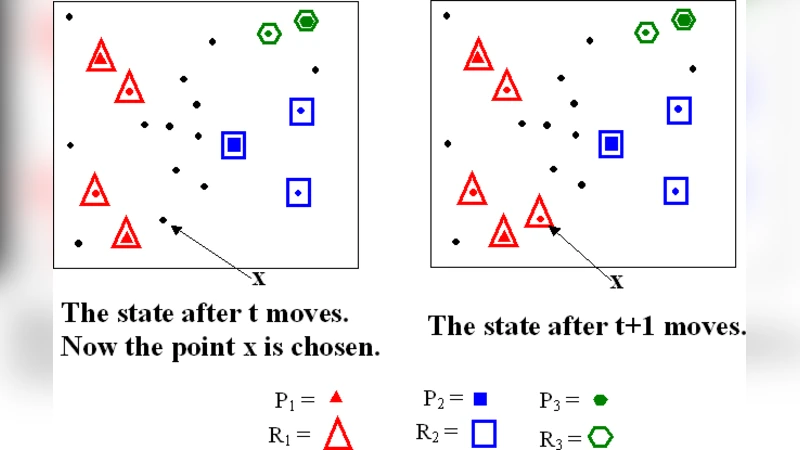
A zone diagram is a relatively new concept which was first defined and studied by T. Asano, J. Matousek and T. Tokuyama. It can be interpreted as a state of equilibrium between several mutually hostile kingdoms. Formally, it is a fixed point of a certain mapping. These authors considered the Euclidean plane and proved the existence and uniqueness of zone diagrams there. In the present paper we generalize this concept in various ways. We consider general sites in m-spaces (a simple generalization of metric spaces) and prove several existence and (non)uniqueness results in this setting. In contrast to previous works, our (rather simple) proofs are based on purely order theoretic arguments. Many explicit examples are given, and some of them illustrate new phenomena which occur in the general case. We also re-interpret zone diagrams as a stable configuration in a certain combinatorial game, and provide an algorithm for finding this configuration in a particular case.
💡 Research Summary
The paper revisits the concept of zone diagrams—a geometric construction originally introduced by Asano, Matoušek, and Tokuyama as a fixed‑point formulation describing an equilibrium among several mutually hostile regions. While the original work was confined to the Euclidean plane, the authors of the present study broaden the setting dramatically by introducing m‑spaces, a simple yet powerful generalization of metric spaces that relaxes symmetry and the full triangle inequality. In this abstract framework, a “site” can be any subset of the space, and the associated region of a site is defined as the set of points that are closer to that site than to any point belonging to the regions of the other sites, with “closer” interpreted via the possibly asymmetric distance function. This definition yields a mapping Φ on the product of region families, and a zone diagram is precisely a fixed point R* = Φ(R*).
The central methodological contribution is a purely order‑theoretic approach. The authors consider the collection of all admissible region families ordered by componentwise inclusion, showing that Φ is monotone with respect to this order. By invoking Zorn’s Lemma and the completeness of the resulting lattice, they prove the existence of both a minimal and a maximal fixed point for any finite family of sites in an arbitrary m‑space. This argument sidesteps the continuity and compactness requirements that dominate earlier proofs in Euclidean settings, thereby delivering a more elementary and widely applicable existence theorem.
Beyond existence, the paper investigates conditions guaranteeing uniqueness. Two main uniqueness theorems are established: (1) if the underlying m‑space satisfies a strong triangle inequality and the sites are pairwise disjoint, then the fixed point is unique; (2) if the distance is symmetric and each site is a closed ball, uniqueness also follows. To demonstrate that these conditions are not merely technical, the authors construct explicit counterexamples in non‑symmetric m‑spaces where multiple distinct zone diagrams arise. They further introduce the notion of a double zone diagram—the result of applying Φ twice, i.e., R** = Φ(Φ(R)). In contrast to ordinary zone diagrams, double zone diagrams may admit several distinct solutions even when the original mapping has a unique fixed point, revealing a new layer of combinatorial complexity.
A particularly innovative aspect of the work is the reinterpretation of zone diagrams as stable configurations in a two‑player combinatorial game. Players alternately expand or contract the region of a chosen site according to the same distance‑based rule; the game terminates precisely when a fixed point of Φ is reached, which is then a Nash equilibrium of the game. This perspective not only provides an intuitive explanation of the equilibrium nature of zone diagrams but also leads to an algorithmic contribution. For finite m‑spaces modeled by weighted graphs, the authors devise a dynamic‑programming‑style algorithm that iteratively refines candidate regions, converging to the minimal (or maximal) fixed point in polynomial time—specifically O(n·m·log m), where n is the number of sites and m the number of vertices.
The paper is richly illustrated with examples. Classical Euclidean instances recover the known unique zone diagram, while asymmetric distance examples on the line and on directed graphs exhibit multiple fixed points, confirming the theoretical non‑uniqueness results. Double zone diagram examples highlight how the second iteration can split the space into qualitatively different partitions, a phenomenon absent in the classical setting.
In conclusion, the authors deliver a unifying framework that extends zone diagrams to a broad class of abstract spaces, replaces analytic arguments with clean order‑theoretic reasoning, and uncovers new phenomena such as non‑uniqueness and double fixed points. The game‑theoretic interpretation and the accompanying polynomial‑time algorithm open avenues for practical applications in wireless network cell planning, robot swarm territory allocation, and other domains where asymmetric distance measures naturally arise. Future work suggested includes numerical approximation schemes for continuous m‑spaces, higher‑dimensional extensions, and deeper exploration of the strategic aspects of the associated combinatorial game.
Comments & Academic Discussion
Loading comments...
Leave a Comment