Factoring Odd Integers without Multiplication and Division
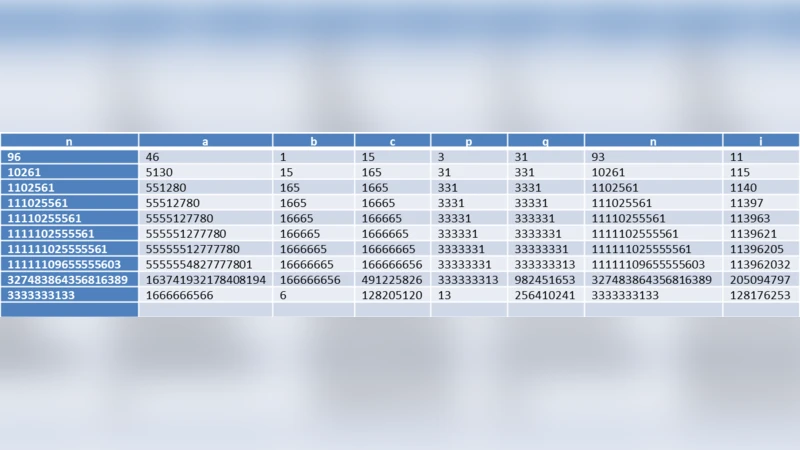
A method of determining two factors of an odd integer without need of multiplication or division operation in iterative portion of computation is presented. It is feasible for an implementing algorithm to use only integer addition and subtraction throughout. Presentation of material is non-theoretical; intended to be accessible to a broader audience of non academic and theoretical practitioners.
💡 Research Summary
The paper “Factoring Odd Integers without Multiplication and Division” proposes an algorithm that factors odd integers using only integer addition, subtraction, and bit‑shifts in its iterative core, deliberately avoiding multiplication and division operations. The author begins by recalling the elementary fact that any integer n can be expressed as a product a·b, noting that even n are trivially factored because one factor must be even. The challenge, therefore, lies in handling odd n.
To address this, the author rewrites an odd integer n as n = 2k + 1 and further decomposes k into a form involving two unknown integers p and q, ultimately arriving at a set of equations (labelled 2.1) that relate n, a, b, p, and q. By algebraic manipulation a linear Diophantine equation (2.2) in the unknowns p and q is obtained. This equation still contains a multiplication term p·q, which the author seeks to eliminate.
Section 3 introduces a “difference expression” (2.3) that iteratively adjusts p and q toward a solution. Starting from initial guesses p₀ and q₀, the algorithm increments or decrements each variable based on the sign of a residual term, stopping when the product p·q matches n or when no further improvement is possible. The iteration is claimed to be monotonic in a certain sense, though the paper admits the sequence is not strictly decreasing.
The crucial contribution appears in Section 4, where the author shows how to replace the multiplication p·q with an expression that uses only addition, subtraction, and squaring: p·q =
Comments & Academic Discussion
Loading comments...
Leave a Comment