A simulation of the Neolithic transition in the Indus valley
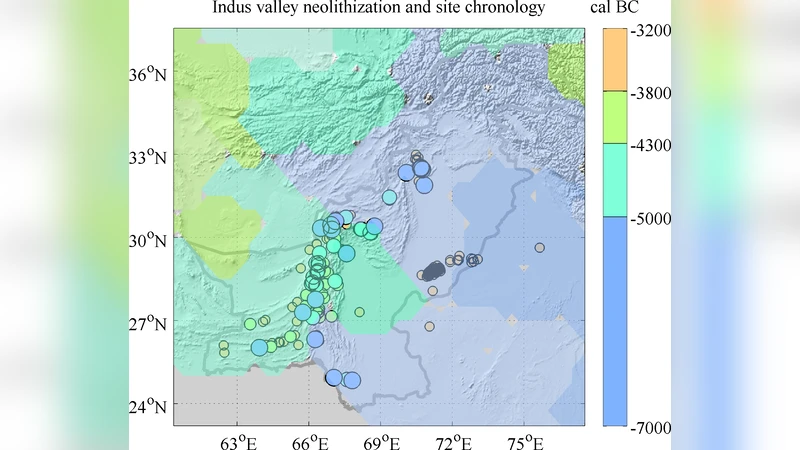
The Indus Valley Civilization (IVC) was one of the first great civilizations in prehistory. This bronze age civilization flourished from the end of the fourth millennium BC. It disintegrated during the second millennium BC; despite much research effort, this decline is not well understood. Less research has been devoted to the emergence of the IVC, which shows continuous cultural precursors since at least the seventh millennium BC. To understand the decline, we believe it is necessary to investigate the rise of the IVC, i.e., the establishment of agriculture and livestock, dense populations and technological developments 7000–3000 BC. Although much archaeological information is available, our capability to investigate the system is hindered by poorly resolved chronology, and by a lack of field work in the intermediate areas between the Indus valley and Mesopotamia. We thus employ a complementary numerical simulation to develop a consistent picture of technology, agropastoralism and population developments in the IVC domain. Results from this Global Land Use and technological Evolution Simulator show that there is (1) fair agreement between the simulated timing of the agricultural transition and radiocarbon dates from early agricultural sites, but the transition is simulated first in India then Pakistan; (2) an independent agropastoralism developing on the Indian subcontinent; and (3) a positive relationship between archeological artifact richness and simulated population density which remains to be quantified.
💡 Research Summary
The paper presents a quantitative simulation of the Neolithic transition in the Indus Valley using the Global Land Use and technological Evolution Simulator (GLUES). While the decline of the Indus Valley Civilization (IVC) has been extensively studied, the processes that led to its emergence—particularly the spread of agriculture, livestock husbandry, population growth, and technological innovation between 7000 and 3000 BC—remain poorly understood. The authors address this gap by applying GLUES, a socio‑technological model that integrates climate‑driven resource availability, demographic dynamics, and cultural traits across 685 biogeographic regions worldwide.
In the model each region is characterized by four state variables: population density (P), technology level (T), the share of agropastoral activities (Q), and economic diversity (N). Population growth rate depends on resource availability (E), which is derived from Net Primary Productivity (NPP) and modulated by abrupt climate events identified from 124 global paleo‑climate proxies. The simulation starts at 9500 sim BC with a low‑intensity foraging baseline (4 % farming, minimal technology). A region is considered to have transitioned to agropastoralism when Q exceeds 0.5.
Results show an east‑west gradient of transition dates. The earliest simulated transitions occur in western India (Rajasthan, Gujarat, Ganges basin) before 5600 sim BC, followed by southern Sindh and northern Pakistan (Punjab, Kashmir) before 5000 sim BC. By the Developed Neolithic (BBM) phase, most of the Indus basin has adopted agriculture, with the Punjab and northern Baluchistan transitioning before 4700 sim BC and northern Sindh before 4500 sim BC. The latest transitions, during the Togau phase, appear in the eastern model domain (central Afghanistan, the Pakistan‑Afghanistan‑Iran triangle) between 4300 and 3800 sim BC.
The simulated timing aligns reasonably with radiocarbon dates from early agricultural sites, especially in Baluchistan and southern Sindh, supporting the model’s ability to capture broad regional patterns. However, the model predicts earlier transitions along the Indus, Ghaggar‑Hakra, and Punjab rivers than archaeological evidence currently shows; the authors attribute this discrepancy to possible site loss in the dynamic floodplain or to yet‑undiscovered early settlements.
A key contribution is the demonstrated positive correlation between simulated population density and archaeological artifact richness, using the Indus Google Earth Gazetteer (≈2 000 artifacts from 368 sites). After correcting for taphonomic bias, regions with higher modeled populations exhibit greater artifact counts, suggesting that demographic intensity left a measurable material signature.
The paper also discusses methodological limitations. First, cultural diffusion and migration are simplified; although GLUES includes a “knowledge loss” parameter, it does not explicitly model trade networks, language spread, or social institutions that likely shaped the Neolithic transition. Second, climate forcing relies on coarse global proxies, which may miss local micro‑climatic variations that could have driven finer‑scale agricultural adoption. Third, the paucity of archaeological data from the intermediate zones between the Indus and Mesopotamia hampers robust validation. Finally, the model assumes a rapid dominance of agropastoralism once Q exceeds the threshold, whereas archaeological records indicate prolonged coexistence of foraging and farming for several centuries.
Despite these caveats, the study provides three major insights: (1) an independent South Asian agricultural center likely emerged in western India before spreading eastward; (2) demographic expansion and material culture density are tightly linked, offering a quantitative bridge between simulation and the archaeological record; and (3) abrupt climate events, as encoded in the resource availability term, play a measurable role in modulating the pace of the transition. The authors recommend future work incorporating high‑resolution regional climate reconstructions, explicit cultural‑network modeling, and new radiocarbon datasets to refine the timing and mechanisms of the Neolithic transition in the Indus Valley.
Comments & Academic Discussion
Loading comments...
Leave a Comment