Correct Convergence of Min-Sum Loopy Belief Propagation in a Block Interpolation Problem
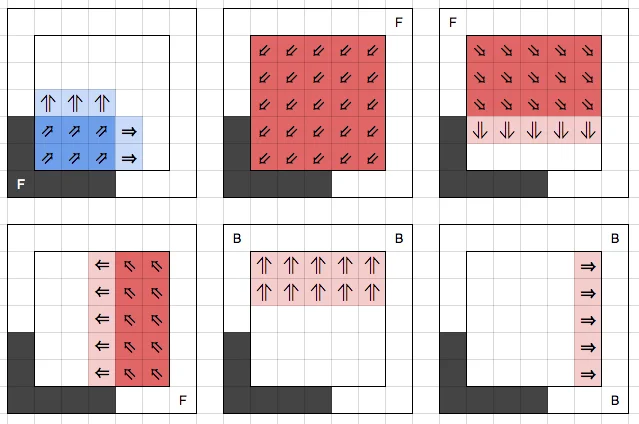
This work proves a new result on the correct convergence of Min-Sum Loopy Belief Propagation (LBP) in an interpolation problem on a square grid graph. The focus is on the notion of local solutions, a numerical quantity attached to each site of the graph that can be used for obtaining MAP estimates. The main result is that over an $N\times N$ grid graph with a one-run boundary configuration, the local solutions at each $i \in B$ can be calculated using Min-Sum LBP by passing difference messages in $2N$ iterations, which parallels the well-known convergence time in trees.
💡 Research Summary
The paper investigates the convergence behavior of Min‑Sum Loopy Belief Propagation (LBP) for a binary Ising model defined on an N × N grid graph, focusing on the MAP interpolation problem where the interior nodes B must be inferred from a prescribed boundary configuration x∂B. The authors introduce the notion of a “local solution” oi = Oi(−1) − Oi(+1), where Oi(·) denotes the minimal number of odd bonds (disagreements) among all interior configurations that fix node i to a given spin. This quantity tells whether a node is forced to be +1, forced to be −1, or can take either value in some optimal global configuration.
To avoid numerical overflow, the standard two‑scalar messages Mj→i(±1) are replaced by their difference m = M(−1) − M(+1). The update rule for these difference messages becomes remarkably simple: each message at iteration n is the sign of the sum of incoming messages from the other three neighbors at iteration n − 1. Formally, mⁿ_{j→i} = sign(∑{k∈∂j\i} mⁿ⁻¹{k→j}), with boundary messages equal to the prescribed spin xj. The estimate of the local solution at node i is then \hat{o}i = ∑{j∈∂i} m_{j→i}.
The main technical contribution is a rigorous proof that, when the boundary configuration is a “one‑run” (i.e., all +1 spins on the boundary form a single connected component), the difference messages converge to their correct values within exactly 2N iterations, regardless of the presence of cycles in the grid. This matches the convergence time for tree‑structured graphs, where the diameter dictates the number of required passes.
The proof proceeds by first recalling that on trees, Min‑Sum BP converges after a number of iterations equal to the tree’s diameter plus one (Proposition 5). For the grid, the authors develop two lemmas—Forward Convergence and Backward Convergence—that describe how messages become fixed in rectangular sub‑regions of the grid. In the forward phase, messages emanating from the four corners propagate inward; after a number of steps proportional to the size of the rectangle, all messages inside that rectangle are either +1, −1, or 0. In the backward phase, these fixed regions expand outward toward the boundary, eventually covering the whole interior B. The total number of steps required is bounded by 2N, which is only two more than the grid’s diameter (2N − 2).
A crucial ingredient is the explicit characterization of the global MAP solutions for one‑run boundaries, previously derived in
Comments & Academic Discussion
Loading comments...
Leave a Comment