Gamma-ray emission from globular clusters
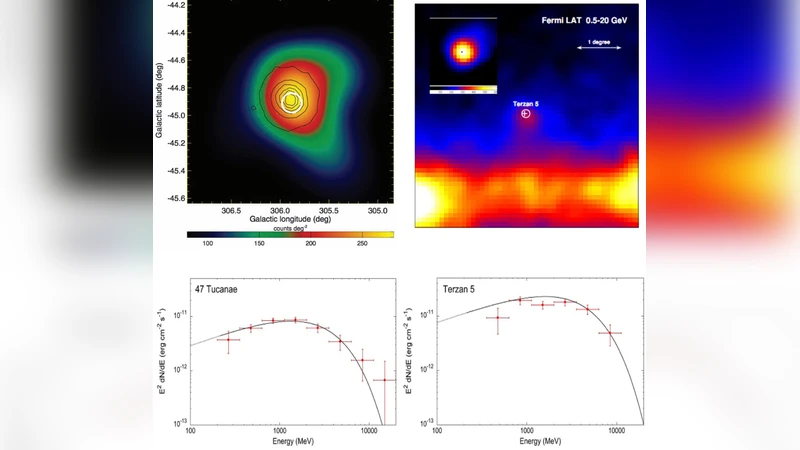
Over the last few years, the data obtained using the Large Area Telescope (LAT) aboard the Fermi Gamma-ray Space Telescope has provided new insights on high-energy processes in globular clusters, particularly those involving compact objects such as Millisecond Pulsars (MSPs). Gamma-ray emission in the 100 MeV to 10 GeV range has been detected from more than a dozen globular clusters in our galaxy, including 47 Tucanae and Terzan 5. Based on a sample of known gamma-ray globular clusters, the empirical relations between gamma-ray luminosity and properties of globular clusters such as their stellar encounter rate, metallicity, and possible optical and infrared photon energy densities, have been derived. The measured gamma-ray spectra are generally described by a power law with a cut-off at a few gigaelectronvolts. Together with the detection of pulsed gamma-rays from two MSPs in two different globular clusters, such spectral signature lends support to the hypothesis that gamma-rays from globular clusters represent collective curvature emission from magnetospheres of MSPs in the clusters. Alternative models, involving Inverse-Compton (IC) emission of relativistic electrons that are accelerated close to MSPs or pulsar wind nebula shocks, have also been suggested. Observations at >100 GeV by using Fermi/LAT and atmospheric Cherenkov telescopes such as H.E.S.S.-II, MAGIC-II, VERITAS, and CTA will help to settle some questions unanswered by current data.
💡 Research Summary
Over the past several years, observations with the Large Area Telescope (LAT) aboard the Fermi Gamma‑ray Space Telescope have opened a new window onto high‑energy phenomena in Galactic globular clusters (GCs). This paper presents a comprehensive analysis of LAT data, focusing on the detection, spectral characterization, and physical interpretation of gamma‑ray emission from more than a dozen GCs, with particular emphasis on the well‑studied systems 47 Tucanae and Terzan 5.
The authors first establish that the gamma‑ray flux from these clusters is detected in the 100 MeV–10 GeV band with high statistical significance. The spectra of all detected GCs are well described by a power‑law with an exponential cut‑off at a few giga‑electronvolts (GeV). This spectral shape mirrors that of individual millisecond pulsars (MSPs), suggesting that the observed emission is the collective curvature radiation from the magnetospheres of many MSPs residing in the dense stellar environments of GCs. The detection of pulsed gamma‑ray signals from two individual MSPs—one in 47 Tuc and one in Terzan 5—provides direct confirmation of this collective‑MSP hypothesis.
Beyond the spectral analysis, the paper explores empirical correlations between the gamma‑ray luminosity (Lγ) of a GC and several cluster‑level properties: the stellar encounter rate (Γ), metallicity (
Comments & Academic Discussion
Loading comments...
Leave a Comment