Isomorphisms in Multilayer Networks
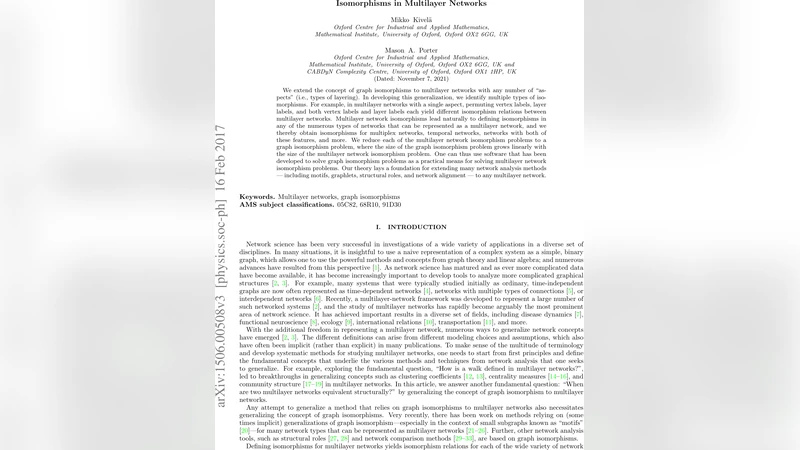
We extend the concept of graph isomorphisms to multilayer networks with any number of “aspects” (i.e., types of layering). In developing this generalization, we identify multiple types of isomorphisms. For example, in multilayer networks with a single aspect, permuting vertex labels, layer labels, and both vertex labels and layer labels each yield different isomorphism relations between multilayer networks. Multilayer network isomorphisms lead naturally to defining isomorphisms in any of the numerous types of networks that can be represented as a multilayer network, and we thereby obtain isomorphisms for multiplex networks, temporal networks, networks with both of these features, and more. We reduce each of the multilayer network isomorphism problems to a graph isomorphism problem, where the size of the graph isomorphism problem grows linearly with the size of the multilayer network isomorphism problem. One can thus use software that has been developed to solve graph isomorphism problems as a practical means for solving multilayer network isomorphism problems. Our theory lays a foundation for extending many network analysis methods — including motifs, graphlets, structural roles, and network alignment — to any multilayer network.
💡 Research Summary
The paper “Isomorphisms in Multilayer Networks” extends the classical notion of graph isomorphism to the far more general setting of multilayer networks, which can have any number of “aspects” (i.e., independent dimensions of layering such as time, interaction type, geographic location, etc.). The authors first formalize a multilayer network as a quadruple M = (Vᴹ, Eᴹ, V, L), where V is the set of physical vertices, L = {L₁,…,L_d} is the collection of elementary‑layer sets for each aspect, Vᴹ ⊆ V × L₁ × … × L_d is the set of vertex‑layer tuples that actually exist, and Eᴹ ⊆ Vᴹ × Vᴹ is the edge set. This representation captures multiplex networks, temporal networks, interconnected networks, and many other structures as special cases.
Three families of isomorphisms are defined:
-
Vertex‑isomorphism – only the vertex labels may be permuted (via a bijection γ ∈ S_V) while all layer labels stay fixed. This is a direct analogue of ordinary graph isomorphism applied to the multilayer setting.
-
Layer‑isomorphism – only the layer labels may be permuted (via a bijection δ ∈ S_Ĺ) while vertex labels remain unchanged. The authors distinguish full layer maps (all aspects may be permuted) from partial layer maps (only a selected subset of aspects is allowed to change).
-
Vertex‑layer‑isomorphism – a combined permutation ζ = (γ, δ) that simultaneously relabels vertices and layers. Because vertex and layer permutations commute, the order of application is irrelevant.
These definitions naturally give rise to corresponding automorphism groups: the set of permutations that map a multilayer network onto itself. The paper shows that multilayer automorphism groups can be far richer than those of ordinary graphs, reflecting symmetries across both vertex and layer dimensions.
The central computational contribution is a linear‑size reduction of any multilayer isomorphism problem to a vertex‑colored graph isomorphism problem. The reduction proceeds by (i) creating a new vertex for each vertex‑layer tuple (v, α), (ii) preserving the original edges between these new vertices, and (iii) assigning colors that encode the original vertex identity and the layer identity (or a combination thereof). The resulting colored graph G has |Vᴹ| vertices and |Eᴹ| edges, i.e., its size grows linearly with the size of the original multilayer network. Consequently, deciding whether two multilayer networks M and M′ are isomorphic under any of the three notions is equivalent to checking whether their corresponding colored graphs G and G′ are isomorphic. This places multilayer isomorphism in the same complexity class as the classic graph isomorphism problem (believed to be NP‑intermediate). Practically, any state‑of‑the‑art graph‑isomorphism solver (e.g., Nauty, Bliss, Traces) can be employed directly, and the authors provide software tools that automate the reduction.
The paper then illustrates how the theory subsumes several important network families:
-
Multiplex networks – edges are colored; a layer‑isomorphism corresponds to ignoring edge colors, while a vertex‑isomorphism respects them.
-
Temporal networks – each time slice is a layer; by allowing only partial layer permutations (e.g., permuting time stamps while preserving their order), one can compare networks up to a relabeling of time or up to a mere reordering of events.
-
Interconnected networks – multiple distinct networks are coupled via inter‑layer edges; vertex‑layer‑isomorphisms capture simultaneous renaming of nodes across all constituent networks.
Beyond structural comparison, the authors argue that multilayer automorphism groups can be used to study symmetry‑driven phenomena such as phase transitions in epidemic spreading or percolation on multilayer substrates.
In summary, the paper delivers a rigorous, unified framework for multilayer network isomorphisms, demonstrates that these problems can be solved efficiently by reduction to ordinary graph isomorphism, and opens the door for extending a wide range of graph‑based analytical tools—motif detection, graphlet counting, role assignment, network alignment—to any multilayer context. Future work will likely focus on exploiting these isomorphisms for practical data analysis, developing specialized algorithms for particular subclasses (e.g., temporal‑only or multiplex‑only), and exploring the interplay between multilayer symmetry and dynamical processes.
Comments & Academic Discussion
Loading comments...
Leave a Comment