On the Polytope Escape Problem for Continuous Linear Dynamical Systems
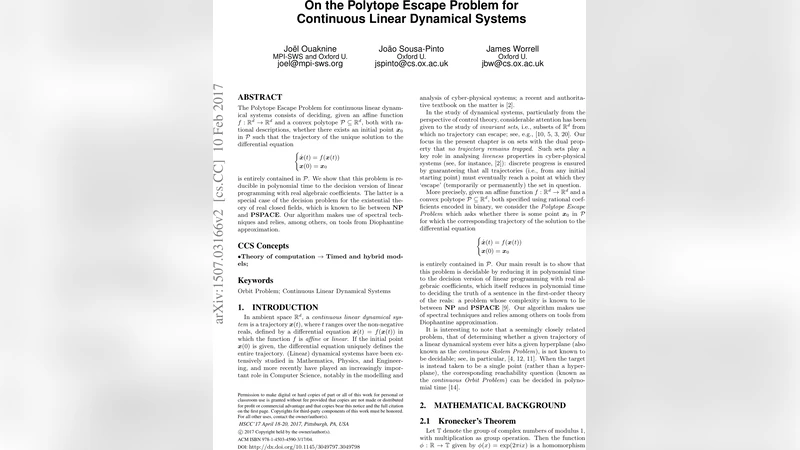
The Polyhedral Escape Problem for continuous linear dynamical systems consists of deciding, given an affine function $f: \mathbb{R}^{d} \rightarrow \mathbb{R}^{d}$ and a convex polyhedron $\mathcal{P} \subseteq \mathbb{R}^{d}$, whether, for some initial point $\boldsymbol{x}{0}$ in $\mathcal{P}$, the trajectory of the unique solution to the differential equation $\dot{\boldsymbol{x}}(t)=f(\boldsymbol{x}(t))$, $\boldsymbol{x}(0)=\boldsymbol{x}{0}$, is entirely contained in $\mathcal{P}$. We show that this problem is decidable, by reducing it in polynomial time to the decision version of linear programming with real algebraic coefficients, thus placing it in $\exists \mathbb{R}$, which lies between NP and PSPACE. Our algorithm makes use of spectral techniques and relies among others on tools from Diophantine approximation.
💡 Research Summary
The paper addresses the Polytope Escape Problem for continuous linear dynamical systems. Given an affine map (f:\mathbb{R}^{d}\rightarrow\mathbb{R}^{d}) (with rational coefficients) and a convex polyhedron (\mathcal{P}\subseteq\mathbb{R}^{d}) (also described by rational data), the question is whether there exists an initial state (x_{0}\in\mathcal{P}) such that the unique solution of the differential equation (\dot{x}(t)=f(x(t))), (x(0)=x_{0}), stays inside (\mathcal{P}) for all non‑negative time.
The authors prove that this problem is decidable. Their main contribution is a polynomial‑time reduction to the existential theory of the reals (∃ℝ), specifically to the decision version of linear programming where the coefficients are real algebraic numbers. Since ∃ℝ lies between NP and PSPACE, the Polytope Escape Problem inherits this complexity bound.
Technical Overview
-
Spectral Decomposition – The matrix part (A) of the affine map is brought into Jordan normal form (A=Q^{-1}JQ) in polynomial time. The matrix exponential (\exp(At)) is expressed explicitly as a block‑diagonal matrix whose entries are finite sums of terms of the form (t^{k}e^{\lambda t}), where (\lambda) are the (possibly complex) eigenvalues of (A).
-
Laurent Polynomials and Self‑Conjugacy – Each component (b^{T}\exp(At)v) is rewritten as a self‑conjugate Laurent polynomial (g(z_{1},\dots,z_{s})) evaluated at (z_{j}=e^{2\pi i\theta_{j}t}). The polynomial is “simple” if each monomial involves only one variable, which simplifies later analysis.
-
Kronecker’s Theorem and Diophantine Approximation – Using Kronecker’s simultaneous inhomogeneous approximation theorem, the authors show that the points ((e^{2\pi i n\theta_{1}},\dots,e^{2\pi i n\theta_{s}})) are dense in the torus (\mathbb{T}^{s}) provided the frequencies (\theta_{1},\dots,\theta_{s},1) are linearly independent over (\mathbb{Q}). This density yields Lemma 3 and Theorem 4, which guarantee that a non‑zero self‑conjugate Laurent polynomial attains negative values infinitely often along integer times.
-
Dominant Asymptotic Term – For each expression (b^{T}\exp(At)v) the authors define a dominant pair ((\rho,m)) with respect to the lexicographic order on (\mathbb{R}\times\mathbb{N}). The dominant term is the one with the largest real exponent (\rho) (and, if tied, the smallest polynomial degree (m)).
-
Sign Analysis via Laurent Polynomials – When the dominant term originates from a complex eigenvalue, the associated coefficient can be written as a simple self‑conjugate Laurent polynomial evaluated on the torus. By Theorem 4, if this coefficient is not identically zero, its lim inf after normalisation by (\exp(\rho t)t^{m}) is strictly negative. Consequently, the whole trajectory eventually violates at least one facet of (\mathcal{P}) unless the coefficient vanishes.
-
Reduction to Existential Linear Programming – Each facet inequality (b_{i}^{T}x\le c_{i}) must hold for all (t\ge0). Using the asymptotic analysis, the authors translate this universal condition into a finite set of algebraic constraints on the initial vector (x_{0}). These constraints are linear (coming from the polyhedron) together with algebraic equalities/inequalities derived from the Laurent polynomial coefficients. The resulting system is exactly a linear program with algebraic coefficients.
-
Complexity Placement – Deciding feasibility of such a linear program is known to be in the existential theory of the reals (∃ℝ). Since the reduction is polynomial‑time, the Polytope Escape Problem belongs to ∃ℝ, i.e., it is decidable and its complexity lies between NP and PSPACE.
Significance
- The result provides the first decidability proof for a global invariance‑type property of continuous linear systems, contrasting with the still‑open decidability of the continuous Skolem problem (reachability of a hyperplane).
- The methodology blends classical linear algebra (Jordan forms), analytic number theory (Kronecker’s theorem), and real algebraic geometry (∃ℝ).
- By showing that the problem reduces to algebraic linear programming, the authors open the door to practical implementations using existing ∃ℝ solvers, albeit with potentially high worst‑case complexity.
Outlook
Future work may aim at tightening the complexity bound (e.g., proving PSPACE‑hardness or finding a polynomial‑space algorithm), extending the approach to systems with non‑linear dynamics, or integrating the technique into automated verification tools for cyber‑physical systems where invariant polyhedral safety regions are common. The paper thus bridges a gap between theoretical decidability and the practical analysis of continuous‑time linear models.
Comments & Academic Discussion
Loading comments...
Leave a Comment