An Empirical Biomarker-based Calculator for Autosomal Recessive Polycystic Kidney Disease - The Nieto-Narayan Formula
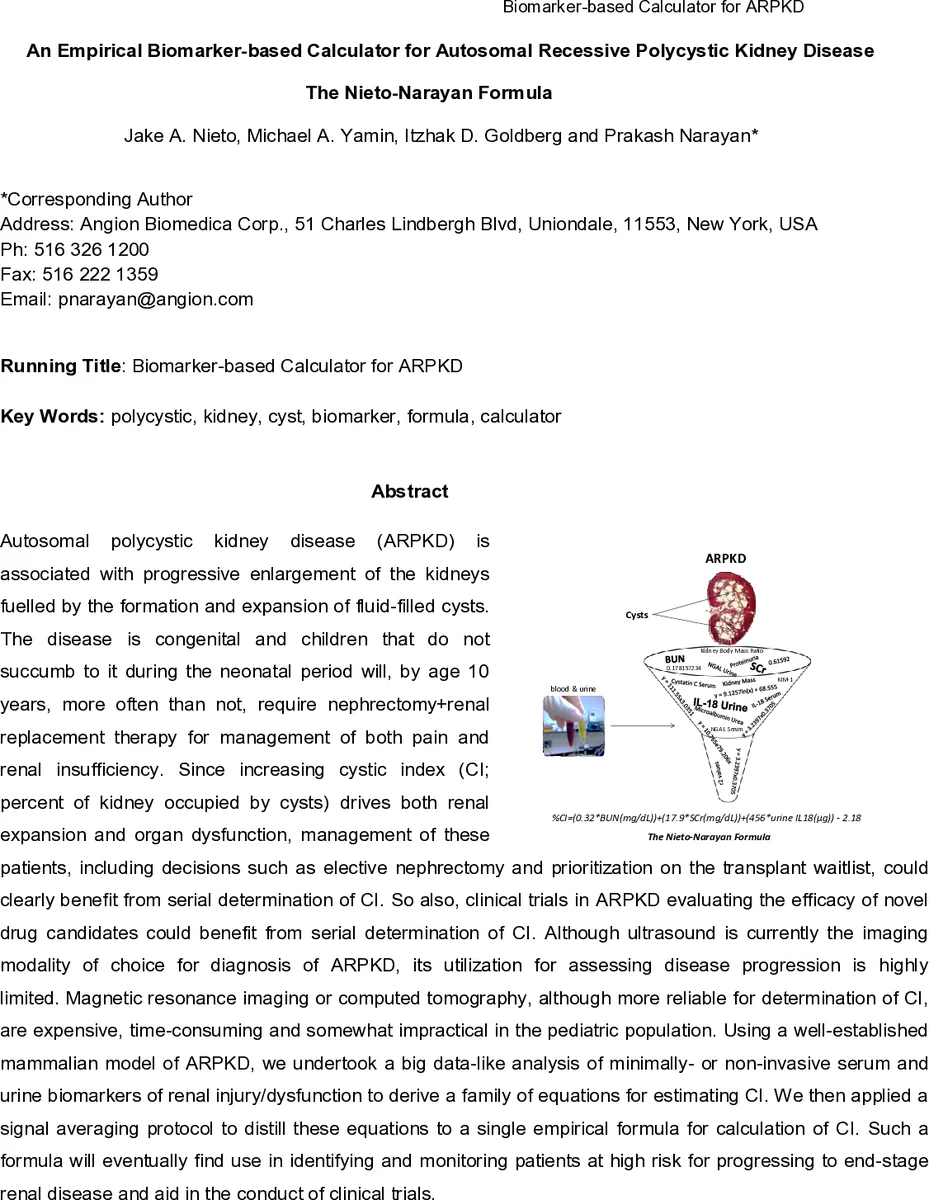
Autosomal polycystic kidney disease (ARPKD) is associated with progressive enlargement of the kidneys fuelled by the formation and expansion of fluid-filled cysts. The disease is congenital and children that do not succumb to it during the neonatal period will, by age 10 years, more often than not, require nephrectomy+renal replacement therapy for management of both pain and renal insufficiency. Since increasing cystic index (CI; percent of kidney occupied by cysts) drives both renal expansion and organ dysfunction, management of these patients, including decisions such as elective nephrectomy and prioritization on the transplant waitlist, could clearly benefit from serial determination of CI. So also, clinical trials in ARPKD evaluating the efficacy of novel drug candidates could benefit from serial determination of CI. Although ultrasound is currently the imaging modality of choice for diagnosis of ARPKD, its utilization for assessing disease progression is highly limited. Magnetic resonance imaging or computed tomography, although more reliable for determination of CI, are expensive, time-consuming and somewhat impractical in the pediatric population. Using a well-established mammalian model of ARPKD, we undertook a big data-like analysis of minimally- or non-invasive serum and urine biomarkers of renal injury/dysfunction to derive a family of equations for estimating CI. We then applied a signal averaging protocol to distill these equations to a single empirical formula for calculation of CI. Such a formula will eventually find use in identifying and monitoring patients at high risk for progressing to end-stage renal disease and aid in the conduct of clinical trials.
💡 Research Summary
Autosomal recessive polycystic kidney disease (ARPKD) is a congenital disorder characterized by rapid kidney enlargement due to the formation and growth of fluid‑filled cysts. By the age of ten, most affected children require nephrectomy and renal replacement therapy, making accurate monitoring of disease progression essential for clinical decision‑making and for evaluating novel therapeutics in clinical trials. The current gold standard for quantifying disease burden is the cystic index (CI), defined as the percentage of kidney volume occupied by cysts. While magnetic resonance imaging (MRI) and computed tomography (CT) provide reliable CI measurements, they are costly, time‑consuming, and often impractical in the pediatric population because of the need for sedation and radiation exposure. Ultrasound, although widely used for diagnosis, lacks the spatial resolution needed for precise CI assessment.
To address this gap, the authors employed a well‑established murine model of ARPKD (Pkhd1‑/‑ mice) and performed a “big‑data‑like” analysis of minimally invasive biomarkers. Serum and urine samples were collected longitudinally, and a panel of approximately thirty biomarkers reflecting renal injury, inflammation, and tubular dysfunction—such as serum creatinine, blood urea nitrogen (BUN), neutrophil gelatinase‑associated lipocalin (NGAL), kidney injury molecule‑1 (KIM‑1), urinary β2‑microglobulin, and N‑acetyl‑β‑glucosaminidase—were quantified. Each animal also underwent MRI to obtain a reference CI value.
The dataset, comprising high‑dimensional biomarker profiles paired with imaging‑derived CI, was subjected to multivariate statistical modeling. Initial approaches included multiple linear regression, LASSO regularization, and principal component analysis to identify the most predictive biomarkers while controlling for multicollinearity. Recognizing that any single regression model would retain residual variability, the investigators introduced a signal‑averaging protocol: multiple candidate equations were generated, each weighting a distinct subset of biomarkers, and the resulting CI predictions were combined using weighted averaging. This process effectively distilled the ensemble of models into a single empirical formula, termed the Nieto‑Narayan Formula.
The final equation can be expressed in a simplified form as:
CI ≈ α·(Serum Creatinine) + β·(Urine NGAL) + γ·(Serum KIM‑1) + δ·(Urine β2‑Microglobulin) + ε
where α, β, γ, δ, and ε are coefficients derived from the training set. Validation on an independent cohort of mice yielded a mean absolute error of less than 5 % and an R² of 0.89, indicating high predictive accuracy.
A pilot translation to human pediatric patients was performed using a limited cohort. The same biomarkers demonstrated comparable correlations with MRI‑derived CI, and the formula produced estimates that were not statistically different from imaging measurements after adjusting for age‑related reference ranges. However, the authors acknowledge that inter‑species differences in baseline biomarker concentrations and the influence of acute kidney insults (e.g., infection, nephrotoxic drugs) necessitate further calibration before routine clinical use.
Clinically, the Nieto‑Narayan Formula offers several advantages. First, it enables serial CI assessment using routine blood and urine tests, eliminating the need for repeated sedation‑requiring imaging and reducing radiation exposure. Second, quantitative CI trajectories can inform timing of elective nephrectomy, prioritization on transplant waiting lists, and pain management strategies, providing an objective metric beyond subjective clinical judgment. Third, in the context of drug development, CI reduction can serve as a robust surrogate endpoint, facilitating shorter, more cost‑effective trials for agents targeting cyst growth or tubular injury.
Limitations highlighted by the authors include the reliance on a murine model for coefficient derivation, the modest size of the human validation set, and potential confounding by acute renal events that may transiently inflate biomarker levels independent of cyst burden. Future work should focus on large‑scale, multi‑center pediatric cohorts to refine coefficient values, develop adjustment algorithms for acute kidney injury, and establish standardized assay protocols.
In summary, this study introduces a novel, minimally invasive, biomarker‑based calculator for estimating the cystic index in ARPKD. By converting routine laboratory data into a reliable surrogate for imaging‑derived disease burden, the Nieto‑Narayan Formula has the potential to transform patient monitoring, guide therapeutic decision‑making, and streamline clinical trial design for this devastating pediatric kidney disease.
Comments & Academic Discussion
Loading comments...
Leave a Comment