Behavior of early warnings near the critical temperature in the two-dimensional Ising model
Among the properties that are common to complex systems, the presence of critical thresholds in the dynamics of the system is one of the most important. Recently, there has been interest in the universalities that occur in the behavior of systems near critical points. These universal properties make it possible to estimate how far a system is from a critical threshold. Several early-warning signals have been reported in time series representing systems near catastrophic shifts. The proper understanding of these early-warnings may allow the prediction and perhaps control of these dramatic shifts in a wide variety of systems. In this paper we analyze this universal behavior for a system that is a paradigm of phase transitions, the Ising model. We study the behavior of the early-warning signals and the way the temporal correlations of the system increase when the system is near the critical point.
💡 Research Summary
This paper presents a systematic investigation of early-warning signals (EWS) associated with critical transitions, using the two-dimensional Ising model as a paradigmatic physical system. The core premise is that diverse complex systems (e.g., ecosystems, climate, economies) exhibit universal dynamical patterns when approaching a tipping point, characterized by phenomena like critical slowing down. The study leverages the well-understood phase transition in the Ising model to test and validate these proposed EWS in a controlled, computational environment.
The authors simulate the Ising model on a 100x100 square lattice using the Metropolis Monte Carlo algorithm, interpreting successive spin configurations as a temporal evolution of the system. Crucially, they reframe the typical nuisance of “critical slowing down” near the critical temperature (T_c ≈ 2.27) – which normally hampers efficient sampling in Monte Carlo simulations – as the central feature of interest. Instead of discarding correlated configurations, they analyze them to detect EWS. Simulations are run for a range of fixed temperatures (T < T_c, T ≈ T_c, T > T_c), generating large ensembles of time series data for the system’s total magnetization, M(t).
The analysis focuses on two main classes of metric-based early-warning indicators. The first class examines changes in the statistical moments of the M(t) time series distribution. As predicted by theory, when the system nears the critical point, its recovery from perturbations slows down, allowing fluctuations to grow. The results confirm a significant increase in the variance (second moment) of magnetization near T_c. Changes in higher-order moments, specifically an increase in kurtosis (fourth moment), are also observed, indicating more frequent visits to extreme states.
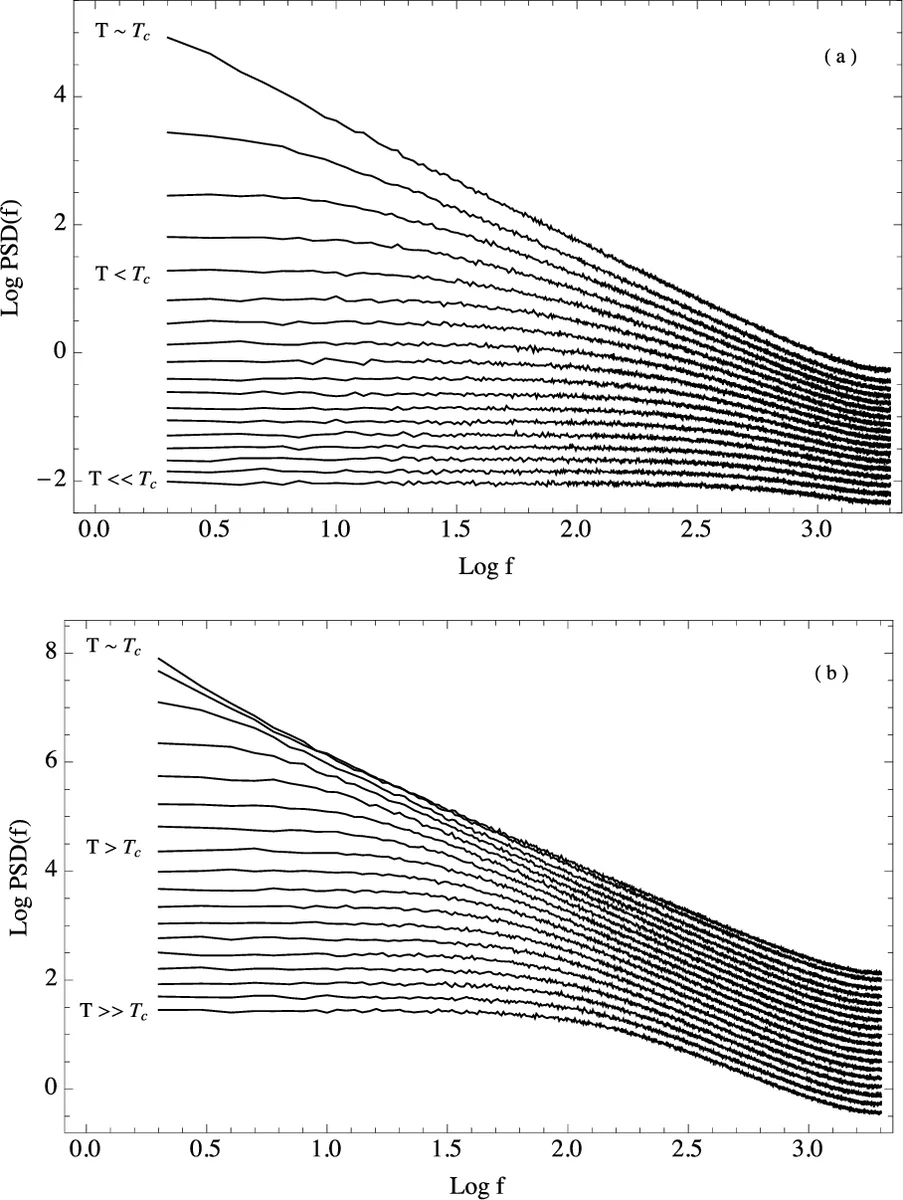
The second class of indicators probes the temporal memory within the system via autocorrelation analysis. Critical slowing down implies that the system’s state becomes more dependent on its past. The study computes the lag-1 autocorrelation coefficient, C(1), and finds a clear rising trend as temperature approaches T_c. This increase in short-term memory is a hallmark EWS. The paper also notes the potential for analyzing correlations across all timescales (e.g., via power spectrum analysis) to detect long-range memory effects.
The key findings demonstrate that generic EWS – increased variance, kurtosis, and autocorrelation – reliably emerge in the Ising model simulations as the control parameter (temperature) approaches its critical value. This work provides a crucial bridge: it shows that abstract EWS theorized for ecological or climate systems are concretely manifested in a fundamental physics model with a known analytical critical point. By doing so, it strengthens the evidence for the universality of these signals. Furthermore, the study offers a practical methodological blueprint, emphasizing that increases in temporal correlation and statistical moments of an observable time series can serve as robust, model-free indicators of proximity to a critical threshold in a wide array of systems.
Comments & Academic Discussion
Loading comments...
Leave a Comment