Upper bounds for the 2-hued chromatic number of graphs in terms of the independence number
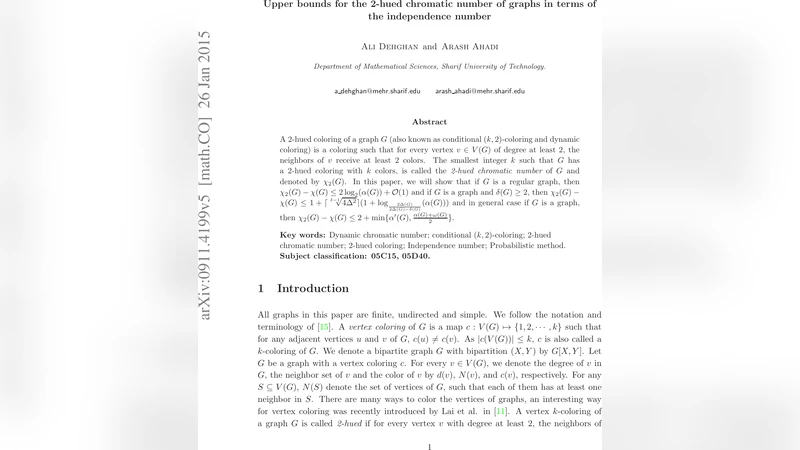
A 2-hued coloring of a graph $G$ (also known as conditional $(k, 2)$-coloring and dynamic coloring) is a coloring such that for every vertex $v\in V(G)$ of degree at least $2$, the neighbors of $v$ receive at least $2$ colors. The smallest integer $k$ such that $G$ has a 2-hued coloring with $ k $ colors, is called the {\it 2-hued chromatic number} of $G$ and denoted by $\chi_2(G)$. In this paper, we will show that if $G$ is a regular graph, then $ \chi_{2}(G)- \chi(G) \leq 2 \log {2}(\alpha(G)) +\mathcal{O}(1) $ and if $G$ is a graph and $\delta(G)\geq 2$, then $ \chi{2}(G)- \chi(G) \leq 1+\lceil \sqrt[\delta -1]{4\Delta^{2}} \rceil ( 1+ \log {\frac{2\Delta(G)}{2\Delta(G)-\delta(G)}} (\alpha(G)) ) $ and in general case if $G$ is a graph, then $ \chi{2}(G)- \chi(G) \leq 2+ \min \lbrace \alpha^{\prime}(G),\frac{\alpha(G)+\omega(G)}{2}\rbrace $.
💡 Research Summary
The paper investigates the relationship between the 2‑hued (dynamic) chromatic number χ₂(G) and the ordinary chromatic number χ(G) of a graph G, focusing on upper bounds expressed through structural parameters such as the independence number α(G), the matching number α′(G), and the clique number ω(G). A 2‑hued coloring requires that every vertex of degree at least two sees at least two different colors among its neighbors; consequently χ₂(G) is always at least χ(G). While previous work supplied coarse bounds involving only the maximum degree Δ(G) or general differences χ₂(G)−χ(G), this study introduces tighter, parameter‑dependent estimates.
The first main theorem addresses regular graphs. Because all vertices share the same degree r, the authors can iteratively construct a 2‑hued coloring by repeatedly selecting maximal independent sets among the yet‑uncolored vertices and assigning a fresh color to each set. Each iteration guarantees the dynamic condition for the already colored vertices, while the new independent set introduces at most a logarithmic increase in the total number of colors. Formally, for any r‑regular graph, \
Comments & Academic Discussion
Loading comments...
Leave a Comment