Competitive division of a mixed manna
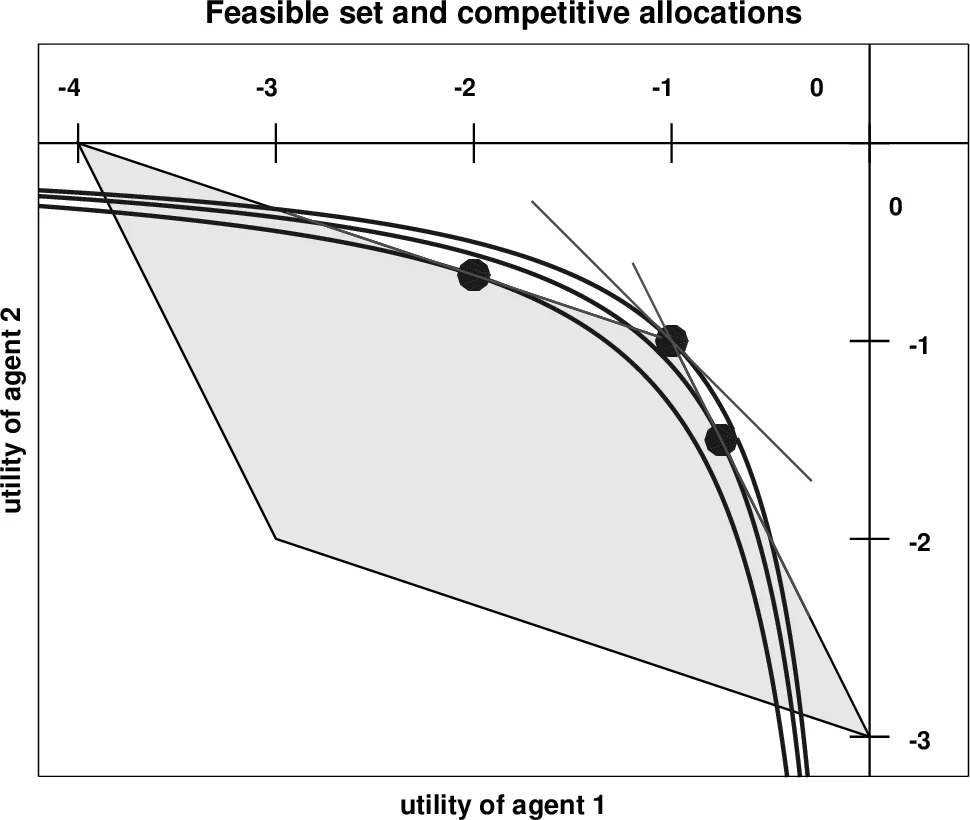
A mixed manna contains goods (that everyone likes), bads (that everyone dislikes), as well as items that are goods to some agents, but bads or satiated to others. If all items are goods and utility functions are homothetic, concave (and monotone), the Competitive Equilibrium with Equal Incomes maximizes the Nash product of utilities: hence it is welfarist (determined utility-wise by the feasible set of profiles), single-valued and easy to compute. We generalize the Gale-Eisenberg Theorem to a mixed manna. The Competitive division is still welfarist and related to the product of utilities or disutilities. If the zero utility profile (before any manna) is Pareto dominated, the competitive profile is unique and still maximizes the product of utilities. If the zero profile is unfeasible, the competitive profiles are the critical points of the product of disutilities on the efficiency frontier, and multiplicity is pervasive. In particular the task of dividing a mixed manna is either good news for everyone, or bad news for everyone. We refine our results in the practically important case of linear preferences, where the axiomatic comparison between the division of goods and that of bads is especially sharp. When we divide goods and the manna improves, everyone weakly benefits under the competitive rule; but no reasonable rule to divide bads can be similarly Resource Monotonic. Also, the much larger set of Non Envious and Efficient divisions of bads can be disconnected so that it will admit no continuous selection.
💡 Research Summary
The paper tackles the problem of fairly dividing a “mixed manna”, a bundle that may contain goods (liked by everyone), bads (disliked by everyone), and items that are goods for some agents, bads or satiated for others. The authors adopt the Competitive Equilibrium with Equal Incomes (CEEI) – a market‑based rule where each agent receives the same artificial budget and prices adjust to clear the market. They first show that, under the usual assumptions of continuity, convexity and homotheticity of preferences, the CEEI retains its “welfarist” character: the set of feasible utility profiles alone determines the competitive allocations.
A central contribution is a classification of mixed‑manna problems into three types, based on the feasibility of the zero‑utility profile (the state before any manna is allocated).
- Positive problems: it is feasible to give every “attracted” agent a strictly positive utility while “repulsed” agents receive zero. In this case the competitive utility profile is unique, lies on the positive orthant, and maximizes the product of utilities – exactly the Nash‑bargaining solution generalized from the classic Gale‑Eisenberg theorem. Moreover, the arrival of the manna is weakly good news for all agents.
- Negative problems: every feasible allocation gives each agent a strictly negative utility. Here the competitive profiles are the critical points (local maxima or minima) of the product of disutilities on the efficient frontier. Multiplicity is pervasive; the number of distinct competitive allocations can grow exponentially with the smaller of the numbers of agents or bads. The arrival of the manna is uniformly bad news.
- Null problems: the zero‑utility profile itself is efficient. The competitive profile is unique but lies on the boundary between the previous two cases, so the manna brings no welfare change.
The authors then focus on the practically important sub‑domain of linear (additive) utilities, which underlies many online fair‑division platforms such as SPLIDDIT and Adjusted Winner. In this setting each agent reports marginal utilities (bids) for each item; positive bids denote goods, negative bids denote bads, and zero bids denote satiated items. They introduce the axiom of Independence of Lost Bids (ILB): lowering a bid on an item that the agent does not receive does not affect the final allocation. Combined with the requirement that all agents end up on the same side of zero, ILB characterizes the competitive rule for any mixed‑manna problem.
The paper also investigates continuity and monotonicity properties. For positive problems the competitive utility correspondence is single‑valued and continuous; for negative problems it is only upper‑hemi‑continuous and admits no continuous single‑valued selection. Consequently, the set of efficient and envy‑free allocations in all‑bads problems can be disconnected, precluding any continuous rule that selects a unique allocation.
A striking impossibility result concerns Resource Monotonicity (RM): when a unanimously liked good increases (or a unanimously disliked bad decreases), every agent should weakly benefit. The competitive rule satisfies RM in positive problems, but the authors prove that no single‑valued rule that guarantees each agent at least her fair share can be RM in all‑bads (negative) problems.
Finally, the authors provide computational insights. In positive problems the competitive allocation can be computed in polynomial time by solving a convex program (maximizing the Nash product). In negative problems, however, the multiplicity of critical points makes computation harder, and the number of distinct competitive allocations can be exponential.
Overall, the paper extends the classic Gale‑Eisenberg theorem to a far richer environment, clarifies how the sign structure of utilities determines existence, uniqueness, and algorithmic tractability of competitive divisions, and offers both axiomatic and computational contributions that bridge theory with real‑world fair‑division platforms.
Comments & Academic Discussion
Loading comments...
Leave a Comment