A slip wave solution in anti-plane elasticity
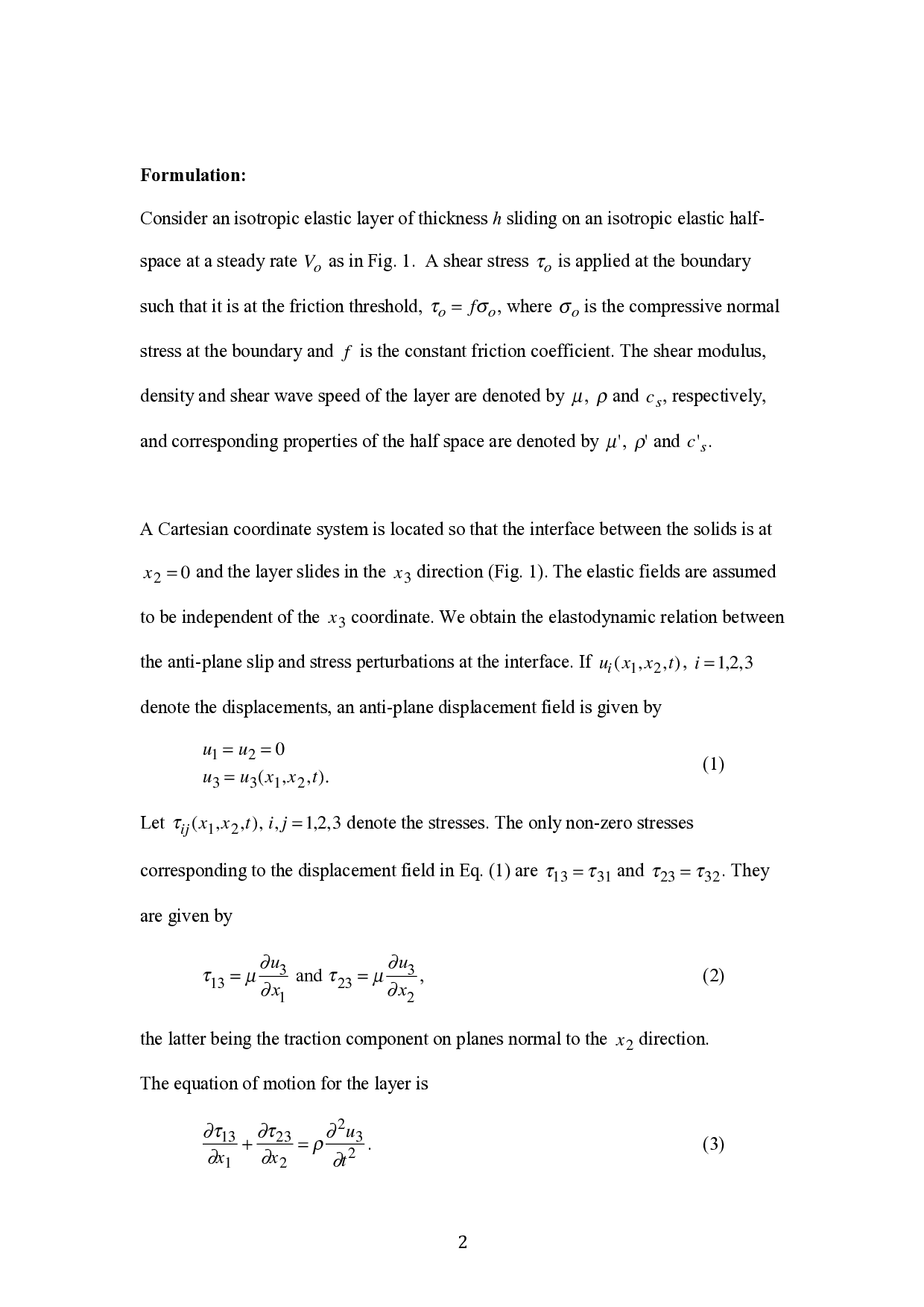
It is shown that a slip wave solution exists for anti-plane sliding of an elastic layer on an elastic half-space. It is a companion solution to the well-known Love wave solution.
💡 Research Summary
The paper investigates wave propagation along the interface between an elastic layer of finite thickness and an elastic half‑space when the layer slides in the anti‑plane (out‑of‑plane) direction. Starting from the equations of motion for each body, the authors derive a two‑dimensional shear‑wave equation for the layer and the half‑space, assuming isotropic, linear elasticity and independence of the out‑of‑plane coordinate. A steady sliding state with constant shear stress at the Coulomb friction threshold is imposed, and small perturbations of slip and shear stress are introduced as single Fourier modes characterized by wavenumber k and complex temporal growth rate p. By following the approach of Ranjith (2009), the relationship between the amplitudes of slip and stress perturbations at the interface is expressed through a transfer function F(k,p).
Poles of F(k,p) correspond to the classical Love wave, a stress‑only interfacial wave that exists for any wavenumber when the shear wave speed of the layer is lower than that of the half‑space (c_s < c’_s). The dispersion relation for the Love wave is multi‑valued because of the periodic nature of the arctangent function, and it can be written in an explicit form involving an integer mode number n.
Zeros of F(k,p) give rise to a new solution: the slip wave. Unlike the Love wave, the slip wave carries a slip perturbation without any accompanying stress perturbation. Its existence condition is simply c_s ≤ c, where c = ±i p/k is the phase velocity, and it holds for any pair of dissimilar materials, regardless of whether the half‑space is faster or slower than the layer. Consequently the slip wave is always present, and its phase velocity depends on the wavenumber but is independent of the half‑space’s material properties.
A comparative analysis shows that, for the same mode number n, the slip wave’s phase velocity is always lower than that of the corresponding Love wave. This ordering can also be derived from a Rayleigh‑quotient variational argument. Moreover, as the mode number varies, the phase‑velocity curves of the two families interleave, producing intervals where a higher‑order Love wave travels faster than a lower‑order slip wave and vice‑versa. This interleaving mirrors the relationship between the in‑plane generalized Rayleigh (slip) wave and the Stoneley wave, as previously reported by Rice et al. (2001).
The authors note that the slip‑wave solution does not depend on the value of the Coulomb friction coefficient or on the steady sliding speed; the same solution arises for frictionless contact or even in the absence of global sliding. Thus the slip wave is a robust feature of anti‑plane sliding interfaces.
In summary, the study demonstrates that a slip wave—characterized by pure slip perturbations and no stress perturbations—exists universally at the interface between an elastic layer and an elastic half‑space undergoing anti‑plane sliding. The slip wave always exists, its phase velocity is lower than that of the Love wave for the same mode, and the two families of interfacial waves exhibit an interleaved pattern of phase velocities across different modes. This finding expands the catalogue of interfacial wave solutions in elasticity and provides a new theoretical tool for interpreting seismic and laboratory observations of sliding interfaces.
Comments & Academic Discussion
Loading comments...
Leave a Comment