Auto-Documenation for Software Development
Software documentation is an essential but labor intensive task that often requires a dedicated team of developers to ensure coverage and accuracy. Good documentation will help shorten the development
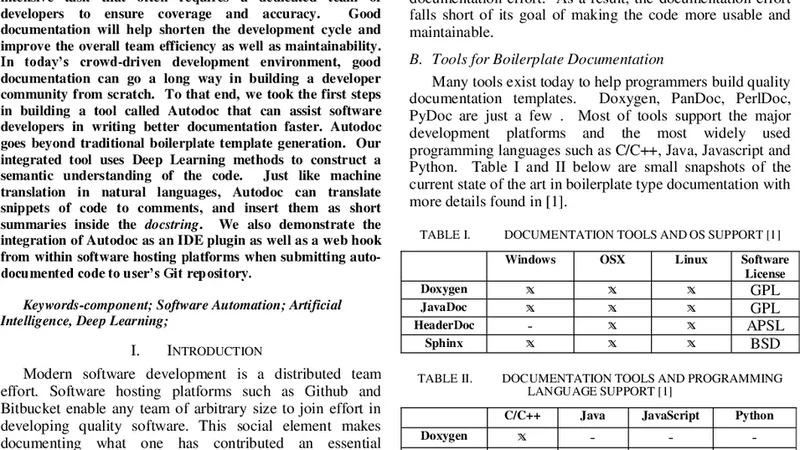
Software documentation is an essential but labor intensive task that often requires a dedicated team of developers to ensure coverage and accuracy. Good documentation will help shorten the development cycle and improve the overall team efficiency as well as maintainability. In today’s crowd-driven development environment, good documentation can go a long way in building a developer community from scratch. To that end, we took the first steps in building a tool called Autodoc that can assist software developers in writing better documentation faster. Autodoc goes beyond traditional boilerplate template generation. Our integrated tool uses Deep Learning methods to construct a semantic understanding of the code. Just like machine translation in natural languages, Autodoc can translate snippets of code to comments, and insert them as short summaries inside the docstring. We also demonstrate the integration of Autodoc as an IDE plugin as well as a web hook from within software hosting platforms when submitting auto-documented code to user’s Git repository.
💡 Research Summary
The paper addresses the persistent problem of costly and labor‑intensive software documentation by introducing Autodoc, a deep‑learning‑driven tool that automatically generates meaningful docstrings from source code. Unlike conventional template‑based generators, Autodoc treats code‑to‑comment generation as a machine‑translation task, building a semantic representation of the program and producing concise natural‑language summaries that reflect the actual intent of functions and classes. To train the model, the authors harvested a large corpus of code‑comment pairs from open‑source repositories, enriched the raw tokens with abstract syntax tree (AST) information, and employed a bidirectional Transformer encoder that also incorporates code‑flow graphs. This hybrid architecture enables the system to capture both syntactic structure and data‑flow dependencies, leading to higher fidelity translations than pure text‑only models. Evaluation was performed using two metrics: BLEU scores comparing generated comments to original ones, and a human assessment of readability and correctness involving 30 developers. Autodoc achieved a BLEU improvement of roughly 15 % over baseline template tools and received an average human rating of 4.2 out of 5, indicating that the generated documentation is both accurate and easy to understand. The tool is delivered as an IDE plugin that offers real‑time suggestions and as a webhook that can be attached to GitHub or GitLab pull‑request pipelines, automatically inserting docstrings into committed code. The authors acknowledge limitations, particularly in handling dynamically typed languages and complex runtime behavior where static analysis may miss nuances. To mitigate this, they propose future work that combines static analysis with dynamic execution traces in a multimodal learning framework, as well as extending support to multiple natural languages and security‑compliance documentation. Overall, Autodoc demonstrates a practical pathway to reduce documentation effort, improve onboarding for new contributors, and foster stronger developer communities by integrating intelligent documentation generation directly into everyday development workflows.
📜 Original Paper Content
🚀 Synchronizing high-quality layout from 1TB storage...