A Systematic Literature Review on Intertemporal Choice in Software Engineering - Protocol and Results
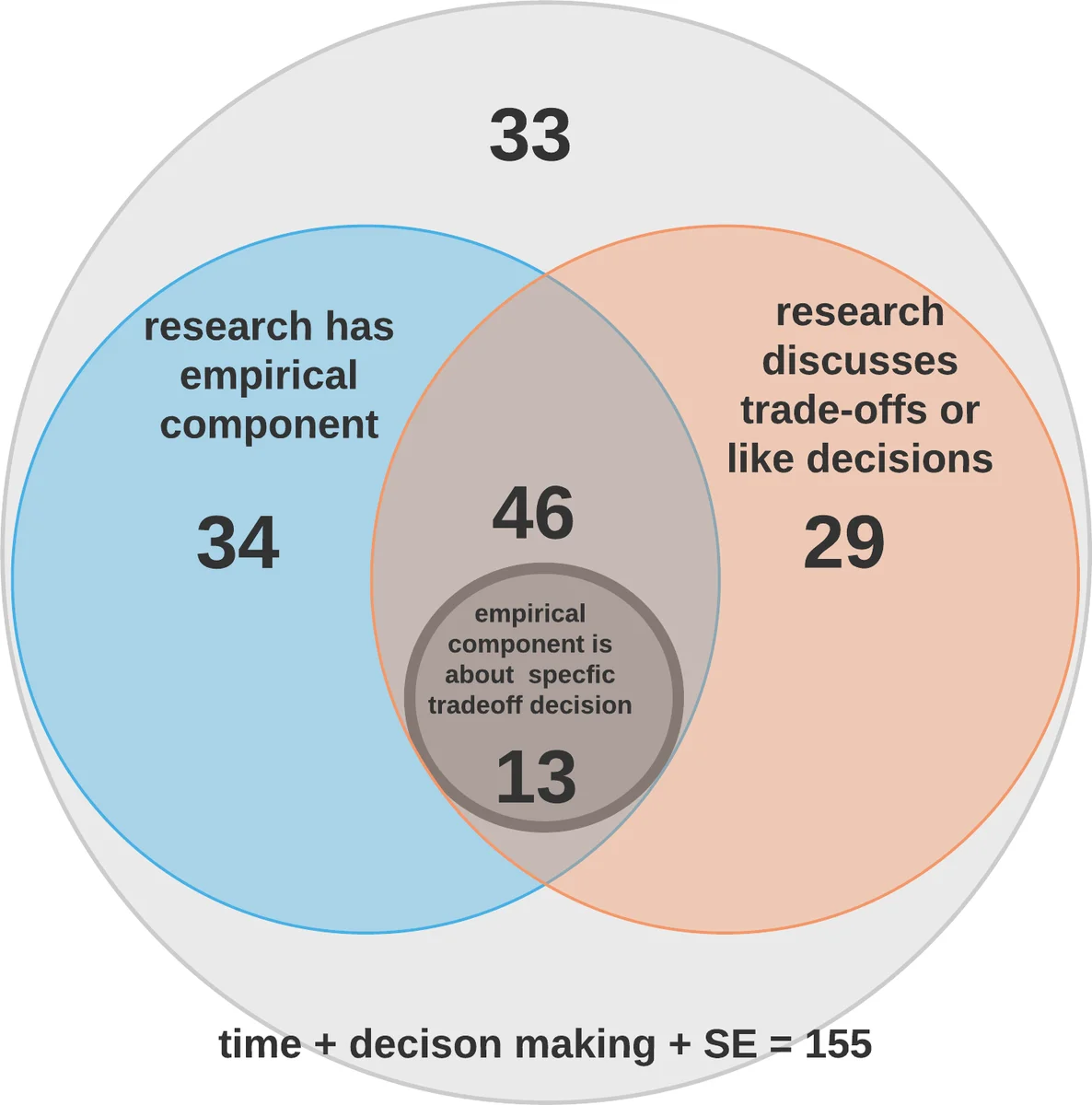
When making choices in software projects, engineers and other stakeholders engage in decision making that involves uncertain future outcomes. Research in psychology, behavioral economics and neuroscience has questioned many of the classical assumptions of how such decisions are made. This literature review aims to characterize the assumptions that underpin the study of these decisions in Software Engineering. We identify empirical research on this subject and analyze how the role of time has been characterized in the study of decision making in SE. The literature review aims to support the development of descriptive frameworks for empirical studies of intertemporal decision making in practice.
💡 Research Summary
This paper, titled “A Systematic Literature Review on Intertemporal Choice in Software Engineering – Protocol and Results,” presents the research protocol and preliminary findings for a systematic review aimed at mapping and analyzing how time and trade-offs across time are conceptualized in software engineering (SE) decision-making research. The core motivation stems from the critical role of decisions in software projects, where outcomes are often delayed, forcing stakeholders to make trade-offs between present and future costs and benefits—a concept known in behavioral economics as “intertemporal choice.”
The authors begin by highlighting a fundamental disconnect. While SE literature frequently employs normative decision theories (e.g., multi-criteria decision analysis, expected utility theory) that prescribe how rational agents should decide, research from psychology and behavioral economics demonstrates that real human decision-makers often deviate from these rational models. Descriptive theories, which seek to explain how people actually decide, reveal phenomena like non-linear discounting of future outcomes and loss aversion. The paper argues that SE has largely overlooked these descriptive insights, creating a gap between theoretical decision models and practical decision behavior. This review is positioned within the emerging field of Behavioral Software Engineering, which seeks to integrate behavioral science concepts into SE.
The review is guided by four Research Questions (RQs): RQ1 identifies empirical SE research studying time-involved trade-off decisions. RQ2 examines the dimensions (e.g., cost, quality, risk) considered in these studies. RQ3 analyzes how the role of time itself is conceptualized. RQ4 uncovers the underlying assumptions about decision-makers that underpin these studies. The authors also connect their inquiry to the SE concept of “technical debt,” reframing it more broadly as “sustainability debt” encompassing environmental, social, individual, economic, and technical dimensions, thereby explicitly linking short-term expedient choices to long-term, multi-faceted consequences.
The methodology follows established guidelines for systematic literature reviews. The search strategy targeted major databases: Scopus, IEEE Xplore, and ACM Digital Library. A pivotal preliminary search revealed that the precise term “intertemporal choice” yielded zero results when combined with “software engineering,” confirming the conceptual gap between the disciplines. Consequently, the final primary search string was simplified to a more generic query: time AND "decision making" AND "software engineering". An ancillary search for "technical debt" was also conducted to capture literature inherently concerned with temporal trade-offs. Inclusion criteria covered all publication years, peer-reviewed journal/conference papers discussing decision-making in software system development. Exclusion criteria filtered out non-English papers, non-peer-reviewed material, and unavailable full texts.
The selection process involved de-duplication, application of inclusion/exclusion criteria, and a rigorous relevance voting procedure on titles and abstracts by multiple researchers, with conflicts resolved through discussion. Papers selected for in-depth analysis were then subjected to a structured data extraction and coding process. Two key coding schemes were applied: 1) Scope of the Decision (Project Management, Requirements/Design/Development, Maintenance, Other), and 2) Research Methodology (Empirical study of a decision, Empirical study not of a decision, Literature review). This classification is crucial for addressing RQ1 and RQ4, distinguishing between papers that empirically investigate decision-making processes and those that merely discuss decisions.
The paper primarily details this protocol—the rigorous plan for conducting the review—and shares preliminary results like search result counts and the absence of the term “intertemporal choice.” It does not present the final synthesized findings answering the RQs, as the full analysis is pending. Instead, its contribution lies in establishing a robust, transparent methodological foundation for the review. It successfully makes the case for the review’s necessity by demonstrating the lack of explicit engagement with intertemporal choice concepts in SE and by outlining a clear path to identify, categorize, and critically analyze existing research on temporal decision-making. The work sets the stage for a subsequent analysis that promises to reveal the prevalent normative biases in SE decision research and to pave the way for more descriptive, behaviorally-informed models of how software practitioners truly make choices involving the future.
Comments & Academic Discussion
Loading comments...
Leave a Comment